[Good morning! Was Santa good to you? I might as well repost this essay about the Christmas truce; since I only have published it on Christmas Day, some readers might have missed it, and EA, believe it or not, sometimes gets new followers from time to time…]
One of the weirdest events in world history took place on Christmas 1914, at the very beginning of the five year, pointless and stunningly destructive carnage of The Great War, what President Woodrow Wilson, right as usual, called “The War to End All Wars.”
World War I, as it was later called after the world war it caused succeeded it, led to the deaths of more than 25 million people, and if anything was accomplished by this carnage, I have yet to read about it.
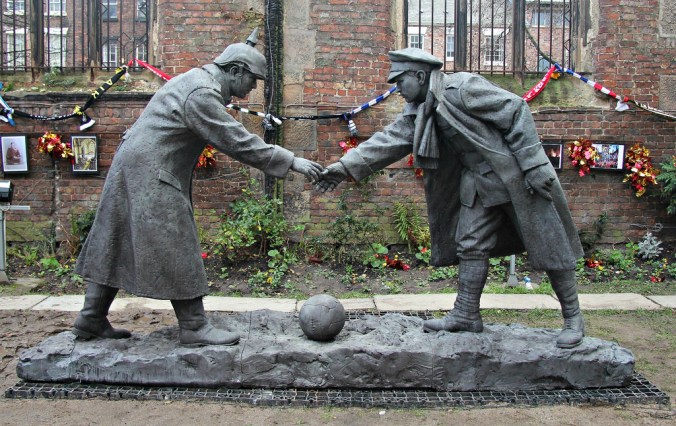
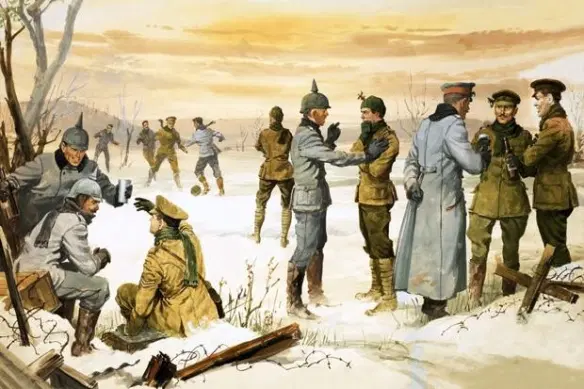
The much sentimentalized event was a spontaneous Christmas truce, as soldiers on opposing sides on the Western Front, defying orders from superiors, pretended the war didn’t exist and left their trenches, put their weapons and animus aside, sang carols, shared food, buried their dead, and even played soccer against each other, as “The Christmas Truce” statue memorializes above.
The brass on both sides—this was a British and German phenomenon only—took steps to ensure that this would never happen again, and it never did.
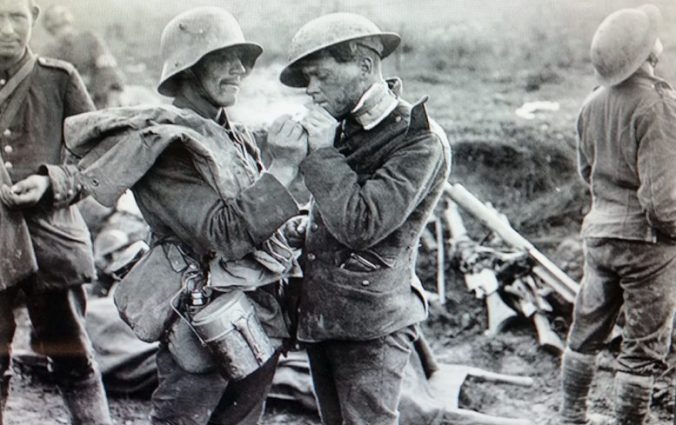
It all began on Christmas Eve, when at 8:30 p.m. an officer of the Royal Irish Rifles reported to headquarters that “The Germans have illuminated their trenches, are singing songs and wishing us a Happy Xmas. Compliments are being exchanged but am nevertheless taking all military precautions.” The two sides progressed to serenading each other with Christmas carols, with the German combatants crooning “Silent Night,” and the British adversaries responding with “The First Noel.“ The war diary of the Scots Guards reported that a private “met a German Patrol and was given a glass of whisky and some cigars, and a message was sent back saying that if we didn’t fire at them, they would not fire at us.”
The same deal was struck spontaneously at other locales across the battlefield. Another British soldier reported that as Christmas Eve wound down into Christmas morning, “all down our line of trenches there came to our ears a greeting unique in war: ‘English soldier, English soldier, a merry Christmas, a merry Christmas!’” He wrote in a letter home that he heard,




 Ethics Alarms