James K. Polk is one of my favorite Presidents, in part because he has never received his due for being spectacularly effective, if unwavering ruthless in achieving his goals. By the standards of fulfilling his own stated objectives, a President can’t be more successful than Polk. He pledged to expand U.S. territory to the West, Southwest and North, and did so, then served only one term, as he had promised. Polk also wrote a fascinating diary, essentially an autobiography.
His relative obscurity arises in part because he was a one term President, but primarily because he existed in the shadow of his fellow Tennessean, Andrew Jackson, who was more flamboyant, more influential on more political fronts, and had far more than four years in the spotlight. He was also much taller. Poor Polk lived just three months after leaving office, dying of cholera in 1849, in Nashville. Tennessee. The laws of the time held that those who died of that dread disease be buried within 24 hours to prevent epidemics, so the former President of the United States was laid to rest in a mass grave less than a year after leaving the White House.
A year later, Polk was removed from the mass grave and buried on the grounds of his Nashville home, Polk Place, in accordance with the will he drew up five months before his death. Polk, a lawyer, stipulated that his body and that of his wife be buried there, and that after his death and his wife’s, the property should be held in trust by the state, which would be bound allow a blood relative to live there. Unfortunately for the dead Polks, the ex-President made a tyro’s drafting gaffe. After Polk’s widow Sarah died in 1891, a court voided the terms of the will because it violated the common-law Rule Against Perpetuities: a property owner can’t bequeath property to unborn future generations. So Polk Place was sold to private interests, eventually razed, and today there is a boutique hotel on the property. On Sept. 19, 1893, Polk’s body and Sarah’s were moved again, to the Nashville grounds of the Capitol.
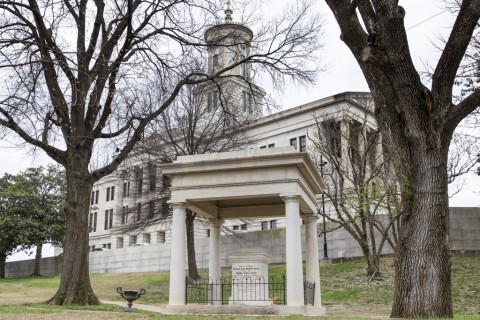
On a small patch of grass within a stone’s thrwo of the Capitol, the Polks’ grave is lies in a modest but attractive classical monument framed by Greek columns, with an inscription declaring that Polk “planted the laws of the American union on the shores of the Pacific.” It was designed by William Strickland, the architect who also designed the Capitol itself and George Washington’s sarcophagus at Mount Vernon in Virginia. But Polk’s Jackson problem continues: his gravesite is dwarfed by a nearby equestrian statue of Old Hickory, and tourists virtually ignore it. And while Jackson’s grave at the Hermitage, his family plantation, is a major tourist draw in Nashville, Polk remains—that is Polk’s remains remain—an afterthought. When President Trump visited Nashville last month, he laid a wreath on Jackson’s tomb, and saluted him in a speech. As for the perpetually dissed 11th President, the campaign jeer of the Whig Party running against the first Dark Horse candidate in 1844 apparently remains appropriate: “Who is Polk?”
Continue reading →
 Ethics Alarms