International relations is an ethical morass, and the Israel/Palestinian mess is an ethical morass inside an ethical morass. In international relations, gaffes turn out to be masterstrokes, and vice-versa, and my usual rejection of consequentialism doesn’t always fit. It is politics on steroids, and a never ending Ethics Train Wreck. Thus I approach the topic of the events that roiled the U.N. right before Christmas with trepidation. There were obviously ethical principles in play here, but beyond that, my certainty recedes like my hairline in 1976.
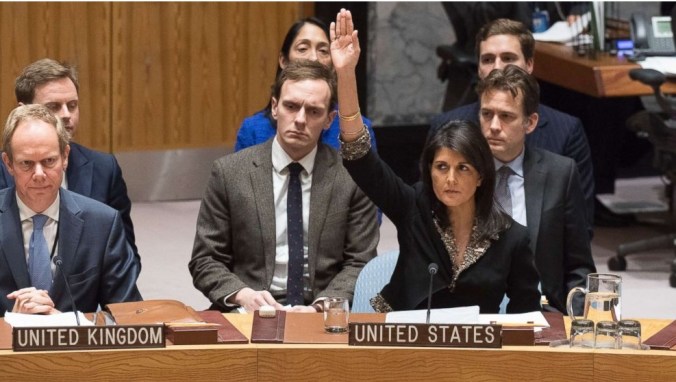
The background: On December 18, UN ambassador Nikki Haley vetoed an Arab-proposed Security Council resolution that rebuked President Trump’s decision to recognize Jerusalem as Israel’s capital and start the process of moving the US embassy there. All other 14 Security Council members supported the anti-American resolution, including U.S. allies Great Britain, France, and Japan. Then the UN General Assembly went on to pass a non-binding resolution disapproving of the Trump administration’s decision. Several more U.S. allies failed to vote with the U.S., including Canada and Australia, which abstained. Before the general assembly vote, Haley announced the US was “taking names” of those voting against the US. and afterward, the U.S. held a party where the only countries invited were Guatemala, Honduras, Israel, the Marshall Islands, Micronesia, Nauru, Palau, and Togo, all of which voted with the U.S.
Finally, Haley announced that the U.S. had negotiated quarter billion dollar cut to the UN’s annual budget, saying “We will no longer let the generosity of the American people be taken advantage of or remain unchecked.”
1 Was it responsible for the U.S. to condemn the actions of the nations, including its allies, that voted for the resolution in the Security Council and the the General Assembly?
The U.S. should be strong rather than weak, and must stand up for core principles. It is beyond argument that much of the hostility to the U.S. decision to move its embassy to Jerusalem was based on anti-Israel bigotry, which flourishes in many of the nations that voted against Israel and the U.s., notably France. The Obama policy was to generally allow the U.N. to direct the U.S., with Obama “leading from behind,” an oxymoron that was a euphemism for “not leading at all.” Many of the nations opposing the U.S. are Arab nations, Muslim nations, and nations who are worried about unrest in their large Muslim populations.
The assertion of a false moral equivalency between Israel and the Palestinians among a majority of the world (and a lot of Democrats) should not be enabled. The Palestinians still officially refuse to acknowledge Israel’s right to exist. British UN Ambassador Matthew Rycroft, for example, said that “The status of Jerusalem should be determined through a negotiated settlement between the Israelis and the Palestinians} and that that Jerusalem must “ultimately be the shared capital” of Palestine and Israel. Yes, that will work well, with the Palestinians still refusing to acknowledge Israel’s right to exist.
The status of Jerusalem, like the status of Palestine, is what is technically known as “all messed up.” In 1949, Israel’s first Prime Minister, David Ben-Gurion, proclaimed Jerusalem as Israel’s “eternal” and “sacred” capital, saying that only hostilities against Israel had “compelled” its leadership to establish the seat of Government in Tel Aviv. “For the State of Israel, he said, “there has always been and always will be one capital only – Jerusalem the Eternal. In 1950 all branches of the Israeli government—legislative, judicial, and executive—were moved to Jerusalem, except that the Ministry of Defense, stayed in Tel Aviv. At the time of Ben Gurion’s proclamations Jerusalem was divided between Israel and Jordan and thus only West Jerusalem was proclaimed Israel’s capital. Then, in 1980, Israel passed the Jerusalem Law, which declared Jerusalem the “complete and united” capital of Israel. In response, the United Nations Security Council passed Resolution 478 that same year, declaring the law “a violation of international law.” “null and void” and that it “must be rescinded forthwith.” Member states were told to withdraw their diplomatic representation from Jerusalem, and 22 of the 24 countries that previously had their embassy there moved back to Tel Aviv. In 1995, under President Clinton, the United States Congress passed the Jerusalem Embassy Act, which required, subject to conditions, that its embassy be moved from Tel Aviv to Jerusalem.
Whether the U.S. tactics will work out well or not is a matter of conjecture, and impossible to know. Are they ethical? Sure they are, compared to the alternative.
2. Was Haley’s Trumpian, tit-for-tat, we take this personally and you’ll regret it rhetoric responsible and ethical? Continue reading

 Ethics Alarms