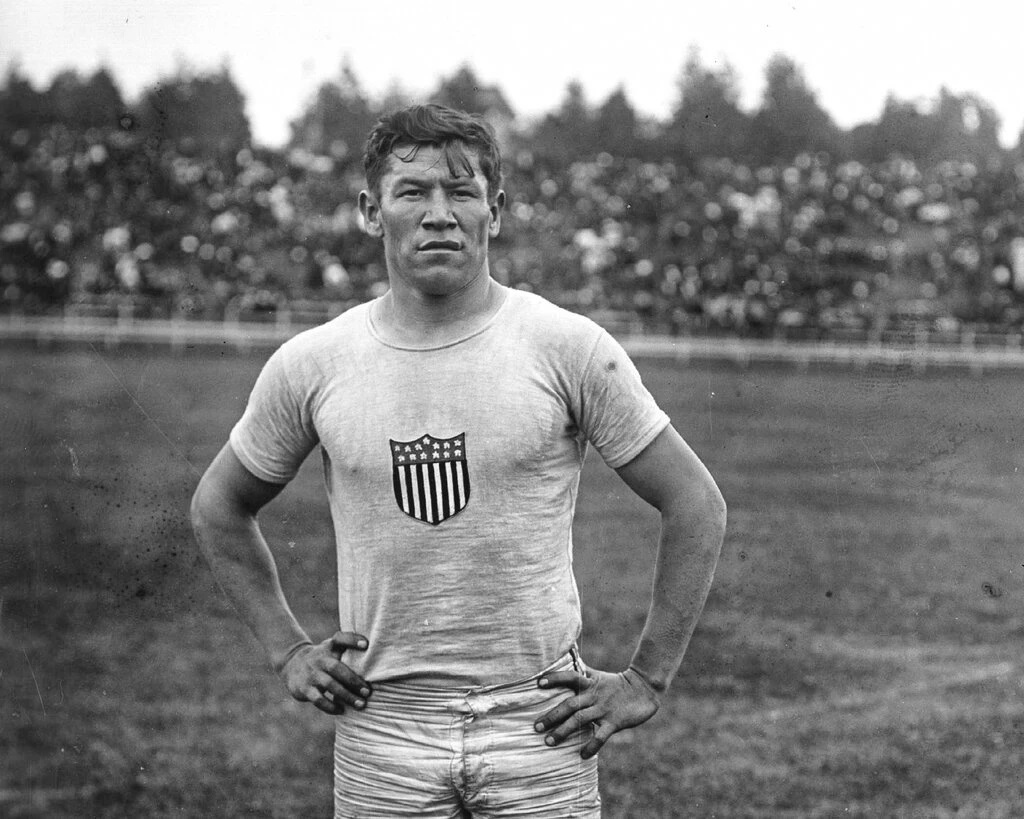
The Long And Messy Ethics Saga Of Jim Thorpe’s Olympic Medals Continues

Jim Thorpe

Whatever it is that is being sought for the late Native American athlete and icon Jim Thorpe, justice isn’t the right word for it.

My father told me about Jim Thorpe in one of his dinner table discourses when I was about 8. The story sure seemed unfair to me then. Thorpe (1887 – 1953), a full-blooded member of the Sac and Fox Nation, had finished first in the 1912 Stockholm Olympics pentathlon and decathlon events, becoming the first Native American to win a gold medal for the United States. Thorpe also played collegiate and professional football and professional baseball to earn a still current reputation as the most versatile great athlete in U.S. sports history. But Thorpe was stripped of his Olympic titles after it was discovered that he had been paid for playing two seasons of semi-professional baseball before competing in the Olympics, thus violating the strict amateurism rules that the Games then embraced.

How technical of those mean Olympics people. This misfortune for Thorpe has always been represented as a horrific injustice and an example of anti-Native American bigotry, but neither is true, and was never true. Thorpe wasn’t eligible for the Olympics under the rules then in place, and in place for what was then believed to be good reasons: the Olympics were for amateur athletes only. Thorpe wasn’t one. All of the arguments for why it was unfair for him to lose his medals (the silver medal winners in both events were bumped up to gold and the official records altered), including the way the story was told in the film biography of Thorpe starring Burt Lancaster, are based on sentiment and flawed ethical reasoning.
Continue reading

The Ethics Conundrum of Jim Thorpe’s Body

Jim Thorpe: Native American, Olympic Champion, baseball star, football star...football.

Jim Thorpe: Native American, Olympic Champion, baseball star, football star…football.

One thing is for certain: Jim Thorpe doesn’t care. The great Native American athlete whose sports legacy was as sterling as his life was tragic died in 1953, recognized by the country he honored with his record-breaking performance in the 1912 Olympics, but like so many of his race, mistreated and exploited by it as well. Since his death, however, a bizarre battle over his body has raged, and it is a perfect example of the Roshomon-like nature of  ethics in some situations. What is the right thing, the fair thing, the ethical thing? The answer sometimes depends on whose viewpoint is applied, and objectivity, the ideal viewpoint we strive for, doesn’t even exist. In an ethical conflict, moreover, there are good ethical principles on both sides of a dispute.

In Jim Thorpe, Pennsylvania, the ethical verdict of what occurred in a Pennsylvania  court last month is clear: the town has been double-crossed. A federal judge ruled that Thorpe’s remains, which lie in a mausoleum built by the town, can be moved to Oklahoma by his family, to be buried on lands belonging to his tribe. In 1953, however, two Pennsylvania towns signed a contract with Thorpe’s widow, committing them to consolidate and rename themselves after the Olympic, football and baseball legend, in return for being able to house Thorpe’s body and reap the tourism benefits of doing so. The contract was valid, if venal in inspiration: Mrs. Thorpe wanted and received cash in return. But a bargain is a bargain, and Thorpe’s presence and name has defined the town for over half a century. Losing Thorpe means losing the town’s identity and signature feature, which is a calamity. Continue reading