More Than a Fool: Bachmann, John Quincy Adams, and Wikipedia

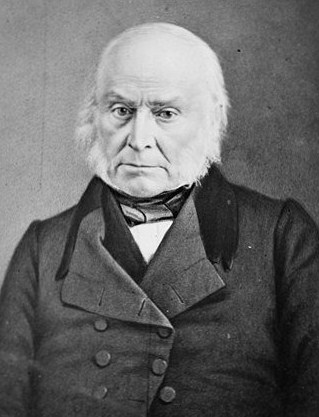
John Quincy Adams, Sixth President, slavery foe, and time-traveling Founding Father

I will strive a bit longer to avoid concluding that Michele Bachmann is as irresponsible, dishonest and dangerous as I strongly suspect that she is, though my determination may not last the time it takes to write this post. I won’t wait any longer to conclude that she is a fool.

In one short week since the controversy erupted over Fox News anchor Chris Wallace daring to ask her on the air, “Are you a flake?” and her subsequent botching of both her answer and the question’s fevered aftermath, she has stumbled into two flaky episodes. One—her mixing up Western movie star icon John Wayne with serial child killer John Wayne Gacy—was at least funny. The other, far less forgivable—her claim that the Founding Fathers “worked tirelessly until slavery was no more in the United States”—has signature significance. Continue reading


“Are You a Flake?” Ethics

"Are you Michele Bachman?"

With only four well-chosen words, Fox News anchor Chris Wallace accomplished several objectives Sunday, all of them in the best tradition of ethical, objective, responsible journalism.

The words were “Are you a flake?,” posed to Minnesota Congresswoman Michele Bachmann, who is running for President.  The question…

1. Properly forced a conservative darling to address her most striking weakness, belying Fox’s well-deserved reputation for bias toward figures its viewers admire…

2. Was a near-perfect example of the “off-the-wall” question technique, which has exposed more than one pretender to high office (Hello, Mike Dukakis!) as less than desirable.

3. Simultaneously gave Bachmann an opportunity to show how quick she could think on her feet while demonstrating important leadership traits like self-awareness, humor, wit, and grace, or, in the alternative, demonstrate the opposite.

How did she do? Well. Judge for yourself: Continue reading

Ethics Hero Emeritus: Marlene Dietrich (1901-1992)

The great Marlene Dietrich, Ethics Hero

It was on this date in 1992 that the magnificent Marlene Dietrich died, in her sleep, in her Paris apartment at age of 91. She had hidden her face from the world since she had stopped performing over a decade before, saying that the public should remember her as she had been. Sadly, Dietrich is one of those former icons of Hollywood whom the public is slowly failing to remember anything about at all; most are more familiar with Madeleine Kahn’s send-up of her in the Western spoof “Blazing Saddles” than they are with Marlene herself. That is wrong, for she deserves better. Not only was Marlene Dietrich a unique performer and important cultural figure, she was also an Ethics Hero.

She was a rising German stage and screen actress when director Josef von Sternberg cast her as Lola-Lola, the beautiful, cynical leading character in “Der blaue Engel,” (The Blue Angel), Germany’s first talking film. The movie made Dietrich a star. Von Sternberg took her with him when Hollywood beckoned and signed her with Paramount Pictures. There Dietrich built her image and legend by perfecting her femme fatale film persona in a series of classic films directed by her mentor: “Morocco” (1930), “Dishonored” (1931), “Shanghai Express” (1932), “Blonde Venus” (1932), “The Scarlet Empress” (1934), and “The Devil Is a Woman” (1935).

Meanwhile, she had already begun fighting Hitler’s regime. Continue reading

Ethics Quote of the Day: Lori Palatnik

Is "ding-dong" wrong?

“In life we must know what is good and what is evil. Yes, we are commanded to remember that there is evil in the world, and not only are we allowed to celebrate when it is destroyed, we must.”

Mrs. Lori Palatnik, in an essay today entitled “Is It Proper To Celebrate Osama bin Laden’s Death?”

Writer David Sirotka at Salon, among others, has sharply criticized the jubilant reaction of most Americans to the terrorist’s death. He found the chanting crowds in front of the White House and Times Square disturbing, symbolizing a gleeful embrace of violence as the way to address problems, an instance of becoming the enemy in order to defeat it: Continue reading

Oscar Ethics: Was Melissa Leo’s Campaign Wrong?

On a difficult day, I am not up to writing about heavy ethics issues, so instead I will comment on an ethics controversy that is as inconsequential as possible—one involving the Oscars.

Melissa Leo, a front-running Best Supporting Actress nominee for her role in “The Fighter,” courted controversy by violating one of the Academy Awards’ unwritten rules: “Don’t promote yourself for an Award—it’s tacky!” Leo personally placed Hollywood trade ads showing her in full glamor mode, a sharp contrast to her character in “The Fighter.” The text simply said “Consider,’ then below that, “Melissa Leo,” and in small print off to the side, the web address http://www.melissaleo.com. She argued that she needed to promote herself because her competitors were getting the benefit of big studio publicity, while she was not. Continue reading

Mr. Friedkin? Mr. Hawks? Meet Mr. Madison and Mr. Twain

It was Saturday Censorship at the Movies last night in Cable Land.

First, I got to watch that manly channel, Spike, blanch at showing a possessed 12-year-old girl use the work “fuck”, which, as you horror devotees know, is a word rather central to showing how she has been taken over, like Helen Thomas, by the demon Pazuzu. There was Linda Blair, as the suddenly possessed Regan O’Neill, bouncing rhythmically on her bed as her horrified mother and physician looked on, shouting “—Me!—Me!—Me!”, apparently horrifying them with a noisy outbreak of egocentricity. The later scene in which the Demon Child is found masturbating with a crucifix was also clumsily chopped up so it was impossible to figure out what was going on. Continue reading

“True Grit” Ethics

I haven’t seen the remake of “True Grit,” but I know I will, and like many other fans of the original 1969 version, I’m trying to conquer my biases. The latest effort by the usually brilliant Coen brothers creates ethical conflicts for me, and I am hoping I can resolve them right now. Can I be fair to their work, while being loyal to a film that is important to me for many reasons?

The original, 1969 “True Grit” won John Wayne his only Oscar for his self-mocking portrayal of fat, seedy law man Rooster Cogburn, 

who is hired by a young girl to track down her father’s murderer. I love the film; I saw it on the big screen nine times, in fact. Remaking it with anyone else in the starring role feels like an insult, somehow, as if the Duke’s version was somehow inadequate.

Intellectually, I know that’s nonsense. Artists have a right to revisit classic stories and put their personal stamp on them, and they should be encouraged to do it. Every new version of a good story, if done well, will discover some unmined treasure in the material. Why discourage the exploration? Continue reading

More Zombie Ethics: George Lucas, Re-Animator

It seems that cinema innovator and mega-mogul George Lucas is using a large chunk of his “Star Wars” merchandising lucre to purchase the rights to screen images of dead movie stars. His plan is to give his tech-magicians at LucasArt the opportunity to perfect the process of re-animating and manipulating them to appear in new roles in new films. Imagine Humphrey Bogart in “Pirates of the Caribbean 5”! Imagine Marilyn Monroe joining the girls in “Sex and the City 2”!  Imagine Cary Grant in a buddy picture with Adam Sandler! Or Jar Jar Binks.

Undoubtedly there are many movie fans who would enjoy having digitally resurrected Hollywood legends appearing side-by-side current idols, and there is probably a lot of money to be made by giving them what they want. Turning deceased stars into computer-generated images and making them do and say anything the programmers choose, with the pace, volume and inflection the directors desire, would represent a significant technological advance. Another obvious benefit is that Lucas’s method is preferable to just digging up the carcasses of the acting greats, hanging them on wires, and using machinery to parade them through movie sets like marionettes.

But not much. Continue reading

The Ethics of Outing the Movie Star

My least favorite website, the ethically challenged Gawker, became the latest media source to publish rapidly spreading tales of the gay sexual escapades of a well-known Hollywood leading man who is also married, has children, attracts a great deal of positive publicity because of his family life, and, to cap it all off, is a high-profile member of a church (the Church of Scientology) that has in the past treated homosexuality as a curable malady. A book is coming out, and the author is pumping up interest in the tabloids.

The ethical question: is this legitimate news? Should it be reported? If it isn’t news, but rather a vile and mean-spirited invasion of privacy, then Gawker, as usual, is wading in slime. If, however, it is news, then why is the mainstream media ignoring the story?

This is a messy ethical conflict. Continue reading

Oprah and the Icons: the Ethics of Lying to Make a Difference

Kitty Kelley’s unauthorized, rip-the-mask-off-the-icon bio is out, and now Oprah Winfrey must weather the inevitable de-construction of some of her meticulously self-created image. Oprah is pretty much untouchable now; I was a guest at her “O” Magazine Expo last Fall in Kansas City, and it was clear that her status with he legion of followers is somewhere between a guru and a goddess. There aren’t many revelations, short of proving that she is secretly Dick Cheney in an elaborate disguise, that could do much to reduce her cultural influence or undo her popularity.

Still, it used to be that heroes, celebrities and cultural icons could count on the whole truth about their personal and career embellishments to surface only late in life, or more often, long after death. Thus it has been a standard tool of rising figures in America to carefully craft an inspiring story and an appealing persona that excite and engage the public, and the truth has had little to do with it. It’s worked, too. Continue reading