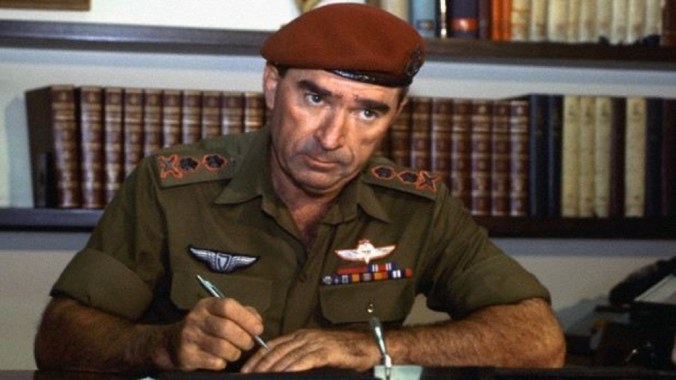
“In principle, when there is a war on terror you conduct it without principles. You simply fight it.”
So said Rafi Eitan, the legendary Israeli spymaster and Mossad operative in an interview with the Israeli newspaper Ha’aretz in 2010. Is that the credo of a hero or a villain? When he died last week at the age of 92, Prime Minister Benjamin Netanyahu called Mr. Eitan “among the heroes of the intelligence services of the State of Israel.” Is “hero of intelligence services” an oxymoron? Eitan’s credo certainly justifies murder, torture and extra-legal activities; indeed, it justifies almost anything. That’s not ethics, it’s the opposite: the ends justify the means, tit for tat, vengeance, and scorched earth warfare without the inconvenience of a formal declaration of war. Former Israeli Prime Minister Ehud Olmert eulogized Eitan as “a smart, cunning and sharp person, who remained capable until his last day”, and praised him as one of “the most intelligent, competent, responsible and creative ministers in the government.” Boy, he sounds like a great guy, if you forget about all the killing.
Eitan, his various obituaries tell us, counted among his more spectacular exploits in support of his nation such operations as the surgical strike on Iraq’s Osirak nuclear reactor in 1981, the systematic assassinations of the Palestinians responsible for the massacre of Israeli athletes at the Munich Olympics in 1972, and the theft of at least 100 pounds of enriched uranium from a nuclear fuel plant in the Pittsburgh area to assist Israel in its atomic bomb program. Eitan was the handler of Jonathan Pollard, the traitorous American Navy intelligence analyst who turned over thousands of classified documents to Israel as its spy, and architect of the operation that has been most celebrated in the various articles in the wake of his death, the capturing of Nazi war criminal Adolf Eichmann in 1960. Continue reading
 Ethics Alarms