Conclusion To The Written Statement of Prof. Jonathan Turley: “The Impeachment Inquiry Into President Donald J. Trump: The Constitutional Basis For Presidential Impeachment”

Jonathan Turley ended his epic testimony before the House Judiciary Committee with a flourish. His whole statement was remarkable, leaving no reasonable argument for impeachment standing—but then the now-insatiable desire to undo the 2016 election has never been rational, and it has relied, despicably, on the historical and legal ignorance of the vast majority of the American people. Turley provided an opportunity for responsible citizens to educate themselves: his language was easy and clear, and there were no pompous or especially academic turns of phrase. Nonetheless, few will read or watch the whole thing, allowing the news media, which has exceeded all previous villainy in this three-year long fiasco, to distort and minimize his patriotic achievement. To the degree that they succeed, it is do the detriment of the nation, and its future. Somehow, Turley makes this clear as well, yet does so without the kind of alienating condemnation that I, in his position, would be unable to resist.

No doubt about it, the professor is a far better scholar and advocate than I am, and a brilliantly talented teacher as well. Still, he made me feel good about the analysis I have been presenting here since 2016. I have studied Presidential history for a shockingly long time; I know my impeachment history well, and observed two of the three previous inquiries up close, live and carefully. I have been certain, certain, from the beginning that what we have seen here is an unprecedented crypto-coup, for virtually all the reasons Professor Turley explains. I’m glad to have the legal authority and the meticulous tracking of where the inquisition ran off the rails, but Turley validated the analysis I have  given readers here. That came as a relief and a confirmation.

It was naturally a special pleasure that the professor ended his testimony by referencing the scene in the video above, from “A Man for All Seasons,” my favorite ethics moment in any movie, and the clip most often used on Ethics Alarms. He also referenced the story of the Republican Senators who turned on their party and voted to acquit President Andrew Johnson, for me the most memorable chapter of “Profiles in Courage,” the book that introduced me to the topic of ethics when I was 12 years old. Turley quotes one of the Senators who was only slightly mentioned by credited author John Fitzgerald Kennedy, but it’s a stirring quote, and damn any politician or citizen who ignores its message.

Lyman Trumbull (R- Ill.) explained fateful decision to vote against Johnson’s impeachment this way:

“Once set the example of impeaching a President for what, when the excitement of the hour shall have subsided, will be regarded as insufficient causes … no future President will be safe who happens to differ with the majority of the House and two-thirds of the Senate …I tremble for the future of my country. I cannot be an instrument to produce such a result; and at the hazard of the ties even of friendship and affection, till calmer times shall do justice to my motives, no alternative is left me…”

Those who endanger the future of my country because of their unrestained anger, hate, confirmation bias, partisan loyalty, prejudice, need to conform, and yes, ignorance and their lack of education, are contemptible. Those who lead them in pursuit of power are worse.

[Turley’s entire statement, with footnotes, is here. The Ethics Alarms edited version is here (Part I); here (PartII); here (Part III); here (Part IV), and here (Part V.) The video is here.]

***

V. CONCLUSION

Allow me to be candid in my closing remarks. I get it. You are mad. The President is mad. My Democratic friends are mad. My Republican friends are mad. My wife is mad. My kids are mad. Even my dog is mad . . . and Luna is a golden doodle and they are never mad. We are all mad and where has it taken us? Will a slipshod impeachment make us less mad or will it only give an invitation for the madness to follow in every future administration?

That is why this is wrong. It is not wrong because President Trump is right. His call was anything but “perfect” and his reference to the Bidens was highly inappropriate. It is not wrong because the House has no legitimate reason to investigate the Ukrainian controversy. The use of military aid for a quid pro quo to investigate one’s political opponent, if proven, can be an impeachable offense.

It is not wrong because we are in an election year. There is no good time for an impeachment, but this process concerns the constitutional right to hold office in this term, not the next.

No, it is wrong because this is not how an American president should be impeached. For two years, members of this Committee have declared that criminal and impeachable acts were established for everything from treason to conspiracy to obstruction. However, no action was taken to impeach. Suddenly, just a few weeks ago, the House announced it would begin an impeachment inquiry and push for a final vote in just a matter of weeks. To do so, the House Intelligence Committee declared that it would not subpoena a host of witnesses who have direct knowledge of any quid pro quo. Instead, it will proceed on a record composed of a relatively small number of witnesses with largely second-hand knowledge of the position. The only three direct conversations with President Trump do not contain a statement of a quid pro quo and two expressly deny such a pre-condition. The House has offered compelling arguments why those two calls can be discounted by the fact that President Trump had knowledge of the underlying whistleblower complaint. However, this does not change the fact that it is moving forward based on conjecture, assuming what the evidence would show if there existed the time or inclination to establish it. The military aid was released after a delay that the witnesses described as “not uncommon” for this or prior Administrations. This is not a case of the unknowable. It is a case of the peripheral. The House testimony is replete with references to witnesses like John Bolton, Rudy Giuliani, and Mike Mulvaney who clearly hold material information.

To impeach a president on such a record would be to expose every future president to the same type of inchoate impeachment. Continue reading

Written Statement of Prof. Jonathan Turley: “The Impeachment Inquiry Into President Donald J. Trump: The Constitutional Basis For Presidential Impeachment” [PART V]

Note the date…

In his final section before concluding, Professor Turley covers other theories being floated as justification for impeachment, and finds them startlingly weak and contrived.

The Hill has Turley’s lament regarding the  the Alliance of Unethical Conduct’s attacks on his thorough and objective dismantling of their coup efforts. (The AUC—that’s the Ethics Alarm shorthand for the Democratic Party-“resistance”-mainstream media alliance to remove Trump from office by any means possible, not Turley’s.)  He writes,

Despite 52 pages of my detailed testimony, more than twice the length of all the other witnesses combined, on the cases and history of impeachment, [Washington Post columnist Dana Milbank] described it as being “primarily emotional and political.” Milbank claimed that I contradicted my testimony in a 2013 hearing when I presented “exactly the opposite case against President Obama” by saying “it would be ‘very dangerous’ to the balance of powers not to hold Obama accountable for assuming powers ‘very similar’ to the ‘right of the king’ to essentially stand above the law.”

But I was not speaking of an impeachment then. It was a discussion of the separation of powers and the need for Congress to fight against unilateral executive actions, the very issue that Democrats raise against Trump. I did not call for Obama to be impeached….

In my testimony Wednesday, I stated repeatedly [as I stated in my testimony during the Clinton impeachment] that a president can be impeached for noncriminal acts…. My objection is not that you cannot impeach Trump for abuse of power but that this record is comparably thin compared to past impeachments…. … Democrats have argued that they do not actually have to prove the elements of crimes…. In the Clinton impeachment, the crime was clearly established and widely recognized…. [W]e are lowering impeachment standards to fit a paucity of evidence and an abundance of anger…. 

Writes Ann Althouse in a post yesterday, “it seems to me that the real impeachable offense has always been that Donald Trump got himself elected.”

I wish Prof. Turley had dealt with that, the real justification, in their minds, for the House’s impeachment push.

Back to the professor:

C.  Extortion.

 As noted earlier, extortion and bribery cases share a common law lineage. Under laws like the Hobbs Act, prosecutors can allege different forms of extortion. The classic form of extortion is coercive extortion to secure property “by violence, force, or fear.”85 Even if one were to claim the loss of military aid could instill fear in a country, that is obviously not a case of coercive extortion as that crime has previously been defined.

Instead, it would presumably be alleged as extortion “under color of official right.” Clearly, both forms of extortion have a coercive element, but the suggestion is that Trump was “trying to extort” the Ukrainians by withholding aid until they agreed to open investigations. The problem is that this allegation is no closer to the actual crime of extortion than it is to its close cousin bribery. The Hobbs Act defines extortion as “the obtaining of property from another, with his consent, induced by wrongful use of actual or threatened force, violence, or fear or under color of official right.”87

As shown in cases like United States v. Silver, extortion is subject to the same limiting definition as bribery and resulted in a similar overturning of convictions. Another obvious threshold problem is defining an investigation into alleged corruption as “property.” Blackstone described a broad definition of extortion in early English law as “an abuse of public, justice which consists in an officer’s unlawfully taking, by colour of his office, from any man, any money or thing of value, that is not due him, or more than is due, or before it is due.”89 The use of anything “of value” today would be instantly rejected. Extortion cases involve tangible property, not possible political advantage.90 In this case, Trump asked for cooperation with the Justice Department in its investigation into the origins of the FBI investigation on the 2016 election. As noted before, that would make a poor basis for any criminal or impeachment theory. The Biden investigation may have tangible political benefits, but it is not a form of property. Indeed, Trump did not know when such an investigation would be completed or what it might find. Thus, the request was for an investigation that might not even benefit Trump.

The theory advanced for impeachment bears a close similarity to one of the extortion theories in United States v. Blagojevich where the Seventh Circuit overturned an extortion conviction based on the Governor of Illinois, Rod Blagojevich, pressuring then Sen. Barack Obama to make him a cabinet member or help arrange for a high- paying job in exchange for Blagojevich appointing a friend of Obama’s to a vacant Senate seat. The prosecutors argued such a favor was property for the purposes of extortion. The court dismissed the notion, stating “The President-elect did not have aproperty interest in any Cabinet job, so an attempt to get him to appoint a particular person to the Cabinet is not an attempt to secure ‘property’ from the President (or the citizenry at large).” In the recent hearings, witnesses spoke of the desire for “deliverables” sought with the aid. Whatever those “deliverables” may have been, they were not property as defined for the purposes of extortion any more than the “logrolling” rejected in Blagojevich.

There is one other aspect of the Blagojevich opinion worth noting. As I discussed earlier, the fact that the military aid was required to be obligated by the end of September weakens the allegation of bribery. Witnesses called before the House Intelligence Committee testified that delays were common, but that aid had to be released by September 30th. It was released on September 11th. The ability to deny the aid, or to even withhold it past September 30th is questionable and could have been challenged in court. The status of the funds also undermines the expansive claims on what constitutes an “official right” or “property”:

“The indictment charged Blagojevich with the ‘color of official right’ version of extortion, but none of the evidence suggests that Blagojevich claimed to have an ‘official right’ to a job in the Cabinet. He did have an ‘official right’ to appoint a new Senator, but unless a position in the Cabinet is ‘property’ from the President’s perspective, then seeking it does not amount to extortion. Yet a political office belongs to the people, not to the incumbent (or to someone hankering after the position). Cleveland v. United States, 531 U.S. 12 (2000), holds that state and municipal licenses, and similar documents, are not ‘property’ in the hands of a  public  agency. That’s equally true of public positions. The President-elect did not have a property interest in any Cabinet job, so an attempt to get him to appoint a particular person to the Cabinet is not an attempt to secure ‘property’ from the President (or the citizenry at large).”

A request for an investigation in another country or the release of money already authorized for Ukraine are even more far afield from the property concepts addressed by the Seventh Circuit.

The obvious flaws in the extortion theory were also made plain by the Supreme Court in Sekhar v. United States, where the defendant sent emails threatening to reveal embarrassing personal information to the New York State Comptroller’s general counsel in order to secure the investment of pension funds with the defendant. In an argument analogous to the current claims, the prosecutors suggested political or administrative support was a form of intangible property. As in McDonnell, the Court was unanimous in rejecting the “absurd” definition of property. The Court was highly dismissive of such convenient linguistic arguments and noted that “shifting and imprecise characterization of

the alleged property at issue betrays the weakness of its case.”94 It concluded that “[a]dopting the Government’s theory here would not only make nonsense of words; it would collapse the longstanding distinction between extortion and coercion and ignore Congress’s choice to penalize one but not the other. That we cannot do.”95 Nor should Congress. Much like such expansive interpretations would be “absurd” for citizens in criminal cases, it would be equally absurd in impeachment cases.

To define a request of this kind as extortion would again convert much of politics into a criminal enterprise. Indeed, much of politics is the leveraging of aid or subsidies or grants for votes and support. In Blagojevich, the court dismissed such “logrolling” as the basis for extortion since it is “a common exercise.” If anything of political value is now the subject of the Hobbs Act, the challenge in Washington would not be defining what extortion is, but what it is not.

D.  Campaign Finance Violation

Some individuals have claimed that the request for investigations also constitutes a felony violation of the election finance laws. Given the clear language of that law and the controlling case law, there are no good-faith grounds for such an argument. To put it simply, this dog won’t hunt as either a criminal or impeachment matter. U.S.C. section 30121 of Title 52 states: “It shall be unlawful for a foreign national, directly or indirectly, to make a contribution or donation of money or other thing of value, or to make an express or implied promise to make a contribution or donation, in connection with a federal, state, or local election.”

On first blush, federal election laws would seem to offer more flexibility to the House since the Federal Election Commission has adopted a broad interpretation of what can constitute a “thing of value” as a contribution. The Commission states “’Anything of value’ includes all ‘in-kind contributions,’ defined as ‘the provision of any goods or services without charge or at a charge that is less than the usual and normal charge for such goods or services.’” However, the Justice Department already reviewed the call and correctly concluded it was not a federal election violation. This determination was made by the prosecutors who make the decisions on whether to bring such cases. The Justice Department concluded that the call did not involve a request for a “thing of value” under the federal law. Congress would be alleging a crime that has been declared not to be a crime by career prosecutors. Such a decision would highlight the danger of claiming criminal acts, while insisting that impeachment does not require actual crimes. The “close enough for impeachment” argument will only undermine the legitimacy of the impeachment process, particularly if dependent on an election fraud allegation that itself is based on a demonstrably slipshod theory. Continue reading

Written Statement of Prof. Jonathan Turley: “The Impeachment Inquiry Into President Donald J. Trump: The Constitutional Basis For Presidential Impeachment” [PART IV]

The press wanted Andrew Johnson impeached, too…

This section of Turley’s masterpiece covers the various “obstruction of justice” claims. The conclusion:

“Basing impeachment on this obstruction theory would itself be an abuse of power. . . by Congress. It would be an extremely dangerous precedent to set for future presidents and Congresses in making an appeal to the Judiciary into “high crime and misdemeanor.”

Boy, Turley did a terrific job…

B.  Obstruction of Justice

 Another crime that was sporadically mentioned during the House Intelligence hearings was obstruction of justice or obstruction of Congress. Once again, with only a few days to prepare this testimony and with no public report on the specific allegations, my analysis remains mired in uncertainty as to any plan to bring such a claim to the foundational evidence for the charge. Most of the references to obstruction have been part of a Ukraine-based impeachment plan that does not include any past alleged crimes from the Russian investigation. I will therefore address the possibility of a Ukraine-related obstruction article of impeachment. However, as I have previously written, I believe an obstruction claim based on the Mueller Report would equally at odds with the record and the controlling case law. The use of an obstruction theory from the Mueller Report would be unsupportable in the House and unsustainable in the Senate. Once again, the lack of information (just weeks before an expected impeachment vote) on the grounds for impeachment is both concerning and challenging. It is akin to being asked to diagnose a patient’s survivability without knowing his specific illness.

Obstruction of justice is a more broadly defined crime than bribery and often overlaps with other crimes like witness tampering, subornation, or specific acts designed to obstruct a given proceeding. There are many federal provisions raising forms of obstruction that reference parallel crimes. Thus, influencing a witness is a standalone crime and also a form of obstruction under 18 U.S.C. 1504. In conventional criminal cases, prosecutions can be relatively straightforward, such as cases of witness intimidation under 18 U.S. 1503. Of course, this is no conventional case. The obstruction claims leveled against President Trump in the Ukrainian context have centered on two main allegations. First, there was considerable discussion of the moving of the transcript of the call with President Zelensky to a classified server as a possible premeditated effort to hide evidence. Second, there have been repeated references to the “obstruction” of President Trump by invoking executive privileges or immunities to withhold witnesses and documents from congressional committees. In my view, neither of these general allegations establishes a plausible case of criminal obstruction or a viable impeachable offense.

In the Mueller report, Assistant Attorney General found no cognizable case was presented for an allegation of obstruction of justice. Many members of this Committee heralded the selection of Rosenstein as a consummate and apolitical professional who was responsible for the appointment of the Special Counsel. He reached this conclusion on the record sent by Mueller and, most importantly, the controlling case law. As with the campaign finance allegation discussed in this testimony, an article based on obstruction in the Russian investigation would seek the removal of a President on the basis of an act previously rejected as a crime by the Justice Department. Many of us have criticized the President for his many comments and tweets on the Russian investigation. However, this is a process that must focus on impeachable conduct, not imprudent or even obnoxious conduct. Continue reading

Written Statement of Prof. Jonathan Turley: “The Impeachment Inquiry Into President Donald J. Trump: The Constitutional Basis For Presidential Impeachment” [PART III]

(Part I is here; Part II, here.)

In this section of his testimony, Turley deals with the Ukraine phone call that is supposedly impeachable. Here is the key paragraph:

“Again, the issue is not whether these comments are correct, but whether they are corrupt. In my view, there is no case law that would support a claim of corrupt intent in such comments to support a bribery charge. There is no question that an investigation of the Bidens would help President Trump politically. However, if President Trump honestly believed that there was a corrupt arrangement with Hunter Biden that was not fully investigated by the Obama Administration, the request for an investigation is not corrupt, notwithstanding its inappropriateness. The Hunter Biden contract has been widely criticized as raw influence peddling. I have joined in that criticism. For many years, I have written about the common practice of companies and lobbyists attempting to curry favor with executive branch officials and members of Congress by giving windfall contracts or jobs to their children. This is a classic example of that corrupt practice.”

IV.   THE CURRENT THEORIES OF IMPEACHABLE CONDUCT AGAINST PRESIDENT DONALD J. TRUMP

 While all three acts in the impeachment standard refer to criminal acts in modern parlance, it is clear that “high crimes and misdemeanors” can encompass non-criminal conduct. It is also true that Congress has always looked to the criminal code in the fashioning of articles of impeachment. The reason is obvious. Criminal allegations not only represent the most serious forms of conduct under our laws, but they also offer an objective source for measuring and proving such conduct. We have never had a presidential impeachment proceed solely or primarily on an abuse of power allegation, though such allegations have been raised in the context of violations of federal or criminal law. Perhaps for that reason, there has been a recent shift away from a pure abuse of power allegation toward direct allegations of criminal conduct. That shift, however, has taken the impeachment process far outside of the relevant definitions and case law on these crimes. It is to those allegations that I would now like to turn.

At the outset, however, two threshold issues are worth noting. First, this hearing is being held before any specific articles have been proposed. During the Clinton impeachment hearing, we were given a clear idea of the expected articles of impeachment and far greater time to prepare analysis of those allegations. The House leadership has repeatedly indicated that they are proceeding on the Ukrainian controversy and not the various alleged violations or crimes alleged during the Russian investigation. Recently, however, Chairman Schiff indicated that there might be additional allegations raised while continuing to reference the end of December as the working date for an impeachment vote. Thus, we are being asked to offer a sincere analysis on the grounds for impeachment while being left in the dark. My testimony is based on the public statements regarding the Ukrainian matter, which contain references to four alleged crimes and, most recently, a possible compromise proposal for censure.

Second, the crimes discussed below were recently raised as part of the House Intelligence Committee hearings as alternatives to the initial framework as an abuse of power. There may be a desire to refashion these facts into crimes with higher resonance with voters, such as bribery. In any case, Chairman Schiff and committee members began to specifically ask witnesses about elements that were pulled from criminal cases. When some of us noted that courts have rejected these broader interpretations or that there are missing elements for these crimes, advocates immediately shifted to a position that it really does not matter because “this is an impeachment.” This allows members to claim criminal acts while dismissing the need to actually support such allegations. If that were the case, members could simply claim any crime from treason to genocide. While impeachment does encompass non-crimes, including abuse of power, past impeachments have largely been structured around criminal definitions. The reason is simple and obvious. The impeachment standard was designed to be a high bar and felonies often were treated as inherently grave and serious. Legal definitions and case law also offer an objective and reliable point of reference for judging the conduct of judicial and executive officers. It is unfair to claim there is a clear case of a crime like bribery and simultaneously dismiss any need to substantiate such a claim under the controlling definitions and meaning of that crime. After all, the common mantra that “no one is above the law” is a reference to the law applied to all citizens, even presidents. If the House does not have the evidence to support a claim of a criminal act, it should either develop such evidence or abandon the claim. As noted below, abandoning such claims would still leave abuse of power as a viable ground for impeachment. It just must be proven.

A.  Bribery

Continue reading

Written Statement of Prof. Jonathan Turley: “The Impeachment Inquiry Into President Donald J. Trump: The Constitutional Basis For Presidential Impeachment” [PART II]

( Part I is here.)

Professor Turley’s testimony continues…

B.  The Nixon Inquiry

The Nixon “impeachment” is often referenced as the “gold standard” for impeachments even though it was not an actual impeachment. President Richard Nixon resigned before the House voted on the final articles of impeachment. Nevertheless, the Nixon inquiry was everything that the Johnson impeachment was not. It was based on an array of clearly defined criminal acts with a broad evidentiary foundation. That record was supported by a number of key judicial decisions on executive privilege claims. It is a worthy model for any presidential impeachment. However, the claim by Chairman Schiff that the Ukrainian controversy is “beyond anything Nixon did” is wildly at odds with the historical record. The allegations in Nixon began with a felony crime of burglary and swept to encompass an array of other crimes involving political slush funds, payments of hush money, maintenance of an enemies list, directing tax audits of critics, witness intimidation, multiple instances of perjury, and even an alleged  kidnapping. Ultimately, there were nearly 70 officials charged and four dozen of them found guilty. Nixon was also named as an unindicted conspirator by a grand jury. The convicted officials include former Attorney General John N. Mitchell (perjury); former Attorney General Richard Kleindienst (contempt of court); former Deputy Director of the Committee to Re-elect The President Jeb Stuart Magruder (conspiracy to the burglary); former Chief of Staff H.R. Haldeman (conspiracy to the burglary, obstruction of justice, and perjury); former counsel and Assistant to the President for Domestic Affairs to Nixon John Ehlichman (conspiracy to the burglary, obstruction of justice, and perjury); former White House Counsel John W. Dean II (obstruction of justice); and former special counsel to the President Charles Colson (obstruction of justice). Many of the Watergate defendants went to jail, with some of the defendants sentenced to as long as 35 years. The claim that the Ukrainian controversy eclipses Watergate is unhinged from history.

While the Ukrainian controversy could still establish impeachable conduct, it undermines that effort to distort the historical record to elevate the current record. Indeed, the comparison to the Nixon inquiry only highlights the glaring differences in the underlying investigations, scope of impeachable conduct, and evidentiary records with the current inquiry. It is a difference between the comprehensive and the cursory; the proven and the presumed. In other words, it is not a comparison the House should invite if it is serious about moving forward in a few weeks on an impeachment based primarily on the Ukrainian controversy. The Nixon inquiry was based on the broadest and most developed evidentiary in any impeachment. There were roughly 14 months of hearings – not 10 weeks. There were scandalous tape recordings of Nixon and a host of criminal pleas and prosecutions. That record included investigations in both the House and the Senate as well as investigations by two special prosecutors, Archibald Cox and Leon Jaworski, including grand jury material. While the inquiry proceeded along sharply partisan lines, the vote on the proposed articles of impeachment ultimately included the support of some Republican members who, again, showed that principle could transcend politics in such historic moments.

Three articles were approved in the Nixon inquiry alleging obstruction of justice, abuse of power, and defiance of committee subpoenas. Two articles of impeachment based on usurping Congress, lying about the bombing of Cambodia, and tax fraud, were rejected on a bipartisan basis. While the Nixon impeachment had the most developed record and comprehensive investigation, I am not a fan of the structure used for the articles. The Committee evaded the need for specificity in alleging crimes like obstruction of justice while listing a variety of specific felonies after a catchall line declaring that “the means used to implement this course of conduct or plan included one or more of the following.” Given its gravity, impeachment should offer concrete and specific allegations in the actual articles. This is the case in most judicial impeachments.

The impeachment began with a felony when “agents of the Committee for the Re- election of the President committed unlawful entry of the headquarters of the Democratic National Committee in Washington, District of Columbia, for the purpose of securing political intelligence.” The first article of impeachment reflected the depth of the record and scope of the alleged crimes in citing Nixon’s personal involvement in the obstruction of federal and congressional investigations. The article included a host of specific criminal acts including lying to federal investigators, suborning perjury, and witness tampering. The second article of impeachment also alleged an array of criminal acts that were placed under the auspices of abuse of power. The article addressed Nixon’s rampant misuse of the IRS, CIA, and FBI to carry out his effort to conceal the evidence and crimes following the break-in. They included Nixon’s use of federal agencies to carry out “covert and unlawful activities” and how he used his office to block the investigation of federal agencies. The third article concerned defiance of Congress stemming from his refusal to turn over material to Congress.

These articles were never subjected to a vote of the full House. In my view, they were flawed in their language and structure. As noted earlier, there was a lack of specificity on the alleged acts due to the use of catch-all lists of alleged offenses. Continue reading

Written Statement of Prof. Jonathan Turley: “The Impeachment Inquiry Into President Donald J. Trump: The Constitutional Basis For Presidential Impeachment” [PART I]

Today, at the impeachment hearings, Prof. Jonathan Turley performed a great public and national service by eviscerating the Democratic theory of impeachment legally, logically and historically. I cannot wait to see if his decisive testimony is given half the prominence by the New York Times as the various headlines shouting about how an official would have done things differently if he or she were President. Unlike almost all of the testimony so far, Turley’s was based on facts and law, and addressed the issue at hand: is there any justification for impeachment proceedings?

It’s a wonderful and clear piece of scholarship that addresses several approaches to the matter that I had wanted to address, notably how the three previous impeachment efforts compare with this one.

Every citizen should read it all; of course, almost none will. The testimony is long, because it is thorough; I have edited it for ease of reading, eliminating footnotes. If you want to read the original document, it is here. Ethics Alarms is going to present this in several parts. Send that link to your smug impeachment-cheering friends, relatives and social media contacts. Tell them that unless they read it, you really don’t want to hear any more on the subject from them, because they want to remain ignorant.

I am proud—relieved?—to find that this serious and admirable scholar embraces many of the positions I have discussed here, though in far more detail and with considerably more authority.

INTRODUCTION

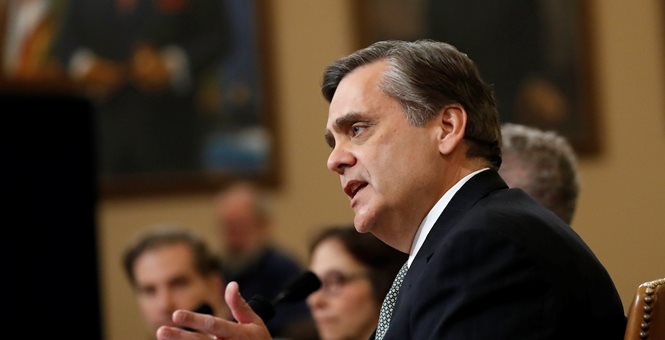
Chairman Nadler, ranking member Collins, members of the Judiciary Committee, my name is Jonathan Turley, and I am a law professor at George Washington University where I hold the J.B. and Maurice C. Shapiro Chair of Public Interest Law. It is an honor to appear before you today to discuss one of the most solemn and important constitutional functions bestowed on this House by the Framers of our Constitution: the impeachment of the President of the United States.

Twenty-one years ago, I sat here before you, Chairman Nadler, and other members of the Judiciary Committee to testify on the history and meaning of the constitutional impeachment standard as part of the impeachment of President William Jefferson Clinton. I never thought that I would have to appear a second time to address the same question with regard to another sitting president. Yet, here we are. Some elements are strikingly similar. The intense rancor and rage of the public debate is the same. It was an atmosphere that the Framers anticipated. Alexander Hamilton warned that charges of impeachable conduct “will seldom fail to agitate the passions of the whole community, and to divide it into parties more or less friendly or inimical to the accused.”2 As with the Clinton impeachment, the Trump impeachment has again proven Hamilton’s words to be prophetic. The stifling intolerance for opposing views is the same. As was the case two decades ago, it is a perilous environment for a legal scholar.

I appear today in my academic capacity to present views founded in prior academic work on impeachment and the separation of powers. My testimony does not reflect the views or approval of CBS News, the BBC, or the newspapers for which I write as a columnist. My testimony was written exclusively by myself with editing assistance from Nicholas Contarino, Andrew Hile, Thomas Huff, and Seth Tate explores the technical and arcane issues normally involved in an academic examination of a legal standard ratified 234 years ago. In truth, the Clinton impeachment hearing proved to be an exception to the tenor of the overall public debate. The testimony from witnesses, ranging from Arthur Schlesinger Jr. to Laurence Tribe to Cass Sunstein, contained divergent views and disciplines. Yet the hearing remained respectful and substantive as we all grappled with this difficult matter. I appear today in the hope that we can achieve that same objective of civil and meaningful discourse despite our good- faith differences on the impeachment standard and its application to the conduct of President Donald J. Trump.

I have spent decades writing about impeachment and presidential powers as an academic and as a legal commentator. My academic work reflects the bias of a Madisonian scholar. I tend to favor Congress in disputes with the Executive Branch and I have been critical of the sweeping claims of presidential power and privileges made by modern Administrations. My prior testimony mirrors my criticism of the expansion of executive powers and privileges. In truth, I have not held much fondness for any president in my lifetime. Indeed, the last president whose executive philosophy I consistently admired was James Madison.

In addition to my academic work, I am a practicing criminal defense lawyer. Among my past cases, I represented the United States House of Representatives as lead counsel challenging payments made under the Affordable Care Act without congressional authorization. I also served as the last lead defense counsel in an impeachment trial in the Senate. With my co-lead counsel Daniel Schwartz, I argued the case on behalf of federal judge Thomas Porteous. (My opposing lead counsel for the House managers was Adam Schiff). In addition to my testimony with other constitutional scholars at the Clinton impeachment hearings, I also represented former Attorneys General during the Clinton impeachment litigation over privilege disputes triggered by the investigation of Independent Counsel Ken Starr. I also served as lead counsel in a bill of attainder case, the sister of impeachment that will be discussed below.

I would like to start, perhaps incongruously, with a statement of three irrelevant facts. First, I am not a supporter of President Trump. I voted against him in 2016 and I have previously voted for Presidents Clinton and Obama. Second, I have been highly critical of President Trump, his policies, and his rhetoric, in dozens of columns. Third, I have repeatedly criticized his raising of the investigation of the Hunter Biden matter with the Ukrainian president. These points are not meant to curry favor or approval. Rather they are meant to drive home a simple point: one can oppose President Trump’s policies or actions but still conclude that the current legal case for impeachment is not just woefully inadequate, but in some respects, dangerous, as the basis for the impeachment of an American president. To put it simply, I hold no brief for President Trump. My personal and political views of President Trump, however, are irrelevant to my impeachment testimony, as they should be to your impeachment vote. Today, my only concern is the integrity and coherence of the constitutional standard and process of impeachment. President Trump will not be our last president and what we leave in the wake of this scandal will shape our democracy for generations to come. I am concerned about lowering impeachment standards to fit a paucity of evidence and an abundance of anger. If the House proceeds solely on the Ukrainian allegations, this impeachment would stand out among modern impeachments as the shortest proceeding, with the thinnest evidentiary record, and the narrowest grounds ever used to impeach a president. That does not bode well for future presidents who are working in a country often sharply and, at times, bitterly divided.

Although I am citing a wide body of my relevant academic work on these questions, I will not repeat that work in this testimony. Instead, I will focus on the history and cases that bear most directly on the questions facing this Committee. My testimony will first address relevant elements of the history and meaning of the impeachment standard. Second, I will discuss the past presidential impeachments and inquiries in the context of this controversy. Finally, I will address some of the specific alleged impeachable offenses raised in this process. In the end, I believe that this process has raised serious and legitimate issues for investigation. Indeed, I have previously stated that a quid pro quo to force the investigation of a political rival in exchange for military aid can be impeachable, if proven. Yet moving forward primarily or exclusively with the Ukraine controversy on this record would be as precarious as it would premature. It comes down to a type of constitutional architecture. Such a slender foundation is a red flag for architects who operate on the accepted 1:10 ratio between the width and height of a structure. The physics are simple. The higher the building, the wider the foundation. There is no higher constitutional structure than the impeachment of a sitting president and, for that reason, an impeachment must have a wide foundation in order to be successful. The Ukraine controversy has not offered such a foundation and would easily collapse in a Senate trial.

Before I address these questions, I would like to make one last cautionary observation regarding the current political atmosphere. In his poem “The Happy Warrior,” William Wordsworth paid homage to Lord Horatio Nelson, a famous admiral and hero of the Napoleonic Wars. Wordsworth began by asking “Who is the happy Warrior? Who is he what every man in arms should wish to be?” The poem captured the deep public sentiment felt by Nelson’s passing and one reader sent Wordsworth a gushing letter proclaiming his love for the poem. Surprisingly, Wordsworth sent back an admonishing response. He told the reader “you are mistaken; your judgment is affected by your moral approval of the lines.” Wordsworth’s point was that it was not his poem that the reader loved, but its subject. My point is only this: it is easy to fall in love with lines that appeal to one’s moral approval. In impeachments, one’s feeling about the subject can distort one’s judgment on the true meaning or quality of an argument. We have too many happy warriors in this impeachment on both sides. What we need are more objective noncombatants, members willing to set aside political passion in favor of constitutional circumspection. Despite our differences of opinion, I believe that this esteemed panel can offer a foundation for such reasoned and civil discourse. If we are to impeach a president for only the third time in our history, we will need to rise above this age of rage and genuinely engage in a civil and substantive discussion. It is to that end that my testimony is offered today. Continue reading

Morning Ethics Warm-Up, 11/13/2019: Protests, Insults, Complaints And Threats

Started this at 3:15 am.

To be honest, I’m going back to bed as soon I  post it…

1. Today’s sample of Trump Derangement: Someone calling himself “Morgan Kilgore” (not hi s real name, however) just submitted a comment in all caps, to this post from May. It reads: TRUMP IS A CROOK AND ROBINSON SAID IT VERY PLAIN SIMPLE, UNLKE THE MUELLER REPORT..YOU TRUMP SUPPORTERS ARE A BUNCH OF FOOLS,LEAD BY A FOOL AND CONMAN.IF TRUMP TOOK A DUMP ON YOUR TURKEY DINNER,YOU WOULD STILL MAKE AN EXCUSE FOR HIM AND IT’S
SAD PEOPLE,VERY SAD. HEY MAYBE YOUR CHILDREN WILL GROWN UP AND HAVE TRUMP. VALUES.

The comment makes no substantive arguments and does not attempt to rebut the post, which is pretty air tight, frankly. I get a lot of these. (“Morgan” will not be joining our discussions.) The comment is also pretty typical of what the average Trump-obsessed Facebook user posts or “likes” on a daily basis.

2.  Freedom of speech watch: Jonathan Turley, who deserves praise for relentlessly flagging and criticizing the alarming increase in anti-speech advocacy from the Left, notes,

“The doublespeak used to justify the denial of free speech is particularly chilling. The students [at Stanford] insisted that allowing people to hear [ conservative pundit Ben Shapiro]  put them at risk: “WE are tired of Stanford Administration’s complicity in putting Black, Brown, Trans, Queer, and Muslim students at risk by allowing SCR to bring Ben Shapiro to campus”…The students declared their commitment not “to allow Shapiro’s talk to go uninterrupted.” In other words, we will not allow other students and faculty listen and have a discourse with Shapiro. What is striking is how these students believe that denying free speech is a noble act — a view fueled by many faculty members who treat speech as violence or a tool of oppression. That makes being a censor sound like being a civil libertarian. You simply declare, as did the Stanford students, that this is a “harmful event” with “harmful people.” Done.

Continue reading

Ethics Warm-Up, 10/15/2019: Farrow, James, Biden, And Another Diploma Bites The Dust…[CORRECTED]

Great.

Now there’s a tidal wave of too many ethics stories and issues to cover…

…and more than ever, I feel that an impeachment information and analysis website is essential, a civic  obligation, and likley to foce me to live out of a cardboard box. I also need to get Mrs. Q’s featured column launched. Naturally, I leave on another ethics seminar road trip today.

If the Red Sox were in the post-season, I’d have to shoot myself…

1. The up-side of the NBA’s cowardly pandering to China and its suppression of basic human rights…we learned what a shallow hypocrite LeBron James is. Of course, many of us knew this when James did his grandstanding champion of social justice act and  extolled Colin Kaepernick’s useless and incoherent protest.  “I stand with anyone who believes in change,” the B-ball superstar said, as if that means something.  It was still enough to attract excessive praise from the sports media. Last week, however, as the Los Angeles Lakers  returned home from a week-long tour of China, James said,

“Yes, we do have freedom of speech.  But at times, there are ramifications for the negative that can happen when you’re not thinking about others, when you only think about yourself. I don’t want to get into a word or sentence feud with Daryl Morey, but I believe he wasn’t educated on the situation at hand, and he spoke.”

Morey, the Houston Rockets GM who tweeted support for the Hong Kong protesters resisting China’s iron boot, only lacked education on how venal and without principles his league was, including stars like James. Morey was “thinking of others”: he was thinking of the people of Hong Kong desperately trying to hold on to as much liberty as they can. No, he wasn’t thinking about James’s giant paycheck, which is clearly all LeBron cares about.

He can take solace in a victory in the NBA’s “It’s not the worst thing” sweepstakes. San Farncisco Warriors coach Steve Kerr, when asked if he’d ever been confronted about human rights abuses on earlier trips to China, Kerr replied, “No. Nor has (America’s) record of human rights abuses come up either… People in China didn’t ask me about, you know, people owning AR-15s and mowing each other down in a mall.”

That’s right, Steve, there is obvious moral equivalency between China’s 30-65 million mass murders and its current oppressive government, and the United States of America. Continue reading

End Of Week Ethics Alarms, 10/11/2019: The Liberty Under Attack Edition

Wait…

I’m looking forward to the weekend  even though I’ll be working throughout.

I’m obviously an idiot.

1. My Ethics Alarms doesn’t even “ping!” on this one.  KTVU, the Bay Area’s Fox affiliate, summarized the St. Louis Cardinals’ devastating win over the Braves in Game 5 of the National League Division Series with a chyron reading, “Braves Scalped.” The Horror! Exclaimed the always sensitive Yahoo! Sports, “That’s straight out of the yikes factory. Particularly given the conversation that’s surrounded the Braves recently. A Cardinals pitcher of Native American descent objected to the Braves’ infamous tomahawk chop and the team responded Wednesday by toning down its use of the chop. There’s not any good time to roll out a “scalped” headline, but this was a particularly bad one.” The headline to the story says the headline is “racist.”

OK, why? I want one good reason. If a team is going to call itself something other than “The Baseball Players,” which would be strikingly unoriginal, you have to admit, then metaphors and colorful language relating to that teams’ nickname are automatically appropriate. “Orioles’/Cardinals’/Bluejays’ Wings Clipped!”…”Red Sox/Whie Sox unravel!”…”Tigers/Cubs/ Declawed!”…”Nats Swatted!”…”Giants Dwarfed!”…  “Pirates Walk The Plank!”…”Diamondbacks Rattled!”…”Mariners Sink!” But “Braves (or Indians) Scalped!” is an outrage? The team lost 13-1! The Braves were down 10-0 after the first half-inning; it was an epic slaughter. I could u8nderstand the discomfort if Native Americans never scalped their adversaries, but they did. This isn’t some kind of historical slander. Let’s see…here’s some of a rather scholarly article on the subject of scalping…

…the languages of the eastern Indians contained many words to describe the scalp, the act of scalping, and the victim of scalping. A Catholic priest among the Hurons in 1623 learned that an onontsira was a war trophy consisting of “the skin of the head with its hair.” The five languages of the Iroquois were especially rich in words to describe the act …To the Mohawks and Oneidas, the scalp was onnonra ; the act of taking it, kannonrackwan . Their western brothers at Onondaga spoke of hononksera , a variation of the Huron word. And although they were recorded after initial contact with the Europeans, the vocabularies of the other Iroquois nations and of the Delaware, Algonquin, Malecite, Micmac, and Montagnais all contained words for scalp, scalping, and the scalped that are closely related to the native words for hair, head, skull, and skin. That these words were obviously not borrowed from European languages lends further support to the notion that they were native to America and deeply rooted in Indian life….paintings and drawings reinforce that image. The single most important picture in this regard is Theodore de Bry’s engraving of Le Moyne’s drawing of “How Outina’s Men Treated the Enemy Dead.” Based on Le Moyne’s observations in 1564-65, the 1591 engraving was the first pictorial representation of Indian scalping, one faithful to Le Moyne’s verbal description and to subsequent accounts from other regions of eastern America. The details—sharp reeds to extract the scalp, drying the green skin over a fire, displaying the trophies on long poles, and later celebrating the victory with established rituals by the sorcerer—lend authenticity to De Bry’s rendering and support to the argument for the Indian invention of scalping….[I]n the end, the American stereotype of scalping must stand as historical fact, whether we are comfortable with it or not.”

In summary, the word was obviously not meant literally to refer to a baseball game. Nor was the use of it was in no way libelous to real Native Americans. Yahoo’s pearl-clutching, and that of social media political correctness cops, is more offensive by far than the Fox chryon.

2.  As if you didn’t have to jump through too many hoops to fly already…In 2005, Congress passed the Real ID Act, which made the addition of a star to state IDs  and drivers licenses necessary to have access to nuclear power plants and federal facilities. Then some genius decided that access to airplanes should be added to the list. Continue reading

Late-Starting Week Ethics Warm-Up, 9/3/2019: Why We Have Fake News

A post-Labor Day mess in San Francisco…

Good morning!

1. Why we have fake news, Part A: “Journalists just make stuff up.” From the Jewish Telegraphic Agency:

A survey of American Jews showed continued disapproval of President Donald Trump, with anti-Semitism high and Israel low on the priority list for Jewish voters. The survey, conducted for a liberal-leaning Jewish organization, the Jewish Electorate Institute, by Greenberg Research, which does polling for Democratic candidates, showed 71 percent of likely Jewish-American voters disapprove of Trump and 29 percent approve, commensurate with polling since Trump’s election…The survey released Wednesday of 1,000 Jewish voters nationally was taken between May 6 and 12, and is consistent with past polling of a constituency that leans strongly Democratic…The poll showed Israeli Prime Minister Benjamin Netanyahu’s favorable/unfavorable score as 45/38. Netanyahu used to score high approval among American Jews, but his sustained clashes with Obama on Palestinian and Iran policy, and his closeness to Trump appear to have eroded American Jewish support.

Gallup:

….Our aggregate from January through August of this year shows a 29% Trump job approval rating among Jews, with 69% disapproval….

Now here’s ABC News Chief Political Analyst Matthew Dowd on Twitter:

Dowd is just citing statistic pulled out of the air, apparently. How can anyone trust these people? Continue reading