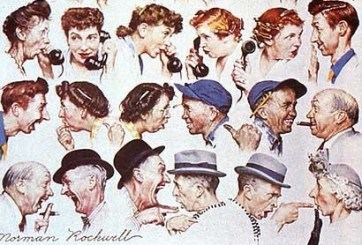
Remarkably, Norman Rockwell accurately predicted how news would be reported in 2013!
Last week, the Huffington Post breathlessly reported that McDonald’s could double its workers wages, thus giving them a “living wage,” by raising the price of a Big Mac by a mere 68 cents. This obviously had appeal to the HuffPo’s liberal sensibilities, more proof of how a big corporation was needlessly lining its pockets while exploiting the lowest rungs of the workforce. The “proof” was in a study that had been represented as a being run by a “University of Kansas researcher.” The study results looked so good that the fine progressives at the site just knew it had to be right—after all, it perfectly confirmed their own beliefs. This, I’m sure you have guessed by now, is confirmation bias in its purest form.
The Huffington post writer and editors didn’t check the source, and didn’t check the study. And as some non-biased, at least in the same direction, reviewers quickly found out when they did, neither held up. The “researcher” was an undergraduate (Arnobio Morelix, whose wonderful name alone would have made me want to check him out) , and the “study” might have been a term paper. The paper’s assumptions, conclusions and math didn’t hold up, as is fairly common for undergraduate papers. The Huffington Post had to retract its story, five days later.
Alas, too late! Continue reading →
 Ethics Alarms