The Legal Profession’s Failure Of Professionalism Regarding Gay Marriage

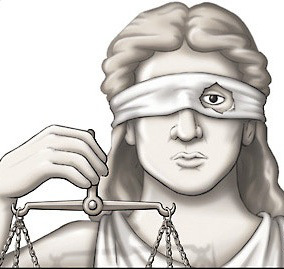
blind_justice

Charles Green helpfully sent me the link to today’s New York Times piece documenting how…

“the imbalance in legal firepower in the same-sex marriage cases resulted from a conviction among many lawyers that opposition to such unions is bigotry akin to racism. But there were economic calculations, too. Law firms that defend traditional marriage may lose clients and find themselves at a disadvantage in hiring new lawyers.”

“Am I right that something’s quite amiss here?” he asks. Indeed he is, and I’ve touched on it before.

There are several factors at work here, but the result is deplorable, and indictment of the corrupt values of the legal profession. One of the factors is bias, and it is a bias that the lawyers themselves are either unaware of,  or are unwilling to avoid its effects as their professional codes of ethics require.

The majority of high-powered lawyers hail from urban centers where liberal culture flourishes among the wealthy, the powerful and the influential. These are cosmopolitan lawyers, sophisticated and urbane, who have gay colleagues, gay friends and gay children. They are less likely to be religious, and more likely to have contempt for those who are. Combine with them the legal academics who drive consensus on legal ethics matters—like most academics, they have marinated in the extreme leftist attitudes of U.S. academia—and it becomes clear why, as Michael W. McConnell, a former federal appeals court judge who teaches law at Stanford, tells the Times, “The level of sheer desire to crush dissent is pretty unprecedented.”

I noticed this in 2011, when the legal ethicists I follow, know and debate with decreed virtually en masse that a judge who was not only gay himself but in a long term domestic relationship with his partner had no ethical obligation to recuse himself before he issued the decision on the constitutionality of California’s anti-same sex marriage Proposition 8. Nor did they feel he was ethically obligated to disclose his situation before ruling. I wrote: Continue reading

The Third Annual Ethics Alarms Awards: The Worst of Ethics 2011 (Part 1)

Yes, it was Joe Paterno's year, all right.

Welcome to the Third  Annual Ethics Alarms Awards, recognizing the Best and Worst of ethics in 2011!

This is the first installment of the Worst; Part 2 is here. And the Best is here. 

2011 prompted more than 1000 posts, and even then I barely scratched the surface of all the ethical dilemmas and unethical conduct swirling around us. If you have other choices for the various distinctions here and in the subsequent Awards posts, please make them known.

Here are my selections:

Unethical Community of the Year:  Huachuca City, Arizona. Leading the way among American communities that believe, in their hysteria, that former sex offenders who have served their sentences are nonetheless fair game for persecution and the denial of basic rights as citizens and human beings, Huachuca County passed an ordinance that bans registered sex offenders from the use of all public facilities, including parks, school and libraries.  Runner-up: Obion County, Tennessee. Last year, Ethics Alarms gave the county runner-up status as “Unethical Community of the Year” for sending its volunteer fire department to watch a man’s house burn down because he had failed to pay a $75.00 fee. In 2011, it did it again. I swear: if Obion County hasn’t come up with a better system and this happens again in 2012, Obion County will get the title no matter what some other unethical community does.

Most Warped Ethical Values: The Penn State students who protested the firing of football coach Joe Paterno, because, you know, he was such a great football coach that a little thing like allowing a predatory child molester to run amuck on campus shouldn’t be blown all out of proportion. Runner-up: Ron Paul supporters.

Unethical Website of the Year: Lovely-Faces, the anti-Facebook stunt pulled by Paolo Cirio, a media artist, and Alessandro Ludovico, media critic and editor-in- chief of Neural magazine, to show how inadequate Facebook’s privacy controls were. To do it, they stole 250,000 Facebook member profiles and organized them into a new dating site—without the members’ permission. The site embodied “the worst of ethical thinking: taking the identities of others for their own purposes (a Golden Rule breach), using other human beings to advance their own agenda (a Kantian no-no) and asserting that their ends justify abusing 250,000 Facebook users, which is irresponsible utilitarianism.” Continue reading

Comment of the Day: “The Ethicists, Backing Judge Walker and Gay Marriage, At An Unacceptable Price”

The motion to vacate Judge Walker’s ruling on Proposition 8 has been filed, you can read it here. Since the original post, I have detected some cracks in the formerly near-united front of legal ethicists and journalists deriding Walker’s critics. Some of them are finally, grudgingly, admitting that the Judge might not have handled his potential conflict so well after all, and that the motion is not a frivolous, anti-gay outrage as they originally labelled it.  The most rickety of the rationalizations put forth on Walker’s behalf, advanced by some his most respected defenders, is that he had no obligation to reveal his own sexual orientation by disclosing his domestic arrangement because of its intimate and private nature. Yet the judge voluntarily disclosed it after his decision was in the books, raising a rebuttable presumption that his original silence was to avoid suggestions of conflict, not out of a desire for privacy.

First time commenter Jada adds her Comment of the Day to the discussion: Continue reading

The Ethicists, Backing Judge Walker and Gay Marriage, At An Unacceptable Price

"Oh, all right...as long as we like the decision."

Thanks to the Judge Walker controversy, now have proof that the best legal ethicists in the nation are human. I suppose that’s something.

My colleagues in the legal ethics field are arguing—decreeing, really— that Judge Vaughn Walker’s decade-long same-sex relationship didn’t need to be disclosed before he ruled against Proposition 8 (California’s voter-approved gay marriage ban) because, they say, it created no reasonable doubts about his impartiality. Coincidentally, they also really, really like his decision. But then, so do I. Continue reading

Judge Walker Was Wrong

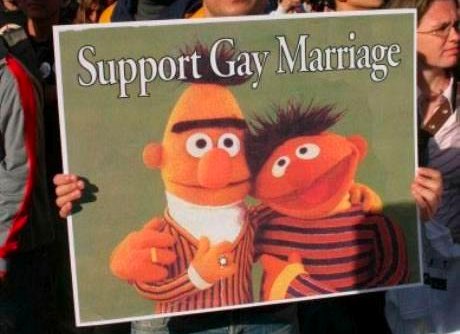
Now that we know about Bert, should Judge Ernie have recused himself?

Judge Vaughn Walker, the Federal District judge who a year ago ruled California’s Proposition 8, which banned same-sex marriages, unconstitutional, was wrong. No, not about the law, which is pretty clearly unconstitutional: his opinion was fair and well-reasoned, and is likely to be upheld on appeal. Walker was ethically wrong in his handling of the delicate issue of his own sexuality, which had raised a controversy about his objectivity and ability to be impartial.

Two weeks ago, following his retirement from the bench, Walker publicly disclosed for the first time that he has been in a same-sex relationship for the past ten years. This changes the analysis regarding the propriety of his ruling on Perry v. Schwarzenegger. Walker had long been rumored to be gay; supposedly “everybody” knew he was gay. My position, as well as that of many others considering the arguments of anti-gay marriage opponents that he should recuse himself, was that sexual orientation could not and should not create a presumption of bias, any more than gender, age, race or marital status. Continue reading

Perry v. Schwarzenegger: Choosing Ethics Over Morality

Predictably, Judge Walker’s decision in Perry v. Schwarzenegger striking down California’s voter approved Proposition 8 has infuriated foes of gay marriage, who have condemned his opinion as judicial activism, a rejection of democratic process, and an agenda-driven farce. Walker himself is being attacked for having a conflict of interest, because he is widely believed to be gay himself. (The belief that a gay judge cannot rule objectively on the issue of gay marriage while a straight judge can is itself an expression of bias.) This is not surprising. What is surprising, at least to me, is that the only substantial argument critics of the opinion can articulate is based on the exact proposition Walker rejected in his opinion: that laws should be able to prohibit conduct based on morality and tradition alone, without quantifiable and verifiable reasons relating to the best interests of society. By insisting that a California law that would withhold a fundamental right—marriage—from a class of Americans must justify itself with reason rather than tradition, Judge Walker ruled that it is ethics, not morality, that should govern American law and justice. Continue reading

Ethics Quote of the Month: Judge Vaughn Walker

His opinion declaring the voter-approved ban on same-sex marriages in California unconstitutional is here.

The opinion really begins on page 110. Opponents of the opinion are calling it “judicial activism,” “overturning the will of the people,” and “ruling by fiat.” Don’t buy it. The judge logically, fairly and appropriately explains why withholding the basic right of marriage from same-sex couples is a violation of essential values and American principles of ethics and law. Forget about the pundits and the spin: read what Judge Walker wrote.

Outing the Judge

“Judge Being Gay a Nonissue During Prop. 8 Trialsays the San Francisco Chronicle headline…outing the judge in the Proposition 8 trial as gay.

If it the judge’s sexual orientation is a non-issue, why does the paper believe it is ethical to reveal it? Continue reading