Morning Ethics Warm-Up, 4/24/18: Presidents, PETA, Privilege, Penn State And Pedophiles

Good Morning.

It just feels like a gliddy glup gloopy nibby nabby noopy kind of day…

1. Musings on the illness of George H.W. Bush. Perhaps I am over-sensitive, but I found the long segments and speculation on cable news this morning about George H.W. Bush suffering from “broken heart syndrome” sensational, intrusive, and wrong. The man is 93, and he’s suffering from a blood infection. As my Dad said often after his 80th birthday, and eventually proved, when one is 80 or more. you can drop dead at any moment, for any reason. Yes, we all know of long-time married couples of advanced years who perish in close proximity. However, the “broken heart syndrome” is anecdotal, without clinical proof, and, essentially, fake news with a romantic tinge.

[Pointer: valkygirrl]

If vile people like Professor Jarrar will attack Barbara Bush when she dies, imagine what George H.W. Bush has in store. The elder Bush is near the bottom of my Presidential ranking, in the general vicinity of his son, Jimmy Carter and Barack Obama but The Ethics Alarms position is that every single President of the United States is owed respect and a debt of gratitude for accepting the overwhelming challenges of the job, and doing, in every case, what he felt was in the best interests of the nation. Before Harry Truman, even taking away the assassinations from the mix, the Presidency was regarded, accurately, as a killing job, with more Presidents than not dying soon after leaving office. That’s not true any  more, but the job is still a terrible physical, emotional and mental burden. The first words out of any American’s mouth when a former President is ailing should be “You have the best wishes of the nation,” and the first words when any former President dies should be “Thank you.”

2.    And this has to do with “collusion” how?  The raid on President Trump’s fixer Michael Cohen revealed that Fox News host Sean Hannity owns millions of dollars worth of real estate across several states, with  links to several shell companies that bought $90 million on 877 residential properties. This is all confidential information, and should never have been jeopardized by the Special Counsel’s effort, coordinated with New York State prosecutors, to gather as much dirt on President Trump as possible—all the better to impeach him with. That this information was leaked to the press indicts the investigation, the process, the judge who allowed the  fruits of the raid unrelated to Trump to be obtained, and the lawyers involved. Of course, the fact that Cohen had these records also rebuts Hannity’s claim, obviously disingenuous from the start, that he wasn’t Cohen’s client, but never mind: Hannity should not have been placed in the position where there was anything to deny.

[Pointer: philk57] Continue reading

Morning Ethics Warm-Up, 4/4/2018: Baseball Lies, A Presidential High Crime, And A Judge Makes A Panty Raid


Wake Up!

1 Fake history, baseball style. Broadcasts of Red Sox games from Fenway Park in Boston refer to “the Pesky Pole,” the official name of the tall, yellow foul pole in right field. It is named in honer of the late Johnny Pesky, who also is honored in a statue outside the park—it featured him and his team mates and longtime friends, Ted Williams, Dom DiMaggio, and Bobby Doerr. Pesky, with a couple of brief interruptions,was a Red Sox lifer, beginning with his 1942 rookie season, and ending with his death several years ago as an honorary coach. In between, he was Sox minor league manager, the big team’s manager, a hitting coach and a broadcaster.

The Pesky Pole got its name because the notoriously power-free shortstop reputedly hit several of the few he managed to slug in his career by knocking a pitch  around the marker, which arose from  what is now the shortest foul line in baseball. The  low Fenway right field fence veers sharply out from there to over 400 feet, so such homers are considered, and indeed are, lucky flukes. During his brief and undistinguished tenure as a Red Sox radio color man, former Red Sox pitching ace Mel Parnell repeatedly told the story about how Johnny won a game for Mel in 1948 with a pole-shot. This tale led directly to the team officially naming the pole on September 27, 2006, on Pesky’s 87th birthday, with a commemorative plaque placed at its base and everything.

Afterwards, and not before, someone actually checked the game records. Pesky never hit the home run  described by Parnell. He only hit six home runs in Fenway at all, and nobody knows how many hit the pole, looped around the pole, or even went to right field. (Pop-ups hit by Punch-and-Judy hitting shortstops sometimes landed in the screen over the left field wall for home runs, as the cursed Bucky Dent can attest.) Nevertheless, the fake history is in place: the Pesky Pole is named that because Johnny Pesky hit a famous home run off of it, or was famous for looping cheap homers around it, or something.

Baseball excels at creating fake history, the most notable being represented by the locale of its Hall of Fame, in Cooperstown, New York. When the museum was envisioned, the accepted story about the game’s origin was the Union general Abner Doubleday invented the sport in 1839 and organized the first game in Cooperstown. After the construction was underway,  research suggested that everything about the Doubleday tale was rumor and myth, but baseball and the museum’s management, in one of the all-time classic examples of adopting the philosophy of the newspaper editor in “The Man Who Shot Liberty Valence,” went to great lengths to keep the original story before the public. Eventually some hard evidence surfaced suggesting that the game was invented by Alexander Cartwright, who was eventually inducted into the Hall as the game’s creator, while Doubleday is not. Nonetheless, the myth survives. Major League Baseball Commissioner Bud Selig, for example,  said in 2010 that “I really believe that Abner Doubleday is the ‘Father of Baseball.'” This is the equivalent of saying that one believes in the Easter Bunny.

Selig was later inducted into the Hall of Fame.

2.Believe it or Not! I would support impeaching  President Trump for his tweeting attacks against Amazon. This is such an abuse of Presidential power that it demands at least a Congressional reprimand or sanction. Amazon lost $53 billion in market value in the wake of the tweets, meaning that investors, retirees, and ordinary Americans lost wealth as well. It is unconscionable for a President of the United States to deliberately target a company, just as it is wrong for a President to punch down at a private citizen, but the consequences of doing what Trump has done to Amazon is far, far worse. The Wall Street Journal suggested in an editorial that if the attack on Amazon was politically motivated because Amazon mogul Jeff Bezos owns the Washington Post, impeachment would be justified. Yes, that would be even worse, but it is not an essential element of this “high crime.” The President of the United States must not abuse his power by intentionally harming lawful businesses.

The foolish resistance is so focused on trying to impeach Trump based on exotic laws and imaginary conspiracies that it doesn’t see the real thing when it’s right in front of its face, and the anti-Trump media has so destroyed its credibility by embracing ridiculous impeachment theories that a valid one will just look like more of the same. Continue reading

Morning Ethics Warm-Up, 3/31/2018: The Baseball-Trained Rifleman, The Hockey Hero Accountant, And Some Other Stuff That’s Just Annoying…

Good morning!

1. “The Rifleman” and “Fix the problem.” I recently was interviewed by a graduate student in organizational leadership and ethics. One thing we discussed was how popular culture in America once dedicated itself to teaching ethical values and ethics problem-solving, especially in shows aimed at young audiences. This is not so true any more; indeed, popular culture models unethical conduct at least as often today.

I told my interviewer about recently watching an episode of “The Rifleman,” the early ’60s TV Western about a single father raising his young son while being called upon to use his skill with a rifle to fight for civilization in the harsh frontier.  In the episode, hero Lucas McCain (played by the under-rated Chuck Connors) had to deal with an old friend, now an infamous outlaw, who had come to town. (The ethical conflict between personal loyalty and an individual’s  duty to society was a frequent theme in Westerns.) Lucas was a part-time deputy, and at the climax of the episode, his friend-gone-bad is prepared to ride out of town to escape arrest for his latest crime. Lucas tells him not to leave, and that if he tries to escape, Lucas will have to let his custom-made rifle settle the matter, as usual. (Peace-loving Lucas somehow managed to kill over a hundred men during the run of the series.)  Smirking, his friend (Richard Anderson, later known as the genius behind “The Six Million Dollar Man”), says that he knows his old friend is bluffing. For Lucas owes him a lifetime debt: he once saved “The Rifleman’s” life.  You’re a good man and a fair man, the villain says. “You won’t shoot me. I know you.” Then he mounts his horse , and with a smiling glance back at “The Rifleman,” who is seemingly paralyzed by the ethical conflict, starts to depart. Now his back is all Lucas has to shoot at, doubling the dilemma.  You never shoot a man in the back, an ethical principle that the two officers who killed Stephon Clark somehow missed. We see McCain look at his deadly rifle, then again at the receding horseman. Then, suddenly, he hurls his rifle, knocking his friend off his horse. The stunned man is arrested by the sheriff, and says, lamely, as he’s led away. “I knew you wouldn’t shoot me.”

I love this episode. It teaches that we have to seek the best solution available when we face ethics conflicts, and that this often requires rejecting the binary option presented to us, and finding a way to fix the problem.

Of course, it helped that Chuck Connors used to play for the Dodgers, and could hurl that rifle with the accuracy of Sandy Koufax.

2. Here we go again! Now that anti-gun hysteria is again “in,” thanks to the cynical use of some Parkland students to carry the anti-Second Amendment message without having to accept the accountability adults do when they make ignorant, dishonest, and illogical arguments in public, teachers and school administrators are back to chilling free speech and expression by abusing their students with absurd “no-tolerance” enforcement. At North Carolina’s Roseboro-Salemburg Middle School, for example, a 13-year-old boy in the seventh grade was suspended for two days for drawing  a stick figure holding a gun.

I drew pictures like this—well, I was little better at it—well into my teens. It’s a picture. It isn’t a threat. It isn’t anything sinister, except to hysterics and fanatics without a sense of perspective or proportion—you know, the kind of people who shouldn’t be trusted to mold young minds. “Due to everything happening in the nation, we’re just being extra vigilant about all issues of safety,” said Sampson County Schools’ Superintendent Eric Bracy, an idiot. How does punishing a boy for a drawing make anyone safer? It makes all of us less safe, by pushing  us one step closer to government censorship of speech and thought.

Then we have Zach Cassidento, a high school senior at Amity High Regional School in Connecticut who was suspended and arrestedarrested!—for posting a picture of his birthday gift, an Airsoft gun, on Snapchat. He was not charged, but was suspended for a day from school….for posting, outside of school, on his personal account, the picture of an entirely legal toy gun (It shoots plastic pellets: my son has several of them).

The people who do this kind of thing to children in violation of their rights as Americans are the same people who cheer on David Hogg while signing factually and legally ridiculous petitions. They should not be permitted to teach, and this kind of conduct ought to be punished.

Where is the ACLU? For the organization not to attack these abuses is an abdication of the organization’s mission. Continue reading

Ethics Quiz: Bill Cosby’s Bias Argument

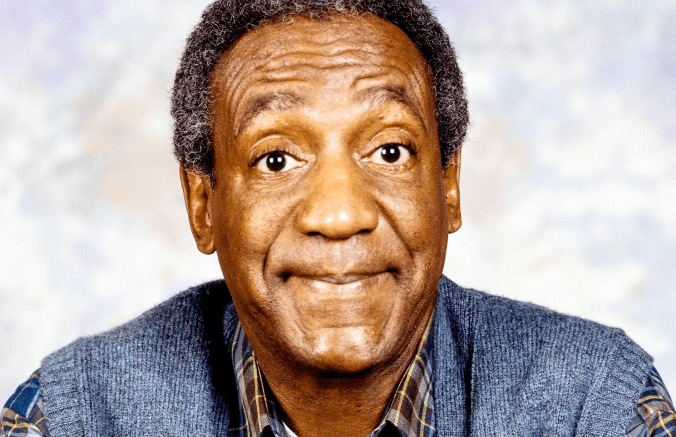
As Bill Cosby’s latest trial gets underway, “the Cos” and his lawyers contend that the presiding judge should recuse himself because the judge’s wife is an advocate for sexual assault victims. Judge Steven O’Neill’s wife, Deborah O’Neill, is a social worker on a University of Pennsylvania special staff that advocates for students who are alleged victims of sexual assault. According to the motion for the judge to recuse, she has donated money to a victims advocacy group that plans an anti-Cosby rally outside the courthouse during Cosby’s trial.


Your Ethics Alarms Ethics Quiz of the Day:

Should the political activities, public statements or occupation of a spouse be considered a sufficient conflict of interest to mandate judge’s recusal?

Continue reading

Windy Morning Ethics Warm-Up, 3/2/18: More Supreme Court Fun, Transparency Games, Ethical and Unethical Quotes Of The Day…

GOOD MORNING!

(Wind storms all over Virginia, knocking out power and my e-mail, and blowing over a tree that narrowly missed my son’s car!)

1 Lack of Transparency? What lack of transparency? During a lecture and moderated discussion at U.C.L.A. this week in which he was a a participant and invited guest, Treasury Secretary Steven Mnuchin was heckled with hisses, jeers, shouted insults and profanity from students and protesters, some of whom were ushered and even carried out by police officers. A programmed sixth grader in the audience even questioned him about the fairness of passing permanent tax cuts for companies and expiring cuts for individuals, because as we all know, 10-year-olds are well-versed in tax policy theory.

Afterwards, Mnuchin  revoked his consent for the official video of the event to be released, perhaps because he was flustered by the harassment and it showed. In response to criticism of this virtual censorship,

The Treasury Department, through a spokesperson, said that what the Secretary did wasn’t what he obviously did—a Jumbo, aka “Elephant? What elephant?”—saying,

“The event was open to the media and a transcript was published. He believes healthy debate is critical to ensuring the right policies that do the most good are advanced.”

He just doesn’t want anyone to see or hear the debate.

A related point: The protests were organized by Lara Stemple, a U.C.L.A. law professor, and students and faculty members participated. Protests are fine; disrupting the event is not. Faculty members who assisted in the heckling should be disciplined, and students who participated should be disciplines as well.  It’s an educational institution, and all views sgould be openly explored and heard without interference. No guest of the university should be treated this way. Ever. No matter who it is or what their position. The treatment on Mnuchin was unethical.

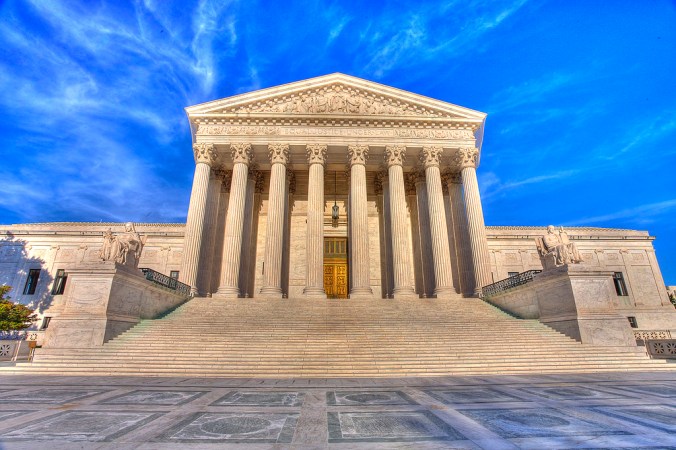
2. More Supreme Court fun with ethics! Minnesota’s law banning “political” clothing and buttons from polling places is being challenged as an affront to free speech. The law prohibits people from wearing a “political badge, political button or other political insignia” at a polling place on an election day, and a member of the tea party movement sued after his “Tea Party” message got him in trouble when he came to vote.

Here is Justice Samuel A. Alito’s exchange with Daniel Rogan of the Hennepin County Attorney’s Office, who was defending Minnesota’s law:

“How about a shirt with a rainbow flag?” asked Alito. “Would that be permitted?”

“A shirt with a rainbow flag?” Rogan repeated. “No, it would — yes, it would be — it would be permitted unless there was — unless there was an issue on the ballot that — that related somehow to — to gay rights.”

Justice Alito: Okay. How about an NRA shirt?

Mr. Rogan: An NRA shirt? Today, in Minnesota, no, it would not, Your Honor. I think that that’s a clear indication—and I think what you’re getting at, Your Honor—

A T-shirt bearing the words of the Second Amendment? Alito asked.

Probably banned because of the gun-control issue, Rogan said.

The First Amendment? Alito asked. Probably not, Rogan answered.

Got it. The First  Amendment isn’t a political statement, but the Second Amendment is. That led Justice Neil M. Gorsuch to observe: “Under your interpretation of ‘political,’ it would forbid people from wearing certain portions of the Bill of Rights into a polling place but not other portions of the Bill of Rights. And I guess I’m just wondering what compelling interest Minnesota has identified that requires a statute that goes so much further than the vast majority of states?”

In contrast, Justice Anthony M. Kennedy asked J. David Breemer, a lawyer for the Pacific Legal Foundation, representing the challengers, “Why should there be speech inside the election booth at all, or inside the what you call the election room? You’re there to vote.”

This is a problem requiring an “all or nothing” solution. Either all forms of political speech must be allowed, or no speech at all. In a sick time where citizens honestly argue that a MAGA cap or a picture of a gun makes them feel threatened and “unsafe,” the ethical option would seem to be Justice Kennedy’s. No speech, messages, no logos, no photos, no American flags. Last fall I voted wearing my Red Sox jacket.

Uh-uh. Continue reading

Morning Ethics Warm-Up, 2/13/18: You Can’t Get Much More Ethics Issues Variety Than This!

Good Morning!

[Mickey is really playing that piano. Boy he was amazing…]

1 A Russian Jumbo!  And it worked! In Russia, Irina Kudinova was charged with mocking the Church after she  posted a photograph that prosecutors alleged was obscene and thus constituted the “deliberate desecration of a religious object” and “insulting the feelings of believers.”   Gee, I can’t imagine why anyone would think THAT..Here’s the photo:

The judge ruled that it was merely a photo of an Easter cake and nothing more. Elephant? What elephant? Or maybe “What elephant phallus?” would be more accurate. Kudinova was awarded 20,000 rubles in a court action for false accusations.

Few cases better illustrate the principle that in Bizarro World attempts at ethical acts become unethical. The problem is that Russia has laws that discourage free speech. In order to undermine an unethical law, the judge in this case made a ruling that is obviously contrary to reality, and what anyone can see with their own eyes. If judges can ignore evidence and deny reality to protect citizens from an unjust law, then they can do the same to unjustly punish citizens who break no laws at all.

I’m happy for Kudinova, but the Russian judge is a well-intentioned ethics dunce. His solution does as much damage as good.

2. “Thanks, Mom and Dad…and bite me.” The parents of GOP Senate candidate Kevin Nicholson each gave $2,700, the maximum allowed, to the primary campaign of the Democrat their son is challenging, Senator Tammy Baldwin. Continue reading

Rewarding Violence And Vigilante Justice: The Unethical Glorification of Randall Margraves

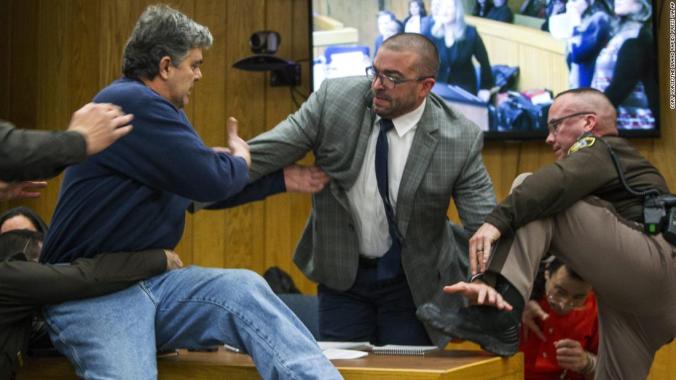
That’s Margraves on the left, with Nassar, his target, cowering in red…

During the sentencing hearing for sexual predator Larry Nasser in an Eaton County, Michigan courtroom, Randall Margraves, the father of three daughters who were all molested by the former USA Women’s Gymnastics doctor, shouted “You son of a bitch!” and rushed Nassar.  He was tackled and placed in handcuffs. Before the attack, Margraves asked Judge Janice Cunningham to grant him “five minutes in a locked room with this demon. Yes or no.”  Perhaps he thought she was Ingham County Court Judge Rosemarie Aquilina, who might have granted his request based on her words at his previous sentencing hearing. Cunningham, however, refused the request.

After the father’s attempt to take the law into his own hands, Michigan Assistant Attorney General Angela Povilaitis told the stunned courtroom, “We cannot behave like this. This is letting him have his power over us….You cannot do this. I understand Mr. Margraves’ frustration, but you cannot do this. Use your words, use your experiences. Do not use physical violence.” Judge Cunningham added,

“We cannot react by using physical violence and assault against someone who has performed criminal acts. What Mr. Nassar did is horrible. It’s unthinkable, but please let the criminal justice system do what it is supposed to do and issue the punishment he should get.”

Nonetheless, no charges were filed against Margraves. Wrong.  This is irresponsible and hypocritical, as well as cowardly. (We know any punishment will be unpopular with the “Think of the children!” and the “What if it was your daughters?” crowds as well as the “Punch Nazis in the face”  constituency) If the message really is that a society can’t give in to vigilante justice and let citizens employ physical violence as extra-legal means to exact vengeance against criminals, then those who behave this way must be punished.  If they are not, then the opposite message is sent: “Well, when someone is really bad, and hurts someone you really care about, we sympathize. We understand how you feel.” What if Margraves had reached Nassar and delivered a punch to his face, fracturing his jaw? Or ripped his lips off? That he didn’t was just moral luck. Would the father have been charged then, as millions around the nation shut down their ethics alarms and cheered?

For the justice system to remains coherent and maintain integrity, the father had to be charged. Continue reading

The Unethical Sentencing Of Dr. Lawrence Nassar

Non-lawyers and journalists mostly cheered Ingham County Court Judge Rosemarie Aquilina’s grandstanding, self-indulgent, unprofessional and unethical handling of Dr. Larry Nassars’s sentencing yesterday. Nobody bothered to seek the opinion of criminal lawyers and judges, much less ethicists. If they had, they would have heard a loud, collective, “Ugh.”

It was a disgrace. I object to victim impact statements in sentencing, a terrible idea pushed by victim’s rights advocates, because it misrepresents the purpose of the justice system. The objective is to punish citizens for violating laws, not to get revenge for victims or their families, not to get “closure,” and not to satisfy emotional needs. The process isn’t personal, or shouldn’t be. If it is personal, then it isn’t objective. Judge Aquila threw all of that out the window as she played to the cameras and the mob.

Criminal defense lawyer and blogger Scott Greenfield aptly explained what was unethical about the parade of victims:

Nassar’s sentencing hearing is a clear example of a judge straying from promoting the public’s trust in a fair and impartial judiciary. Let’s begin with Judge Aquilina’s decision allowing over one hundred and sixty victim impact statements across seven days. 

Victim impact statements are theoretically allowed as a means of giving a crime victim the chance to describe their experience to the court. Defense lawyers aren’t typically fans of them, and too many can arguably have a prejudicial effect against a defendant.

Contrast Nasssar’s hearing with that of Dylann Roof, the Charleston shooter responsible for the deaths of nine churchgoers. Judge Richard Gergel admonished the State’s list of thirty-eight statements, cautioning against a “spectacle”. David Bruck, the attorney assigned to advise Roof, claimed the proceeding violated “every principle restraining victim impact statements under the 8th Amendment.”

Strangely, no advocate stood to question admitting impact statements from over 160 victims, including gold medal Olympians, might prejudice a jurist’s decision. It’s hard to imagine Judge Aquilina even entertaining such an argument.

It is also hard to imagine Nassar’s sleepwalking defense attorney making such an objection. She was praised by the judge for taking on an unpopular client, but taking him on isn’t enough. She was supposed to protect his rights.

Then the judge delivered her sentence, turning her moment in the national spotlight into a self-aggrandizing, virtue-signalling, vainglorious soliloquy to the gallery. This was one more example of why televised court proceedings are a bad idea.

I’m going to give you the whole transcript of her remarks, bolding the sections before my comments. Cut to the bolded sections if you don’t care to experience the full measure of Judge Aquilina’s narcissism. One section,, however, was left out of all the published versions that I could find:

“Our Constitution does not allow for cruel and unusual punishment. If it did, I have to say, I might allow what he did to all of these beautiful souls—these young women in their childhood—I would allow someone or many people to do to him what he did to others.”

The judge apparently had this excised from the official transcript. No wonder. She is advocating prison rape and by doing so, endorsing it. Michigan’s judicial ethics standards require in part,

“A judge should respect and observe the law. At all times, the conduct and manner of a judge should promote public confidence in the integrity and impartiality of the judiciary. Without regard to a person’s race, gender, or other protected personal characteristic, a judge should treat every person fairly, with courtesy and respect.”

Needless to say—I hope—‘I wish I could have you gang raped’ does not meet this standard. It is also troubling that a judge would distort the record. She said what she said, and the public should know she is the kind of jurist would say something like that—an unethical one. The state’s judicial panel should also know.

Here is the rest: Continue reading

The Unprepared Judicial Nominee [Updated]


Matthew S.] Petersen, a lawyer serving on the Federal Election Commission, was one of five President Trump judicial nominees to be questioned by the Senate Judiciary Committee last week. Senator John N. Kennedy, a Republican from Louisiana, subjected Petersen to questions regarding basic litigation law, such as the Daubert standard, which has to do with qualifying expert witness testimony, the definition of a motion in limine, and several other bits of information a junior litigator would have to have in his memory banks. The potential judge told the Senator that he had never tried a case or argued a motion in court. He said he last read the Federal Rules of evidence in law school. “I understand that the path that many successful district court judges have taken has been a different one than I’ve taken,” Petersen said.

Naturally, being a Trump nominee, Petersen is being widely mocked in the news media and by Democrats. Some legal experts have been more sympathetic, like Judge Wayne R. Andersen, who was a federal judge in the Northern District of Illinois for nearly 20 years. He told reporters  that there was a continuing debate within the legal profession about the qualifications required of a trial judge, saying, “Anyone who steps to the federal bench lacks a huge amount of federal experience necessary to do the job,” and that Senator Kennedy’s questions, while fair, “would eliminate 80 percent of the nation’s lawyers and many of the most talented lawyers.”

Lawyer/Blogger John Hinderaker wrote in part,

The lawyers who have the most thorough understanding of substantive areas of the law–real estate, taxes, corporate governance and so on–are generally not litigators. Do we really want to say that all of these non-litigators–the majority of lawyers–are unfit to be trial judges?…does it mean that one of my non-litigator partners would be disqualified from such an appointment, no matter how good a lawyer he or she might be? I don’t think so.

… Newly-appointed judges attend “judge school,” where they are taught the finer points of the rules of evidence….Most lawyers who are appointed to the bench in both federal and state courts have backgrounds in litigation. No doubt that is appropriate. However, it is by no means rare for non-litigator lawyers to be appointed, or win election, to the bench. In my opinion, that is a good thing. I don’t see why a minority of lawyers–litigators–should have a monopoly on the bench. I don’t know whether Matthew Petersen will make a good judge or not. But in my view, he doesn’t deserve to be ridiculed because his highly-successful law career has been conducted outside of the courtroom.

I agree; he shouldn’t be ridiculed for that. Continue reading

The Bad Judges And The Law Dog

The legal commentariat is much amused by a case out of Louisiana involving  the right to counsel. I don’t think it’s funny at all.

( Oh all right, it’s a little funny.)

Warren Demesme was being interviewed by detectives, not for the first time, about some alleged sexual misconduct with minors. He was read his rights, “Mirandized,” as they say, and said that he understood, and waived those rights. (He could, however, choose to invoke them at any time, per several Supreme Court rulings.)

At some point the interview got tense, and the suspect said,

“If y’all, this is how I feel, if y’all think I did it, I know that I didn’t do it so why don’t you just give me a lawyer dog cause this is not what’s up.”

He was not, however, given access to a lawyer, and when he appealed his subsequent conviction on the grounds that he requested legal assistance and was not accommodated, the lower court rejected his argument, saying that he had not made his desire for a lawyer clear and unambiguous. Incredibly, the Louisiana Supreme Court agreed, writing in part,

The defendant argues he invoked his right to counsel. And the basis for this comes from the second interview, where I believe the defendant ambiguously referenced a lawyer..As this Court has written, “[i]f a suspect makes a reference to an attorney that is ambiguous or equivocal in that a reasonable police officer in light of the circumstances would have understood only that the suspect might be invoking his right to counsel, the cessation of questioning is not required.” State v. Payne (La. 2002); see also Davis v. United States (1994) (agreeing with the lower courts’ conclusion that the statement “[m]aybe I should talk to a lawyer” is not an unambiguous request for a lawyer). In my view, the defendant’s ambiguous and equivocal reference to a “lawyer dog” does not constitute an invocation of counsel that warrants termination of the interview and does not violate Edwards v. Arizona (1981).

Right.

And the vote on the Supreme Court in favor of this indefensible ruling was 8 to 1. 8 to 1!

Forget it, Jack. It’s Louisianatown. Continue reading