Ethics Dunces: At Least Two Dozen Federal Judges Who Don’t Get That “Appearance of Impropriety” Thingy

I don’t have to exert myself much for this one…

Paul Caron reveals on his excellent Tax Prof Blog that a new report released today by Fix the Court documents how two dozen federal judges who teach at law schools went ahead and ruled in cases involving their law schools’ parent universities. Conflict? What conflict?

Multiple circuits (p. 12 in the report) and Judicial Conference policy (p. 11) have held that just because a judge teaches in one part of a university doesn’t mean that he or she will be biased in adjudicating a case in which that university is a party. Funny—most people, including most lawyers, would call this a slam dunk “appearance of impropriety” situation…because it is.

“This has conflict written all over it,” Fix the Court’s Gabe Roth said. “If you teach at a law school, and especially if the law school is paying you, you shouldn’t be sitting on cases involving the university that the law school is a part of. Even if a judge-adjunct professes, as several have, that the law school at which they teach is but ‘one small and virtually autonomous part’ of the university, a neutral observer who sees ‘OSU Law’ on a judge’s disclosure would be correct in imputing bias any time that judge presides over a case involving Ohio State University.”

That seems pretty obvious to me, but then I’m just an ethicist and spend way to much time pondering such matters.

The recent attacks on the U.S. Supreme Court for not having an enforceable code of conduct and ethics neatly distracts from the widespread corruption in the rest of the judiciary, as highlighted by the recent wave of partisan judges working with the Axis of Unethical Conduct to hamstring Trump Administration policies. Judges are more poorly trained in judicial ethics than lawyers are in legal ethics. Elected judges are partisan by design; too many judges are well-past their shelf life, and DEI mania since 2020 has loaded the judiciary with too many robed ones whose primary qualifications for the bench are immutable biological features.

The judiciary is yet another rotting institution that needs serious reform and fast—as if we didn’t have enough to worry about already.

Look! The House’s Dumbest Member Filed a Smart Bill On Judicial Ethics!

Rep. Hank Johnson, the Democratic Congressman who famously expressed the fear that “Guam might tip over” because of all the U.S. military equipment on the island, filed his ‘‘Transparency and Responsibility in Upholding Standards in the Judiciary Act’ (or the ‘‘TRUST Act’’ to its friends). The bill aims to deal with a serious ethics problem in the judiciary, one of many.

Under the Judicial Conduct & Disability Act, the law that supposedly governs judicial discipline, investigations into misconduct are terminated when a judge retires, resigns, or dies. How convenient! The mere departure of a judge from the bench is enough to halt any inquiry into alleged abuses of their office, misconduct, even crimes. This system shields bad judges from accountability

With life tenure and unchecked power, judges have lots of opportunity to engage in outrageous behavior, and many do. Berating and demeaning (or sexually harassing) law clerks, forcing them to watch pornography, firing clerks on a whim, and judged concealing serious cognitive decline are among the offenses that have resulted in zero consequences for judges in recent years: all a judge needs to do to keep his or her pension and reputation is to quit. If they are not senile, they can often nab high-paying jobs with law firms.

Continue reading

Tales of the King’s Pass

During the baseball off-season the MLB channel on DirecTV has a lot of dead time to fill between the periodic announcements of trades, free agent signings and post-season awards and honors. Lately it has been re-running an old Bob Castas show called “Studio 42” (that’s Jackie Robinson’s number) where the perpetually boyish-looking baseball commentator, who now really is Old Bob, interviews retired players and managers about significant games and moments in their careers.

In an episode I happened across this morning after my dog woke me up and then stole the bed as soon as I got out of it, Costas’s guest was the late, great manager Whitey Herzog, like so many successful baseball managers, a mediocre-to-poor player in his Major League career. Whitey told a story that is as good an example of the King’s Pass, #11 on the Rationalization List, as there is.

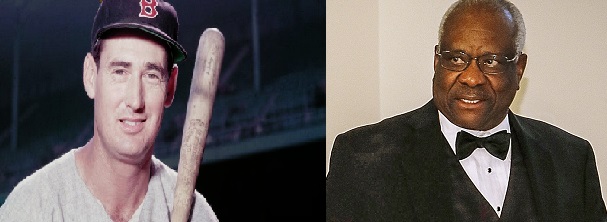
He said that in one game between the old Washington Senators (the first Senators, the team that moved to Minnesota and became the Twins) and the Red Sox in Boston, Ted Williams had drawn a walk on a 3-2 pitch right down the middle of the plate that the umpire had called a ball. Williams was famous for his plate discipline and above-average eyesight, and umpires frequently let him, opposing players complained, call his own balls and strikes because unpires acknowledged that he was better at it than they were. Herzog came to bat late in the same contest having walked four times and with a chance to set a record by getting five bases-on-balls in a single game. He told Costas that the umpire called him out on strikes on a 3-2 pitch in the dirt.

“I turned around and said to the ump, ‘You give Williams five strikes and give me only two. It should be the other way around!'”

This struck me particularly squarely because I had been thinking about the Judicial Conference declining to take any action against Supreme Court Justice Clarence Thomas, who has been the subject of a Senate Judiciary inquiry ever since ProPublica revealed that the Justice had neglected to report around half a million in luxury travel and gifts as legally required by the Ethics in Government Act of 1978.

Continue reading

A Federal Judge Gets Benchslapped For An Unethical Times Column

On May 24, 2024, while Supreme Court Justice Jackson was dreaming of playing “Medea,” The New York Times published an op-ed entitled, “A Federal Judge Wonders: How Could Alito Have Been So Foolish?” by Senior Judge Michael A. Ponsor of the United States District Court for the District of Massachusetts.  Judge Ponsor addressed the flying of an upside-down American flag and the “Appeal to Heaven” flags outside homes owned by Supreme Court Justice Samuel Alito, a controversy covered thoroughly on Ethics Alarms.

The ethics verdict here was that the controversy was contrived, and that the attack on Alito was politically motivated, biased, and wrong. Judge Ponsor, however, opined that “any judge with reasonable ethical instincts would have” recognized that the flag displays were improper because they could be perceived as “a banner of allegiance on partisan issues that are or could be before the court.”

Let me inject here, “Sure, by an idiot!” “The appearance of impropriety is a reason-based standard. “Hey, this SCOTUS judge’s wife flew the same flag that began the HBO John Adams series: that must mean that her husband is in the bag for President Trump!” is not a reasonable perception.

Continue reading

Ethics Dunces: U.S. Judicial Conference Committee on Financial Disclosure

Problem: Judges getting adverse public scrutiny for not reporting potential conflicts of interest and avoiding the appearance of impropriety.

Solution: Lower the standards for conflicts of interest and the appearance of impropriety.

Problem solved!

Yecchh.

Continue reading

Gee, I Wonder Why the Public Is Losing Trust In The Justice System….

I am heading to Richmond to do a three hour legal ethics seminar, and in my preparation, I ran across this depressing story. The seminar is called “Legal Ethics Unmasked,” and man oh man, has watching lawyers, prosecutors and judges reveal the creeps beneath been disillusioning.

The ABA headline was certainly clickbait: “Judge settles suit accusing lawyer of threatening to release her intimate photos in bid to scuttle deposition.”

Continue reading

Ethics Dunce, Redux: Justice Clarence Thomas

In a new filing released today, Justice Clarence Thomas amended his financial disclosure for 2019 to note that he “inadvertently omitted” reporting two extravagant vacations paid for by conservative billionaire Harlan Crow, one to Indonesia and the other to the Bohemian Grove, an all-male retreat in northern California. Just slipped his mind! Hey, it could happen to anybody! Who hasn’t completely forgotten about a luxury trip they have enjoyed on the dime of a politically active tycoon? Heck, I know I just remembered one today, after I read this story. Well, it’s all better now; Thomas just retroactively corrected his lie of omission from five years ago.

Anyone who accepts this is ethically estopped from complaining about the White House editing Joe Biden’s blabberings to make him sound less like he belongs in a hospice.

Pro Publica correctly notes that last year, when these and other examples unusual largess from Crow—like paying for Thomas’s mother’s house—were revealed, Thomas’s “Justice Thomas’s lawyers issued a statement on the Justice’s behalf. saying that the allegations were untrue.

Like all lawyers, Supreme Court Justices are prohibited from lying in the course of their professional conduct. The prohibition on lawyer conduct is serious, but even more serious for judges, and extra-special, supercalifragilisticexpialidocious serious for the highest judges in the land.

Thomas is a disgrace, as I have said before.

But at least he never let his wife fly a 250-year-old historical flag that some idiots used to express their own political opinions…

Remove This Judge!

The Dexter Taylor case raises interesting Second Amendment issues to be sure.

A New York jury found Taylor guilty of second-degree criminal possession of a loaded weapon, four counts of third-degree criminal possession of a weapon, five counts of criminal possession of a firearm, second-degree criminal possession of five or more firearms, unlawful possession of pistol ammunition, violation of certificate of registration, prohibition on unfinished frames or receivers. Now Taylor, a 52-year-old African-American software engineer, is on Rikers Island waiting to be sentenced. He became interested in gunsmithing as a hobby years ago, but a joint ATF/NYPD task force discovered he was legally buying gun parts from various companies and began investigating him, leading to a SWAT raid and his arrest. His legal team explains his side of the case here.

That’s not the focus of this post, however. This is: during his trial, Judge Abena Darkeh allegedly said at one point, “Do not bring the Second Amendment into this courtroom. It doesn’t exist here. So you can’t argue Second Amendment. This is New York.” Darkeh was appointed by New York City’s crypto-communist Mayor Bill de Blasio in 2015.

Continue reading

The Chrystal Clanton Saga: I Don’t Understand This Story At All…

Does this make sense to you?

SCOTUS Justice Clarence Thomas has hired Crystal Clanton to be his law clerk beginning in the upcoming term. In 2015, when Clanton was 20 and working for Turning Point USA, she was accused of sending racist texts to a fellow employee. One alleged text read, “I HATE BLACK PEOPLE…Like fuck them all … I hate blacks. End of story.” The New Yorker’s Jane Mayer wrote about the texts in 2017 in an article about Turning Point USA, which is close with Thomas’s activist wife Ginni. Clanton wrote in an email to Mayer, “I have no recollection of these messages and they do not reflect what I believe or who I am and the same was true when I was a teenager.” The first aspect of the story I don’t understand: I am reading everywhere that Clanton didn’t deny writing the texts, which points to her guilt. I would say that stating that you don’t recall sending a message and that it isn’t something you believe, believed or would ever say is the equivalent of a denial.

Continue reading

Ralph Petty, the Moonlighting Texas ADA, Strikes Again!

Back in 2021, an outrageous legal ethics scandal in Texas so disturbed me that I wrote virtually the same post about it twice, once in May and again in September, without realizing it until one of you reminded me. This time, however, I’m not repeating myself.

Former Texas attorney Weldon Ralph Petty Jr prosecuted defendants before Midland County judges as an assistant district attorney, while simultaneously working as a law clerk for some of the same judges, on occasion advising them regarding the criminal cases he was prosecuting. He did this for more than a decade, with the complicity of the judges and his colleagues. Finally another prosecutor blew the whistle on this unethical conduct, which even Fani Willis would recognize as a conflict of interest. Maybe.

Last month Petty, who was disbarred, appeared in the news again.

Continue reading