
Being Fair To Harry Reid: This Began With A Borking

Blame the first domino, not the last one..

Blame the first domino, not the last one..

I generally revile Senate Majority Leader Harry Reid for his hyper-partisan leadership of the Senate, his unethical statements and his manner of conducting himself.  Still, I am bound to take this rare opportunity to defend Sen. Reid, who is taking the brunt of  criticism from both Democrats and Republicans for weakening the filibuster last week. True: he didn’t have to take this course, and I think it will probably, as the talking head shows Sunday seemed to agree, make the toxic and dysfunctional politics in Washington worse, not better. Reid, however, is not the primary one at fault. He was doing his job as he saw it, dealing with circumstances that are now beyond his control.

What led to the so-called “nuclear option” becoming reality was an unplanned convergence of Machiavellian politics, breaches of professional duty, dishonesty, irresponsible legislating, lack of statesmanship, unfairness, disrespect, bad luck, incompetent leadership, and most of all, a cycle of revenge that is now only likely to continue. Most of this was out of Harry Reid’s hands.

History shows that U.S. Presidents were once virtually always given the benefit of the doubt regarding judicial appointments to the federal courts, except in the rare cases of serious ethical questions or dubious qualifications. It was a good system, and the right system, and both parties followed it, realizing that the ideological mix in the courts was fluid and cyclical, and that today’s new conservative judge would eventually be offset by the appointee of the next liberal President, and vice versa. Democrats destroyed that tradition and accord on judicial appointments when in 1987, the Senate Democrats blocked President Reagan’s nomination of Robert Bork, who had been selected by President Reagan to fill a vacancy on the U.S. Supreme Court. Continue reading

The New York Times Asks: “Should We Be Truth Vigilantes?” Ethics Alarms Answers: “No, Because You Can’t Be Trusted.”

Should Times reporters be like Wonder Woman's lasso of truth?

In an appeal to New York Times readers that is at once alarming, naive, arrogant and ominous, Arthur Brisbane, the Times’ “public editor” (Translation: ombudsman) asks whether the paper’s reporters should be “truth vigilante(s)… should challenge ‘facts’ that are asserted by newsmakers they write about.”

The answer is no, no, no, and for the obvious reasons. Times reporters are biased, and not inclined to challenge dubious statements they agree with or that come from political figures they like, and are inclined to find statements “non-factual” because of their own preferences and biases. Helpfully, the two examples cited by Brisbane are exactly the kinds of statements the Times, and most of the press, are completely incapable of handling fairly. Here’s the first: Continue reading

Obamacare Recusal Wars: Right and Left Are Equally Deluded

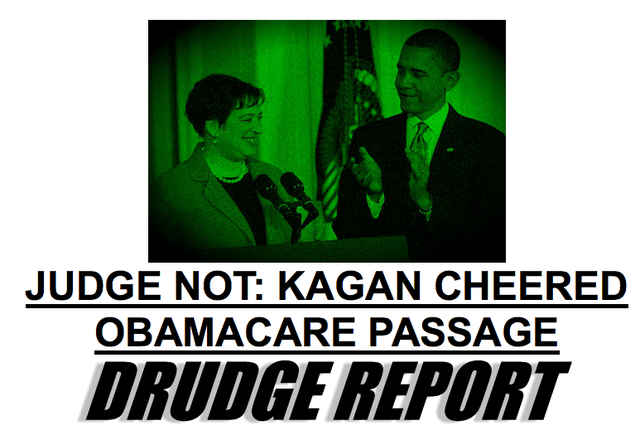
Note to Drudge: Cheering your boss's victories is not unethical. It's not unusual. It is not even meaningful. It's called "smart."

I hadn’t written about the dual efforts to knock Justice Kagan and Justice Thomas off the Supreme Court panel considering the constitutionality of Obamacare’s individual mandate, because it is so obviously politics masquerading as ethics. I also though they would stop soon, since there is no chance either Justice will recuse at this point, and neither should.

The controversy is still occupying newspapers, blogs and talking heads, however, so I suppose it is worth discussing, especially to make this point: what concerns those seeking recusal is that they know, or think they know, how each Justice will vote on the issue, and they want to rig the process by finding a technicality that will prevent one or the other from participating. Does anyone really think that Kagan’s previous work as Solicitor General under Obama will bias her already liberal leanings? No. Does anyone really believe that Clarence Thomas would vote for an interpretation of the Constitution that opens that door for Congress to demand that we buy whatever it tells us to, were he not trying to please his conservative wife? Tell me another. Both recusal arguments are intellectually dishonest attempts to interfere with full judicial consideration of a politically explosive matter. Continue reading

Sorrell v. IMS Health: Legal, Ethical, and Unjust

The case of Sorrell v. IMS Health, which the Supreme Court decided yesterday, sharply focuses the philosophical disagreement over the role of the courts in public policy. The legal question was rather straightforward; the ethical issues are complex. Is it the Court’s duty to make bad—but constitutional— laws work, or is its duty to follow the laws, and leave it to the legislature to fix their flaws?

This was a case about incompetent  lawmaking. Gladys Mensing and Julie Demahy had sued Pliva and other generic drug manufacturers in  Louisiana and Minnesota over the labels for metoclopramide, the generic version of Reglan. The drug, used to treat acid reflux, had caused them to develop a neurological movement disorder called tardive dyskinesia. None of the generic drug’s manufacturers and distributors included warnings on the labels about the danger of extended use of the medication, even though the risk was known to them. Neither did the manufacturers of the brand-name drug. The problem was that the state statutes required generic drug manufacturers to included warnings about dangerous side effects, while federal regulations required generic drugs to carry the exact same label information as their brand name equivalent.  Continue reading

Unethical Quote of the Week: Wrongly Imprisoned Victim John Thompson

“I don’t think training would have had anything to do with nothing really, to be honest with you, because you could have trained them and they would still do it. You need to punish them for doing it, then they won’t do it.”

John Thompson, who was wrongly and illegally convicted of murder in Louisiana and spent 14 years on death row because prosecutors withheld exculpatory blood evidence from his lawyers and his trial. His civil suit against the prosecutor’s office, run by Harry Connick, Sr. (yes, the singer’s father) for millions in punitive damages, on the theory that the prosecutors who framed him were inadequately trained, was overturned last week by the U.S. Supreme Court.

This statement apparently was made by Thompson last October, when the Supreme Court took the case, and I missed it. It surfaced again this morning in a Washington Post editorial calling for harsher punishment for prosecutors who violate the rights of accused suspects and send innocent people to prison or execution. The Post has never been more right, and the $14 million originally awarded to Thompson by an appalled jury for his ordeal is still inadequate compensation for the 18 years he spent behind bars because of a prosecutor’s dishonesty.

But the theory used to get Thompson his money—that the tragedy would have been prevented if Connick’s office hadn’t been negligent in training its lawyers in prosecutorial ethics—was a sham, and deserved to be rejected by the Court, no matter how much Thompson deserved the money, or indeed, ten time the money. Continue reading

Ethics Dunce Follow-up: Justice Thomas’s False Disclosures

From the New York Times:

“Justice Clarence Thomas of the Supreme Court acknowledged in filings released on Monday that he erred by not disclosing his wife’s past employment as required by federal law.
Justice Thomas said that in his annual financial disclosure statements over the last six years, the employment of his wife, Virginia Thomas, was “inadvertently omitted due to a misunderstanding of the filing instructions. To rectify that situation, Justice Thomas filed seven pages of amended disclosures listing Mrs. Thomas’s employment in that time with the Heritage Foundation, a conservative policy group, and Hillsdale College in Michigan, for which she ran a constitutional law center in Washington.” Continue reading

Ethics Dunce: Justice Clarence Thomas

Will Supreme Court Justice Clarence Thomas be impeached because he failed to disclose his wife’s income, as required by Federal law, for at least five years? No.

Should he be? Probably not, though if it was proven that he intentionally used incorrect information, he could be found guilty of perjury. More likely is a civil penalty. In any event, his wife’s income isn’t a crucial piece of information in Thomas’s case, though his ideological enemies will argue otherwise. Such an omission is virtually never a cause for judicial discipline.

Is it a serious breach of his duties nonetheless? Yes. Continue reading

The Kagan Hearings: The Right Thing For Republicans To Do

There is not one chance in a thousand that they will do it, of course. But Senate Republicans can do much good for the country, the political culture, and, in the long term, themselves, if they would undertake a courageous, principled and ethical act: confirming Elena Kagan to the Supreme Court, after establishing her qualifications to serve, by an overwhelming if not unanimous vote. Continue reading

Deceit and Dishonesty in the Capital Punishment Debate

Those who oppose the death penalty on moral grounds, fervently believing that the taking of human life is always wrong, also believe, it seems, that lesser sins are legitimate tools if they can save even one condemned prisoner. The misconduct of choice seems to be intellectual dishonesty, and there have recently been some  obvious displays of it. Whether you believe such tactics are justifiable or not, there is no question that they muddle the capital punishment debate. Continue reading