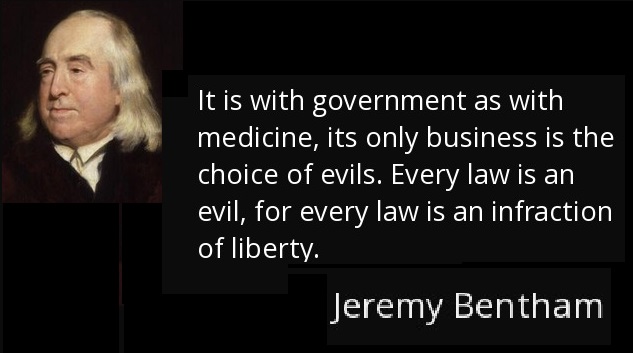
“Choice of Evils,” taken from the utilitarian philospher Jeremy Bentham’s (1748-1832) famous quote above, is an ethically rich “Law and Order” episode from 2006 that I recent watched again. Assistant DA Jack McCoy decides to prosecute a mother for murder after she admits to shooting her homeless, psychopath son. Her defense: she did it to protect the community, or, in cruder terms, he needed killing. She had met his girlfriend who was pregnant, and told her that her son would eventually kill her and the baby if she didn’t get away.
The mother explained that her first husband and the dead man’s father is in prison for murder, and like his son. lacked empathy or a conscience. She related how her son displayed all the traits of a psychopath growing up, such as torturing and killing animals. In sympathy for her plight, McCoy offered the mother a manslaughter plea and short prison time, but she turned the deal down, adamant that she hd done nothing wrong. She was then charged with second-degree murder (that’s also generous, since the killing was premeditated), and the trial began.
The problem of how to deal with “bad seeds” is a societal dilemma of long standing, and one without a satisfactory solution. It is easy to sympathize with the mother’s plight, but a society that approves of preemptive executions when an individual seems likely to harm someone before he or she actually does is on a fast track to chaos; it’s not even a slippery slope. Once again, the seductive appeal of pre-crime measures has to be resisted decisively, or individual rights and justice mean nothing.
Does society have to wait until a loudly ticking time bomb goes off? If it’s a human time bomb, absolutely, and no exceptions. Sometimes, that metaphorical bomb turns out to be a dud, and every human being has the same right to be judged on the harm, if any, he or she actually does rather than the harm some feel they are certain to do.
In the episode, it is discovered mid-trial that the son had in fact murdered a man, which his mother did not know at the time she murdered him. McCoy argued to the judge that this was irrelevant to the case and likely to mislead the jury. He was correct. The mother’s act was exactly as illegal and intolerable whether her son was a likely killer or a proven one. The discovered homicide is an example of moral luck: it changes how the mother’s act is perceived, but doesn’t change the ethical analysis at all.
In the end, the jury votes guilty, and sends the mother to prison for 25 years. This is because she admits on the stand that her current husband had threatened to leave her if her son moved back into their home, which he announced he would soon do. Thus the preemptive murder began to look less like an altruistic act to spare society, and more like one for the mother’s personal benefit.
Again, it shouldn’t have mattered. Killing a human being based on probabilities and presumed future harm to society can never be deemed just or tolerable.
Never.


 Ethics Alarms
In response to the post about the mainstream news media still presenting the deaths of Freddie Gray and Mike Brown as “murders” despite all evidence and judicial law enforcement determinations to the contrary, Matthew B raised some interesting questions that I’ve pondered myself.
Here is his Comment of the Day on the post, “If The News Media Won’t Resist Publicizing Big Lies, What Hope Is There?: