
Huh! I didn’t know this was traditional Chinese business attire! Imagine: This is what Marco Polo must have seen!
The most amusing reaction to the apotheosis of progressive silliness that was the attacks on Utah high-schooler Keziah Daum for wearing a Chinese-style prom dress came from China, where the South China Post’ s Alex Lo, who authored a column titled, “Go ahead, appropriate my culture.” He wrote in part,
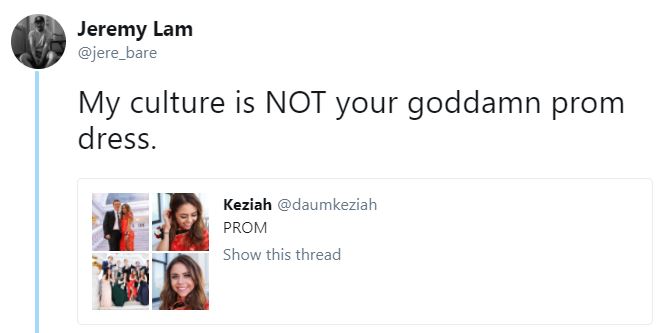
If anyone thinks social media is harmless, this incident should prove otherwise. A person called Jeremy Lam apparently first tweeted about her transgression, which is now being called “cultural appropriation”. “My culture is NOT your goddamn prom dress,” he posted…I apologise in advance for contributing to the silliness, but just needed to get it off my chest. A publication as esteemed as The Independent of London ran a column supportive of the criticism.“The debate her prom pictures have prompted is justified,” the columnist wrote. “Cultural appropriation is about power, and to many she is the embodiment of a system that empowers white people to take whatever they want, go wherever they want and be able to fall back on: ‘Well, I didn’t mean any harm’.”
I would argue those who scream loudest about cultural appropriation are themselves after power…Why does Jeremy Lam think Chinese is his culture? Is his the same as mine? Is it some kind of property like an inheritance? If so, where is the will, written in our DNA, perhaps? And is it taxable or payable, and by whom? Why did Lam write in English? Isn’t he inappropriately appropriating English-speaking culture? …SJWs turn culture into some kind of finite asset, a zero-sum rather than a growing-sum game. They are oblivious or ignorant of how human cultures actually work: culture is cultural appropriation.
The topic sparked many excellent comments here, including this Comment of the Day by Alexander Cheezem…on the post, Ethics Dunces: Jeremy Lam And The Cultural Appropriation Police:
It’s worth noting the issue of what I can only call — with much irony — aggregation bias here. There _has_ to be a term for it that doesn’t rely on punning off a statistical concept, though…”
In reflection, I suppose that what’s going on is technically a variant of the ecological fallacy — but it’s manifesting as a form of bias (in the non-statistical sense) based on the aggregation of behavior… so the term isn’t quite right, leading me right back to punning off of the statistical concept. I can’t explain the issue without a massive amount of technical language (e.g. “the emergent nature of many features of a complex system”).
And that is a huge problem with modern liberalism. Continue reading

 Ethics Alarms