The Dilemma of the Oblivious Questioner

"Where was I? Oh, right...so what you were saying about client perjury reminds me of a trial in the Boer War...well, it wasn't a trial exactly; that was what Churchill's cousin called it---wait, not Churchill's cousin...the other guy, the one who was such a good canasta player. Nobody plays canasta any more..."

“Where was I? Oh, right…so what you were saying about client perjury reminds me of a trial in the Boer War…well, it wasn’t a trial exactly; that was what Churchill’s cousin called it—wait, not Churchill’s cousin…the other guy…no, it was a girl, I misspoke… the one who was such a good canasta player. Nobody plays canasta any more…”

I launched a new legal ethics seminar today. This is always nerve-wracking, because it has to last exactly three hours, has to cover the topics I’ve included in the printed materials, and the programs are interactive, meaning that the degree of attendee participation is unpredictable. After I’ve done a program a couple of times, I usually have a good idea about which segments prompt a lot discussion and which don’t, so I can time my own comments accordingly. The first time, however, it is pure guesswork.

This one, a country-music themed program, was going to be tight, but was close to schedule until an elderly lawyer burdened with various medical paraphernalia raised his hand. I called on him by reflex, and then realized that he was the same attendee who had blathered on earlier in the program, telling an irrelevant and pointless anecdote that ate up five minutes. Sure enough, the second he got his hands on the mic he was off again, this time making an obscure and convoluted comparison between what I had been discussing and Japanese war crime trials, but it was even worse. He went on tangents; he forgot names; he backtracked; he never made any coherent point. Some people got up and left. It was easily a ten minute filibuster, and permanently killed any chance I had of covering all my material. He finally reached the end, never making clear what the story had to do with anything. I went on to the next segment.

Now I wonder if I handled the situation properly and made the right ethical call, which was to tolerate his clueless intrusion and not embarrass him by cutting him off. Continue reading

Ethics Hero: Dick Hoyt

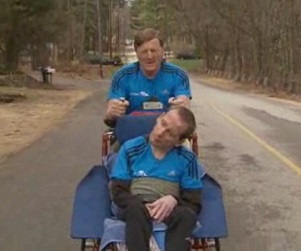
hoytsI don’t think I’ll have to explain why Dick Hoyt is an Ethics Hero.

Rick Hoyt has cerebral palsy and has been a quadriplegic since childhood. When he was in middle school, he told his father, Dick, that he wanted to compete in a charity marathon for a basketball player who had been paralyzed in an accident. Dick Hoyt agreed to push his son’s wheel chair in the race. When it was over, Rick told him, “Dad, when I’m ‘running,’ it feels like I’m not handicapped!” Touched and inspired, Dick Hoyt, 72, went on to push his son, now  51, in 1,091 events, including 252 triathlons, 70 marathons, 94 half marathons, and 155 five-kilometer races. They have never finished last. The father-son team is preparing to compete in their 31st Boston Marathon next week.

When they compete in the triathlons, Dick pulls his son in a boat tied to a cord as he swims, and pedals for him on a tandem bicycle for the cycle round. In 1989, the family set up the Hoyt Foundation which has the goal of helping disabled youths participate in activities that their disabilities would normally preclude.

Rick says his only wish is that he could make his dad sit in the chair and push him for once.

Every now and then, I learn about people whose kindness, selflessness and ethical instincts place me in awe.

Dick Hoyt is such an individual.

__________________________________

Facts and Graphic: Opposing Views

Ethics Hero: Michael Bublé

This video, and therefore the incident, is three years old now and viewed on YouTube by millions,  but it’s new to me, and it raises my opinion of Michael Bublé , an old-fashioned but youngish Vegas-style crooner in the Andy Williams mold, but cuter.

Here is what’s ethical about the singer’s spontaneous conduct:

  • He was kind. Few performers allow their concerts to be hi-jacked like this.
  • He was courageous. Professionals know that any time you give up control, anything can happen.  Bublé was confident that he could handle whatever came his way, but it is still a risk.
  • He was generous. His reaction to realizing the kid could really sing was pitch-perfect.
  • He demonstrated the Golden Rule, and explicitly so, when he made the decision to bring the 15-year-old on stage, saying, “I remember being your age.”

…all marks of an Ethics Hero, and a lucky one, because this could have gone horribly wrong.

_________________________________

Pointer: Kathleen Dunn (via Facebook)

Out Of A State Lottery, A Golden Rule Moment

We're NOT going to be selfish and exclusive, even though we can and you expect us to!

“We’re NOT going to be selfish and exclusive, even though we can and you expect us to!”

It never seems to work out this way, and thus it is interesting to speculate why the office lottery pool at Keller Williams Partner Realty in Plantation, Florida treated a dilemma so differently, and so much more ethically, than the key participants here, or here.

Jennifer Maldonado had only been working as an administrative assistant at the company for two weeks, and because she hadn’t received her first pay check, she decided not to join the office Powerball pool when she was approached. The organizer even offered to loan her the money: nope, insisted Maldonado. Not this time; maybe next. Naturally, the pool not only won that week, but won big: a million dollars to be divided among the 12 person staff…except Maldonado, of course.When Maldonado showed up for work and saw everyone screaming, crying and celebrating, she thought they were playing a practical joke in her to teach her a lesson. “I knew I was the only one who hadn’t put in the money, so I thought they were pranking me and going out of their way to make me feel something,” she recalled, that “something” presumably being “rotten.”

Jennifer obviously didn’t know her co-workers yet. Not only weren’t they trying to make her feel badly, they had held a meeting and decided to give her a cut of the winnings even though she hadn’t opted in to the enterprise—not a full share, but a significant amount. Jennifer didn’t expect anything, wasn’t going to sue them or hold a grudge, and yet they made her part of the group’s good fortune anyway. This is the Golden Rule exemplified. It is also exemplary ethics: generosity, kindness, empathy, and inclusiveness. The staff”s gesture said, and eloquently, “Welcome to the family! You can trust us. We care about you. We look out for each other, and we handle each other’s mistakes.”

Perfect. Continue reading

Dog Owner Ethics: The Suicide and the Pitcher

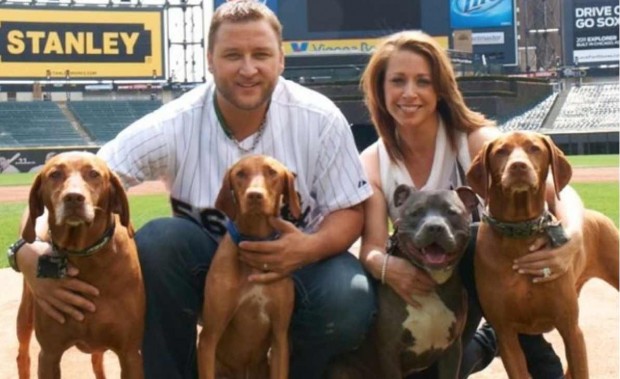
Does one of these nice creatures not belong in this picture? Ontario says yes. The correct answer is  no.

Does one of these nice creatures not belong in this picture? Ontario says yes. The correct answer is no.

Our life-changing events often become crises for our canine companions. In the news today: ethical  and unethical responses in such circumstances, by two individuals in the public eye.

The Unethical

Mindy McReady, the troubled country music star, committed suicide Sunday on the front porch of the home she shared with her boyfriend, who had recently committed suicide there as well. She apparently killed the couple’s dog before taking her own life. McReady’s friends insist that she didn’t kill the dog out of malice, but because she didn’t want to leave the dog alone. Granted, McReady deserves consideration and compassion, since her actions that day were not those dictated by a healthy or fully functioning mind. Still, I read of dog owners doing this a lot, and I’ve known a few—not committing suicide, but killing their dogs when they knew they wouldn’t be able to keep them any more, on the theory that the dog would be happier dead than with new owners. Continue reading

Horrible Thought: The Last Unethical Act Ever?

Asteroid coming

From antic conservative talk radio host Chris Plante comes this horrible thought, just expressed on his morning show in Washington D.C. :

How do we know NASA,  in the grand tradition of former official Jon Harpold–quoted as arguing in 2003 that if their flight were doomed by an unrepairable  heat shield flaw, the astronauts on the Space Shuttle Columbia shouldn’t be told of their certain deaths and be allowed to burn up upon re-entry, quickly and humanely— isn’t lying to us about today’s near-miss with an asteroid?

“Maybe the Obama Administration, in its infinite wisdom, has determined that it’s best that we not know the the truth, which is that the asteroid is going to hit the Earth and we’re all going to die,” Plante said.

Oh-oh.

For the record, if true, this is completely unethical.

I thought you should know.

Thanks for everything.

UPDATE: Whew!

________________________________

Spark: Chris Plante

Graphic: Oh, what the hell difference does it make now? I’m headed to Boston to say goodbye to Fenway Park.

Beyoncé Ethics II: Has-Been Shaming at the Super Bowl?

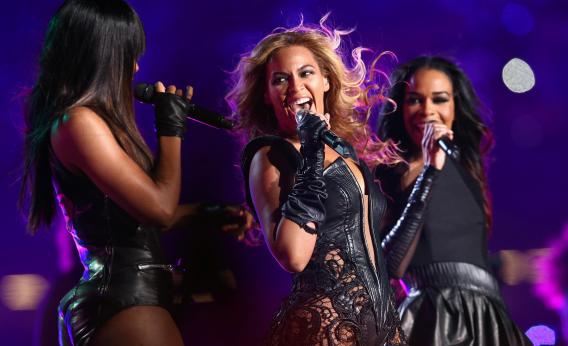
Destinys ChildBeyoncé didn’t lip-sync her Super Bowl appearance, but according to Slate writer Julia Turner, she was ungracious, unkind and disrespectful to her former Destiny’s Child partners, Kelly Rowland and Michelle Williams, who joined her in the half-time show for what was billed as a reunion. She writes:

Beyoncé’s lack of magnaminity reached its peak as their medley came to its climax. Instead of launching into a full rendition of “Say My Name” or some other Destiny’s Child classic, she said “Kelly and Michelle, can y’all help me sing this one?” Kelly responded, “Sho’ nuff, baby,” and the trio launched into “Single Ladies,” Beyoncé’s solo hit—about how great it is to be solo. This was, as Dave Weigel tweeted, “Like Beatles reuniting and singing ‘Mull of Kintyre,’ ” Paul McCartney’s Wings classic. Beyoncé, don’t shame Kelly and Michelle by dragging them back into the national spotlight and then making them sing the very song that shows what a culturally relevant force you still are, and what afterthoughts they have become! Be generous. Share the spotlight. You have so much.”

Fair? Continue reading

Unethical Quote of the Week: Former NASA Official Jon Harpold

“Don’t you think it would be better for them to have a happy successful flight and die unexpectedly during entry than to stay on orbit, knowing that there was nothing to be done until the air ran out?”

—–Space Shuttle Columbia mission operations chief Jon Harpold in 2003, talking about the Shuttle crew then in flight, as quoted by former NASA flight director Wayne Hale on his blog this week. Harpold was musing on a hypothetical situation (he thought) where NASA had determined that the Shuttle couldn’t safely return to Earth.

Columbia crew

Days before Columbia disintegrated on re-entry due to a damaged heat shield, NASA officials met to determine whether Columbia was safe to land despite some damage after takeoff. They decided, wrongly, as it turned out, that the Shuttle was safe. In the course of the meeting, Jon Harpold raised the hypothetical dilemma of a doomed Shuttle and an unaware crew.

Hale tells the story to make the point that NASA’s culture at the time was organizationally and ethically flawed. I agree.

Harpold’s position is kind but monstrous. It presumes to withhold the truth from those most effected by it, on the theory that it is better to die suddenly and unexpectedly than to have the opportunity to fight and strive to the end to solve what might be an impossible problem. Nobody should feel that he has the right to make that decision, to give up on life itself, for another who still has the capacity to think and act. This is disrespect for the values of personal liberty and autonomy, both much in the public mind today.

We each must have the right to make our own decisions about our fates, and must always have the information we need to make those decisions as wisely as we can. Those who fear the truth have insufficient reverence for it. Even the worst information may contain the seeds of victory.

I’m not going gentle into that good night, and damn anyone who tries to trick me into doing so out of misplaced kindness.

__________________________________

Facts: Kansas City Star

Graphic: KCNTV

Ethics Alarms attempts to give proper attribution and credit to all sources of facts, analysis and other assistance that go into its blog posts. If you are aware of one I missed, or believe your own work was used in any way without proper attribution, please contact me, Jack Marshall, at  jamproethics@verizon.net.

The Saga of the Entrepreneural Legal Mentor

"OK, now pay attention. I'll teach you to hunt, but it will cost you..."

“OK, now pay attention. I’ll teach you to hunt, but it will cost you…”

Attorney Kenneth Beck is reeling from a barrage of criticism he has received for placing this ad on Craig’s List:

ARE YOU RECENTLY ADMITTED TO THE BAR, OR AWAITING BAR RESULTS, BUT NEED EXPERIENCE FOR THAT FIRST JOB?

General practice attorney with more than twenty years of experience is willing to train a small number of recently admitted attorneys, or those awaiting bar results. For a monthly fee, you will be able to shadow the experienced attorney, and learn by watching the day to day practice of law. Observe the following types of proceedings, as they occur; Civil Short Calender motion arguments, foreclosure mediation’s, pre-trial conferences, Workers Compensation and Social Security hearings, real estate closings, discovery proceedings and compliance, research and general office operations. …

The unprecedented ad, now pulled, prompted nasty e-mails from his target audience and a lot of ridicule on various legal blogs. Beck hit a nerve, obviously, in fact several: the perceived venality of the profession, the desperate plight of recent law grads in a tight market, the lack of practical training students receive in law school. Some even suggested that the ad rose, or rather fell, to the level of professional misconduct. “Will this kind of revenue producer be censured by the state bar association?”, asked the blog Law and More.

That one is easy: no, because nothing about the ad raises legitimate questions about Black’s trustworthiness or honesty, and there is no clear violation of any existing rules inherent in his proposition. Still, the question lingers: even if this doesn’t nick the Rules of Professional Conduct, is it ethical? Continue reading