Comment of the Day: “You’re A Marked Man, Charlie Brown!”

The Lone Ranger, a.k.a. Clayton Moore, unmasked.

The Lone Ranger, a.k.a. Clayton Moore, unmasked.

One of the satisfying aspects of this blog for me is how a post will occasionally spark one of its diverse and intellectually agitated commenters to take the original post in unexpected and delightful directions. This gem from Karl Penny is a prime example. In the article inspired by the legal problems faced by the owner of Charlie Brown’s now grown up cartoon voice, I mentioned the actor who was TV’s Lone Ranger, Clayton Moore, prompting this lovely anecdotd from Karl. Here is his Comment of the Day on the post “You’re A Marked Man, Charlie Brown!“:

“Your comments about Clayton Moore got me to remembering one of the reasons I became such a fan of Clayton Moore, the man, even more than his acting. It’s from William C. Cline in “Those Enduring Matinee Idols”:

“In conclusion, I want to describe a vignette I witnessed during the afternoon that illustrated why Clayton Moore has been so successful and well-loved during his 24-year stint as ‘The Lone Ranger’, and why those of us who cherish serials detected the quality of the man even before then.
As Moore stood talking–with occasional interruption to shake hands with fans, sign autographs, and even speak to a small boy about the dangers of handling real firearms–a young woman timidly approached him holding the hands of a little lad of about seven and a girl perhaps nine years old. The boy gathered up his courage and thrust out his hand boldly. ‘Hello, Lone Ranger,’ he blurted. ‘My daddy says you’re the best. How come you’re not on TV anymore?’

 The little girl just stood there.

‘Thank you, son,” Moore replied. ‘I’m sure your dad is a great fellow, too. Maybe some time later the TV stations will show the programs again. Then you and your sister can see Tonto and me in action like your dad and mother did.’ The little girl continued to just stand there.

Turning to her, Moore noticed the expression on her face–that unique, particular expression that indicates only one thing, blindness. Looking up at the mother, he spoke one word, softly: ‘Total?’ he asked.

‘Not quite, but legally,’ she replied. Continue reading

Comment of the Day: “And The Solution To This Phenomenon Is Simply Ethics. Why Is That So Hard?”

Sir Galahad

Sir Galahad

Reader Aaron Paschall was on a roll today, and his two-part comment on the thread regarding a woman’s lament about the sexual harassment she faces every day constitutes one of the best and most eloquent Comments of the Day Ethics Alarms has ever recognized with the honor. Here is Aaron’s perspective on the post “And The Solution To This Phenomenon Is Simply Ethics: Why Is That So Hard?”:

“Certainly it’s a sad state of affairs when a woman (or man) has to keep to the well-lit areas in order to avoid the dangers lurking in the dark. If Emily’s post is a lamentation that it would be wonderful if people needn’t fear the darkness, then I agree wholeheartedly. If Emily’s post is intended as a screed about how unfair it is that she can’t go walking down dark alleys as she would like because of all the nasty, brutish men lurking in the shadows, I can only laugh and say that I can’t walk down those alleys, either. Nor would I wish to, because I’m wiser than that. Continue reading

Ethics Hero: Michael Garcia

Say thanks to Michael, everybody.

Say thanks to Michael, everybody.

An ethical culture is constructed of millions of acts, small and large, prominent and not, that reinforce the best of human values, priorities and aspirations. The Ethics Heroes among us are those who recognize the opportunities to engage in such acts, and who have the courage, initiative and wisdom to not merely perform them, but to perform them impeccably.

Meet waiter Michael Garcia, Ethics Hero.

Garcia, a waiter at Laurenzo’s in Houston, Texas, was serving a family that has regularly patronized the restaurant since it opened. The family’s five-year-old son Milo has Down syndrome, and was talking and making noises, not being disruptive, but still noticeably different than the usual young patron at the family restaurant.  A member of a family at a neighboring table in Garcia’s serving section became annoyed, and began making disparaging comments about Milo. That family farther away from the child, and from that table, still within Garcia’s service responsibilities, said, the offended patron said audibly,

“Special needs children need to be special somewhere else.” Continue reading

And The Solution To This Phenomenon Is Simply Ethics. Why Is That So Hard?

construction_workers_at_voi_bigWith her “Letter to the Guy Who Harassed Me Outside the Bar” , Emily Heist Moss makes me briefly wonder, not for the first time, why all men haven’t been murdered in their beds by an organized feminist vigilante posse. The conduct she describes is disgusting and infuriating just to read about, and I don’t even have to experience it.

The amazing thing is that this kind of ritual harassment would vanish with some slight behavioral additions to our culture, many of which once were the norm, habits of good conduct like etiquette,  manners, consideration, civility, fairness, kindness, respect, and the Golden Rule. They could become cultural norms again, and rather easily, I would think, with an increase in responsible parenting, a responsible popular culture, and the development of role models with integrity. Not featuring serial and unapologetic sexual harassers as stars of sitcoms (Charlie Sheen) and political conventions (William Jefferson Clinton) would help; so would a serious effort by Hollywood not to trivialize workplace harassment as cute or amusing, as in the long-running “Cheers,” or in current TV  dramas like “Criminal Minds” and “NCIS.”

Moss writes, Continue reading

Ethics Quote of the Month: Jodie Foster

Jodie foster

Why is Jodie Foster’s stream of consciousness speech as she accepted the Golden Globe’s lifetime achievement honor, the Cecil B. DeMille Award, worthy of praise for its ethical values?

  • It was genuine, open and honest. Celebrities are paid to live their lives in public, and all of them struggle to find the proper, fair, and sane balance between what they are obligated to show the world, and what they keep secure in their private lives. Nobody has struggled with this balance more than Foster, or suffered moire because of it. A performer since she was a toddler, she never really had a choice to live a normal life. Her speech was a gift to the public revealing inner thoughts and emotions about someone it cares about but has never known as well as it would like to. Continue reading

A Christmas Story Redux: Alek and the Controllable Christmas Lights

Go ahead! Try em!

Go ahead! Try em!

Christmas is right around the bend, so it is again time to celebrate Alek O. Komarnitsky and his creative, slightly wacky, Christmas lights extravaganza that he has transformed from a mildly unethical spoof to an act of charity and generosity.

Back in 2004, Alek received national attention for his whimsical holiday website that allowed people all over the world to turn his elaborate Christmas lights on and off from their home computers. Everyone had fun, which was clearly Alek’s design. Still, when it became known that his site was a hoax and that the lights going on and off were only an illusion, I weighed in (on The Ethics Scoreboard) with the opinion that perpetrating such a large-scale deception was wrong, no matter how well-intentioned and light-hearted. Alek took issue with my criticism, and we had a spirited e-mail debate.

Then, at a significant cost in time and money, Alek devised a way to really let people all over the world turn on his lights. He has done this ever since, and uses the site to raise money to cure Celiac disease. He writes: Continue reading

An Ethics Hero Potpourri!

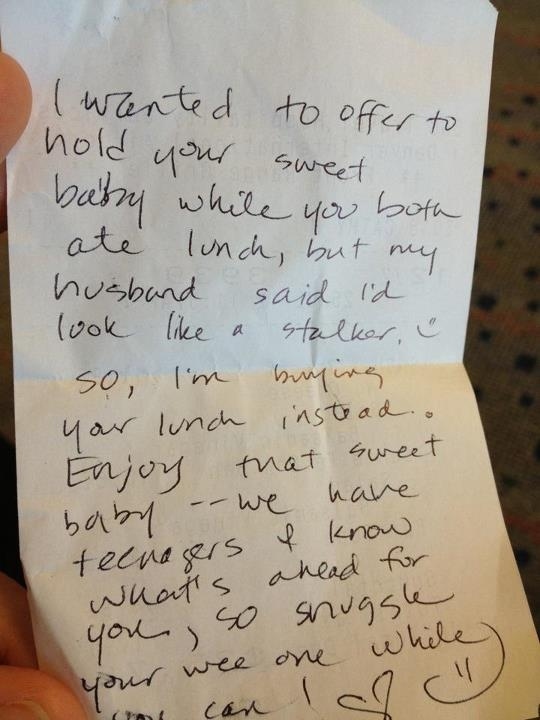
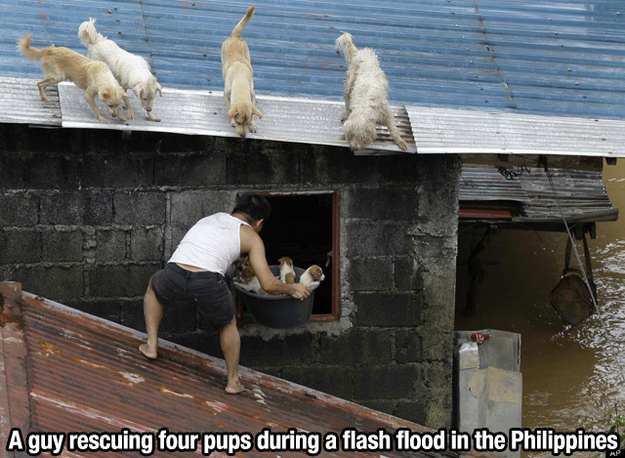
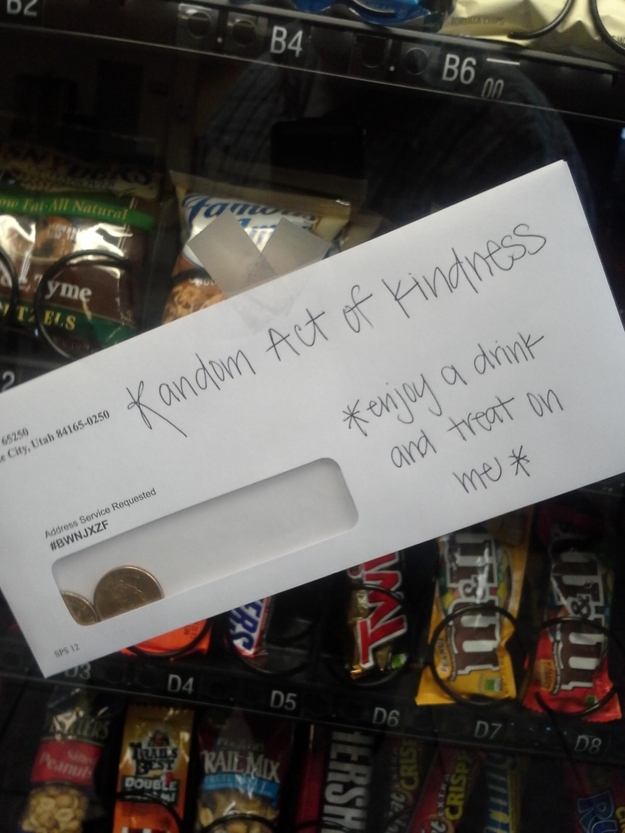
Earlier this year, Buzzfeed gathered and posted these sixteen photographic records of people being kind just because that’s how we should be. Yes, I guess one or more of them may be fake; it doesn’t matter much. It is still helpful to remember, especially in my business, that there are a lot of good people out there.

Thanks, Buzzfeed.

1.

Kindness 1

2.

Kindness2

3.

Kindness3

Continue reading

UPDATE: A Cynical Ethics Tale That Wasn’t So Cynical After All

In the recent Ethics Alarms post The Asperger’s Child, the Company With A Heart, and the Cheapskate Parents: A Cynical Ethics Tale, I expressed both ethical and credibility doubts about the heart-warming story of a little boy who was sent the out-of stock LEGO set he had saved to buy for two years, only to discover that it was no longer manufactured and could only be purchased at premium rates via collectors or online auction. The child’s joyful reaction when he opened the box containing the set sent to him as a gift by the toymaker was captured in a family video that subsequently went viral on YouTube.

I won’t rehash my analysis here; read the post. I questioned why the family wouldn’t just contribute the necessary funds to ensure that the child’s long effort to obtain the toy didn’t come to naught, and I expressed skepticism that LEGO’s generosity wasn’t part of a pre-arranged quid pro quo in exchange for the video, especially since the father is professional videographer, and the YouTube product functioned as a promotion for LEGO.

By purest coincidence, a personal friend here in the Washington, D.C. metropolitan area, Jeff Westlake, is also a close personal friend of the Groccia family. He was privy to the events of the story as they unfolded, and relayed information to me about both the family and the events surrounding the YouTube video that were not evident in the media reports. Thanks to Jeff’s insight, I am now satisfied that the family’s decision to explore every avenue of obtaining the LEGO set was reasonable rather than penurious, and that there was no quid pro quo with LEGO.

I apologize for mistakenly impugning the Groccia’s motives and account in the episode. I don’t apologize for raising the ethical issues that I saw implicit in the media accounts. That’s my job, and provoking discussion and debate over the ethical or unethical conduct of public figures is why this blog exists. If a family is going to participate in making an occurrence in their lives the subject of news stories, features and blog posts, they cannot insist that all commentary be unequivocally positive. I thought the doubts I expressed were legitimate and fair; it happens that they were not borne out by the facts.

Mr. Groccia was offended, understandably, and not so understandably, decided to respond here with, first, an anonymous comment noting that my “foil hat must be too tight as it appears to be impeding your cognitive abilities.” I didn’t know who the author was, and informed him via the email; address accompanying the comment that I would post his remarks if 1) I had a real name, as the Comment Policies require,  and 2) if the screen name he used was not a commercial website, since this would lead to the comment being spammed. He responded that he “knew” I wouldn’t have the “spine” to print his comment, which is manifestly not the case. I told him that I would be happy to publish a more thorough account by him, and would retract my suspicions if I was persuaded by it. Instead. Mr. Groccia chose to send a series of alternately insulting and threatening e-mails, none of which were substantive, and all of which served to reinforce my doubts. There the matter would have laid, except for the intervention of Jeff Westlake. I’m grateful to him for setting the record straight.


The Asperger’s Child, the Company With A Heart, and the Cheapskate Parents: A Cynical Ethics Tale

This is a sweet and gooey ethics tale with, I fear, a fishy center.

James, luckily captured in spontaneous celebration over the completely unexpected gift from the LEGO company

James, luckily captured in spontaneous celebration over the completely unexpected gift from the LEGO company

James Groccia of West Boylston, Massachusetts was nine years old when he told his parents that his dream gift was an Emerald Night Train LEGO Set. His parents, seeking to build his character before he could build his dream train. told the boy that he had to save up for the expensive set, which cost $100. James has Asperger’s Syndrome, which means that he obsesses about things that interest him to an extreme degree, and he made the Lego set the object of his tunnel vision. After two years of meticulous saving, he finally had enough money saved to purchase his prize—-and discovered that it had been discontinued. Now the  Emerald Night Train could only be obtained from collectors or in expensive online auctions, costing far more money than James had saved. The boy was devastated.

At the suggestion of James’ Asperger’s counsellor, his mother helped him write a letter to LEGO, explaining his devotion to the toy and asking if the company could track one down for him. It responded, with regret,  that indeed the Emerald Night Train LEGO Set was out of stock and was no longer made. Then, a few days before James’s birthday this October, a box addressed to James arrived at the family home. Yes, Virginia, it was a brand-new model of the Emerald Night Train! The accompanying letter from Lego said, Continue reading

Jack’s Anti-Political Correctness, Political Bloodsport and Contrived Offense Crusade: Progress Report

As I noted earlier, I am in New Mexico talking to journalists here about the Pat Rogers affair. You can sample one of the fruits of my labors here, a story in the Santa Fe New Mexican. It’s pretty accurate, as press interviews go, though the last quote was botched. I didn’t say that I was a “Greek American conservative Democrat with an anti-war war hero father,” but that my diverse views were the product of “a Greek American conservative Democrat mother and  an anti-war war hero father.” [ UPDATE: This has been corrected.]

If you’ve missed the various posts on this issue, you can find them here, here and here.

One odd note: during my meeting with several reporters from the paper, one of them suggested that making a joke about Custer’s Last Stand was like making a joke about the Holocaust. I let it pass, but the comment seems bizarre to me. Custer, after all, got himself and his men killed, and it was his opposition that was the object of genocide, not the cavalry. Why would ridiculing Custer offend Native Americans?