Lara Logan’s Cairo Ordeal Starts An Ethics Train Wreck

A female CBS correspondent gets cut off from her security while doing live coverage of the demonstrations in Cairo, is surrounded by a group of Egyptians in the crowd, attacked, and sexually assaulted. She is rescued by Egyptian police and flown back to the U.S., where she is hospitalized.

This what happened to “60 Minutes” Correspondent Lara Logan, and you wouldn’t think such an unambiguous example of brutality and criminal conduct would raise any ethical controversies. But the already nasty incident has metastasized into a full-fledged Ethics Train Wreck, with both the Left and the Right taking turns disgracing themselves.

And the media, of course. Continue reading

Ethics Night on “American Idol,” As An Ethics Hero Is Born

Ethics Hero, Scotty McCreery

“American Idol’s” group portion of its winnowing process always is the most fascinating chapter of its yearly saga, as the singing competition briefly shifts into full reality show mode. I’ve never been convinced that it was a fair method to judge aspiring singers who were competing as solo acts, as it frequently results in superior vocalists being dumped because they couldn’t sing harmony, learn choreography and lyrics under pressure, or play well with others. I know you have to get that mass of ambition and ego reduced to 24 people somehow, but group day is the equivalent of throwing darts at a dartboard.

It makes for great ethics scenarios, though. The format guarantees it, as the contestants have to form groups of four or five in a cruel process reminiscent of choosing sides for pick-up baseball games, guaranteeing that some people will end up feeling like the fat kid who always gets chosen last, if at all.

Last night there were several featured ethics dramas, with the judges, as they have been all season, being less than consistent in their responses to them. Continue reading

Ethics Perils of an Over-eager Bieber Prompted By An Unethical Interviewer

In the current Rolling Stone magazine, teen singing sensation Justin Bieber opines on the morality of the U.S. health care system (Bieber is Canadian) and abortion, saying, among other things…

On abortion: “I really don’t believe in abortion. It’s like killing a baby?”

Abortion in cases of rape: “Well, I think that’s really sad, but everything happens for a reason. I guess I haven’t been in that position, so I wouldn’t be able to judge that.”

On the U.S. and its current health care system: “You guys are evil. [Rolling Stone notes that he  says this “with a laugh.”] Canada’s the best country in the world. We go to the doctor and we don’t need to worry about paying him, but here, your whole life, you’re broke because of medical bills. My bodyguard’s baby was premature, and now he has to pay for it. In Canada, if your baby’s premature, he stays in the hospital as long as he needs to, and then you go home.”

So to sum up: in the course of one interview, Rolling Stone managed to prompt a 16-year-old to… Continue reading

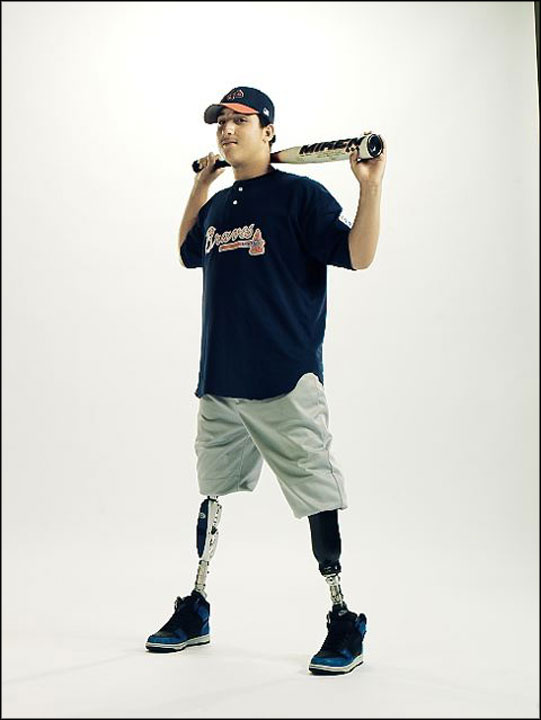
The Dilemma of the Legless High School Pitcher

Seemingly an inspirational movie in the making, Anthony Burruto is a student at Dr. Phillips High School in Orlando, Florida. He has been playing baseball since he was 8 years old, despite the inconvenience of having both of his legs amputated when he was an infant. He plays the game on prosthetic legs that are all he has ever known, and does it well as a pitcher who can throw a mean curve and a fastball that has been clocked at 80 mph. This is Anthony’s sophomore year, and his goal was to play on Dr. Phillips High varsity baseball team this spring.

After two days of try-outs, Coach Mike Bradley cut him. Anthony’s metal legs, adept as he was at using them, made him too slow off the pitching mound when he had to field a bunt, said the coach, and teams would take advantage of his inability to jump off the mound quickly.

Sorry, kid.  Continue reading

To Edit, or Not to Edit: A Blogging Ethical Dilemma

I was just simultaneously reading an excellent, if not particularly revolutionary, article about blogging ethics and checking out the latest comments on the Immortal Tide (with Acti-lift!) Debate. Suddenly I found myself wishing that the author, whose essay concentrated on editing blog posts, had also addressed the issue of editing blog comments.

Unlike some blog platforms, WordPress does not have a feature that allows commenters to review or spell-check their own posts. Despite this, many of the regular commenters here have a better record of avoiding typos than I do, and I have preview and spellcheck features. When they make a spelling or grammatical error (and I notice it), I will fix it for them: WordPress allows me to edit comments. Sometimes a commenter will e-mail me personally and request an edit, and I am happy to oblige.

A while ago, one new commenter whose post was riddled with spelling and grammatical errors accused me of letting her errors stand to make her look unintelligent because she had disagreed with my original post, while I continued to edit comments that were more friendly. In her case, I actually hadn’t read the previous typo-infested comment that she was referring to, and treated her complaint as a request to edit it, which I did. But it was a mess, and I wondered then if it made sense, or was even fair, to turn an inarticulate, careless comment into a clear and persuasive one.

Today I have read several posts on the endless Tide commercial thread from a 15-year-old girl. The post is in text-speak, essentially, without capitals, punctuation or any attention to style. It is a clear comment, however,even if it is obviously the expression of a 21st Century teen. Should I edit her comment to give it more credibility, by punctuating it, for example?

What is an ethical editing policy regarding comments on an ethics blog? The options, as I see them, with their ethical pros and cons: Continue reading

The Lost Flashdrive and Presumed Consent

“Lose a flashdrive here? Call the Arboretum if you’re one of the visitors in this photo, or phone these guys if they are friends of yours. A flashdrive packed with photos and software has been in our lost-N-found for at least a month — Store manager Lynnea suggested we post a photo from the drive and see if someone cla…ims it. Describe the drive and its contents accurately & provide your postal — we’ll happily return it.”

The Boyce Thompson Arboretum in Superior Arizona recently posted this notice on its Facebook page, along with one of the photographs a staff member took off the lost flashdrive. Obviously the material on the drive is private; just as obviously, the flashdrive is lost. Is the Arboretum within reasonable ethical boundaries to examine and publicize private information without the permission of the flashdrive’s owner to help the owner recover his lost property? Continue reading

The Maine Incivility Project

Thank goodness for the Maine Incivility Project.

With all the talk about incivility sparked by the media’s determination to blame a madman’s shooting rampage on Sarah Palin, Rush Limbaugh and the Tea Party, it rapidly became evident that civility is a somewhat elusive concept. For example, while shouting “You lie!” at the President while he is speaking is definitely uncivil, arguing that the President was really foreign born isn’t—it’s stupid, but not uncivil. Calling Rush Limbaugh “a Big, Fat, Idiot” in the title of your book, as Sen. Al Franken did, is uncivil, as is calling Nancy Pelosi “the Wicked Witch of the West,” as Rush Limbaugh did. Using cross-hairs to designate Democratic House seats that Republicans are “gunning for'”, “targeting” or “taking aim at”, on the other hand, is not uncivil…just unsettling if one is metaphor-challenged or hoplophobic (having a pathological fear of guns.)

Never fear, however. Before the echoes  of President Obama’s call for Americans to come together had barely faded, the public got a handy lesson from the Governor of Maine about what incivility sounds like, as his term launches the new Maine Incivility Project. Continue reading

Christmas: the Ethical Holiday

Benjamin Franklin recognized the importance of regularly focusing one’s attention on ethical conduct rather than the usual non-ethical goals, needs, desires and impulses that occupy the thoughts of even the most virtuous among us. He suggested that every morning an individual should challenge himself to do good during the day. In the 21st century psychologists call this “priming,” a form of beneficial self-brain-washing that plants the seeds of future choices.

The Christmas season operates as an effective form of mass population priming, using tradition, lore, music, poetry, ritual, literature, art and entertainment to celebrate basic ethical virtues and exemplary conduct toward other human beings. Continue reading

Hero, Villain or Hypocrite: The Dilemma of the Undercover Dog-Fighter

The limits of absolutism and the drawbacks of utilitarianism both come under scrutiny in assessing the strange saga of Terry Mills, whom the ASPCA recently appointed as its Animal Fighting Specialist.

Beyond question, this is a job he is uniquely qualified to hold. In 2008, Mills worked for the FBI’s domestic-terrorism task force, and went under-cover for more than a year to expose and break up a national dog-fighting ring. His efforts resulted in many arrests, and the rescue of more than 500 animals. Accomplishing all of this, however, required Mills to become part of the culture he was attacking. He trained and fought his own dogs, engaging in the very cruelty he was working to prevent. Continue reading

Ethics and Altzheimer’s Testing: An Easy Call

Sometimes I think bioethicists spend too much of their time looking for new ethical dilemmas rather than giving thoughtful guidance on the dilemmas we already have. A recent example: the New York Times wrote about a supposed ethical dilemma appearing in the wake of new tests that reveal the likelihood of whether an individual will get Alzheimer’s at some point in the future. As the article put it:

“Since there is no treatment for Alzheimer’s, is it a good thing to tell people, years earlier, that they have this progressive degenerative brain disease or have a good chance of getting it?…It is a quandary that is emblematic of major changes in the practice of medicine, affecting not just Alzheimer’s patients. Modern medicine has produced new diagnostic tools, from scanners to genetic tests, that can find diseases or predict disease risk decades before people would notice any symptoms. At the same time, many of those diseases have no effective treatments. Does it help to know you are likely to get a disease if there is nothing you can do?”

My question is: “What’s the dilemma?” Continue reading