
Perfect! Just what you need to handle that pesky flea, Professor!
Ben Edelman, a rather well-noted Harvard Business School professor, had this fascinating exchange with a local Szechuan restaurant:

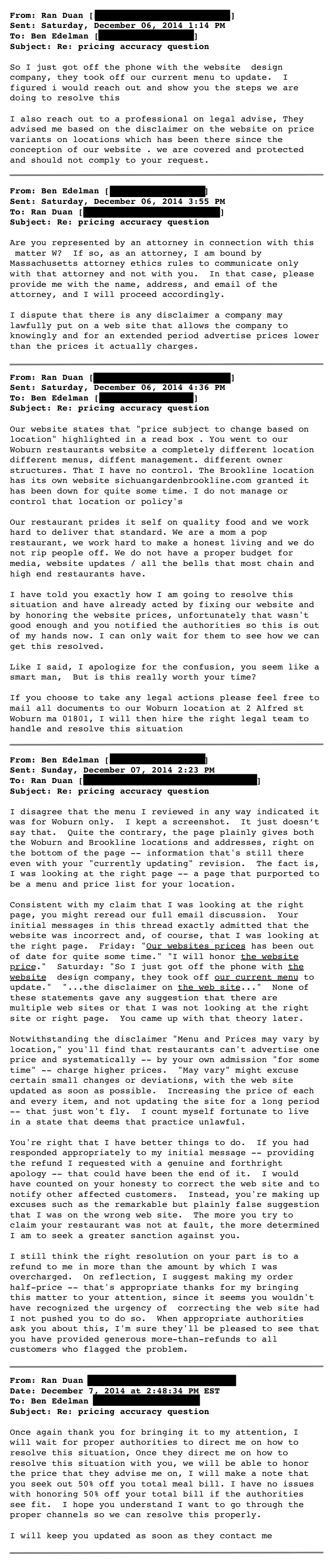 Your Ethics Alarms Ethics Quiz:
Perfect! Just what you need to handle that pesky flea, Professor!
Ben Edelman, a rather well-noted Harvard Business School professor, had this fascinating exchange with a local Szechuan restaurant:
Your Ethics Alarms Ethics Quiz:
 A hoary statutory destruction debate that hails from the Fifties centered on the simple prohibition, “No Vehicles in the Park.” The question is whether the reasonable and proper interpretation of such a prohibition should rest on the clear meaning of the words alone, or whether the underlying purpose and reasoning behind the rule or law must be taken into account. A tank is a vehicle: does the rule mean that a WW I tank can’t be placed in the park as a memorial? Is a baby stroller a vehicle (the dictionary says yes)? If we accept the literal approach—the school of jurisprudence championed by scholar L.A. Hart that is called legal positivism—we take legal interpretation out the realm of ethics and morality, and give judges only the power to apply laws as written, results be damned. The other approach, more popular with non-lawyers and many judges but not necessarily correct, is identified with Hart’s contemporary Lon Fuller, and called the natural law approach.
This conflict has arisen in intriguing fashion in a South Carolina dispute over the application of that state’s Stand Your Ground law in domestic abuse cases. In 2012, an abusive boyfriend, Eric Lee, dragged Whitlee Jones down a street by her hair. She got away, and Lee returned to the apartment they shared. A 911 call prompted by the hair-dragging spectacle brought a policeman to visit, and Lee put him at ease, saying that all was well.
It wasn’t. Jones, having retrieved her hair weave that didn’t survive the drag through downtown Charleston, returned to the apartment to pack her belongings and move out. As Jones began to leave the apartment, Lee blocked her way, and according to Jones, began to shake her. She pulled out a knife and stabbed him once, and once was enough. Lee died. Jones was arrested for murder. Continue reading

I write here often that we must distinguish between law and ethics, and as a lawyer, I am comfortable with the reality that a decision required by the law may be unethical, in that the results may harmful and undermine the broad goal of what a law or laws are supposed to accomplish: a healthy society, a functioning government, a safe and happy public and justice. Just as doctors need to develop emotional armor that allows them to go on practicing medicine when the operation is a success but the patient dies, so must judges learn to move on when interpreting a law as written has an absurd result, and they must allow that result to occur. I understand all that.
I still can’t understand the opinion in Taylor v. Kobach, however.Maybe someone can explain it to me with a straight face. The opinion itself is beyond reproach, clear and unassailable. The problem is that it ignores the Mastodon in the courtroom: the letter that the opinion deems sufficient to meet the requirements of the statute in question embodies a lie, and defeats the intent of the very statute that the court is using to declare the letter valid.
How can judges do that? How can they stand doing that? Continue reading

Sorry Carol; you should have had this years ago.
I just checked. I was certain that I had named Carol Costello an Ethics Dunce a half-dozen times at least, and discovered, to my shock and shame, that she has never been designated one here. Unethical Quotes of the Month, the chief offender in various disgraceful and biased performances by CNN or the news media as a whole, but somehow the most throbbingly ethics-challenged broadcast journalist not employed by MSNBC or Fox has never been honored as an Ethics Alarms Ethics Dunce!
Well, that streak ends now, and I can make it short and sweet.
This morning, Costello once again confidently proclaimed her lack of familiarity with the concept of ethics by summing up the conviction of former Virginian Governor Bob McDonnell and his wife for bribery and corruption this way:
“Now the Virginia legislature needs to pass tough new ethics laws so this never happens again.“
I’m just going to go into my shed with a hammer, and club myself into oblivion, because obviously my life is pointless and an utter failure. Continue reading

“You can’t worry forever about your mistakes. You fucked up. You trusted us. Make the best of it. ” —Otter (DuPont) to Flounder (Its former employees) in “Animal House”
Law and ethics are two different things, and courts are frequently forced to embrace unethical results in order to uphold a bad law or to deal with a messy fact pattern. It is seldom, however, that one sees as blatant an example of atrociously unethical behavior being ruled legal as in a recent case in Texas, decided this month. It is the kind of case that promotes distrust all around, as you will see. When that is the result, the ruling itself is unethical.
In the case of Sawyer, Kempf, et al. v DuPont and Company, an employer’s false promise not to exercise a legal right in order to induce its employees to forgo their negotiated rights was deemed unenforceable. The legal reasoning is solid. The ethics stinks, and is as good an example as you will ever find for the inspiration behind Charles Dickens’ (speaking through his creation Mr. Bumble, in “Oliver Twist”) statement, “The law is a ass.” Continue reading
 Tennessee is one of the most activist states that it comes to protecting children; for example, it has the among most stringent laws in the nation regarding the mandatory reporting of suspected child abuse. It also has a new law that just went into effect this month that allows officials to arrest mothers for assault who illegally use narcotics while they are pregnant if the child is born with symptoms indicating that the drug use impaired the child’s condition.
Predictable and tiresomely, the media and “war on women” scolds are attacking this is yet another incursion on the rights of women to have dominion over their own bodies. Think Progress, dishonestly, calls it a “pregnancy criminalization law.” This is intentional misrepresentation, a TP specialty. The law doesn’t criminalize pregnancy in any way, by even the most distorted interpretation. The knee-jerk opposition to the law highlights the problems of consistency and integrity that the women’s rights and pro-abortion forces have in all the areas relating to childbirth. Essentially, their position is that if conduct is related to child birth—or preventing it—in any way, anything they say, want or do must be accepted, and asserting otherwise, no matter what the justification, makes the government an oppressor of women. Continue reading

Darren Smith, one of the less-circumspect guest-bloggers that law professor Jonathan Turley inexplicably entrusts his blog to on weekends, wrote a post critical of Washington State for a law criminalizing the advertising of food as “Kosher-Style” when it is not, in fact, kosher.
Maybe he’s just a big fan of the offending restaurant chain he highlights, Five Guys, and is thinking with his stomach. Otherwise, he has no excuse for essentially giving a pass to intentional misrepresentation and fraudulent advertising as “no big deal.” Smith writes:
“Your author visited a Five Guys restaurant in Washington and did note that the “Kosher Style” hot dogs are cooked on the same grill as the beef, which would be a mixing of kosher and non-kosher foods in the making of the end product….The company has made an effort, on the company website at least, to note that these hot dogs are in the style of kosher and not actually kosher, but this might not be enough in Washington….There are numerous examples of products in the U.S. economy that use the word “Style” to declare that the food product is not actually as pure as might be expected of a product marketed without the word “Style”. Some examples might be “Artisan style breads” or “Honey style sauce” and do not necessarily break Washington’s, other states’ or Federal consumer protection laws. Yet Washington’s legislature decided that “style” was not enough with regard to differentiating kosher foods with non-kosher. It is either Pure or Not-Pure, and criminalized violations….It is certainly difficult to operate a business in numerous states having often greatly varied laws and administrative codes and when serving something as ordinary as a hot dog might possibly constitute a crime; it can make any business worry. Five Guys likely just wants to provide a menu its customers enjoy.”
Elsewhere in the article, Smith acknowledges that for certain religions eating non-kosher food can be “quite significant,” yet he pooh-poohs the effort of Washington legislators to stop establishments like Five Guys from using deceitful language to suggest that food is kosher when it isn’t. Disclaimers on websites and even menus come under the category of “fine print,” like “results not typical” in diet aid ads. Here’s a useful ethics tip: if you have to explain why your misleading description isn’t really misleading, a) it’s misleading, and b) you know it. All Five Guys has to do to take itself out of legal peril is to stop misleading its customers. Smith, however, thinks the problem is the law. Continue reading
 On a purely ethical basis, it is difficult to argue with the majority opinion in Hall v. Florida, where the U.S. Supreme Court ruled that executing a convicted killer whose IQ had been determined to be 71 was still cruel and unusual, and thus a violation of the 8th Amendment, despite Florida law’s cut-off for mental retardation being a score of 70. On the basis of law, however, the SCOTUS decision is hard to defend. Funny, I thought the job of the Supreme Court was to interpret laws.
“Intellectual disability is a condition, not a number…,” wrote Justice Kennedy for the 5-4 majority, in which he joined the so-called “liberal wing.” “This is not to say that an IQ test score is unhelpful. It is of considerable significance, as the medical community recognizes. But in using these scores to assess a defendant’s eligibility for the death penalty, a State must afford these test scores the same studied skepticism that those who design and use the tests do, and understand that an IQ test score represents a range rather than a fixed number.”
The problem is that the whole concept of a “condition” like intellectual disability is a subjective one. The theater company for which I serve as artistic director is presenting the Abby Mann historical drama “Judgment at Nuremberg,” and one of the most troubling scenes involves a man, the son of a Communist, sterilized by the Nazis because he was “mentally defective,” or perhaps because of his family’s political views. The Nazi test: make a sentence out of the words hare, hunter, and field. A witness for the prosecution, the man who was sterilized fails to answer the test on the stand, just as he failed when quizzed by the Nazis. Continue reading

I spent the wee hours last night watching “Insidious 2” (not as scary as “1,” and too confusing to watch while composing ethics blog posts), and, to fend off nightmares, the Wayans’ “A Haunted House” (sillier, grosser and not as funny as their two “Scary Movie” efforts). Naturally, this set me wondering about the ethics of selling a haunted house to an unaware buyer.
I thought I had covered this problem before here and here, where the topic was whether a property owner had an ethical obligation to divulge that the house in question had been the site of gruesome murders or suicides. The law in most states declares caveat emptor, but that’s only the law. The ethics verdict, in my view (but not everyone’s) is this, which my last comment on the topic, in 2013: Continue reading

“We made Mr. Wolf an offer he couldn’t refuse. Oddly, he refused it.”
What is it worth to a baseball team to save a million bucks? Apparently it’s worth being shunned by future players for being sleazy and dishonest.
Oh, it was all legal, don’t get me wrong. The Seattle Mariners, who, it should be noted, recently signed second-baseman Robinson Cano to a ten year contract averaging 24 million dollars a season, inked a deal with veteran pitcher Randy Wolf that guaranteed him a paltry million dollars if he made the team’s roster based on his performance in Spring Training. Sure enough,Wolf pitched well and not only made the team, but was told that he would be in the Mariners’ starting rotation.
There was a catch, however. Wolf was told that his being officially named to the team’s 2014 25 man roster to start the season—that’s next week, baseball fans—was contingent on him signing a legal document known as a 45-day advanced-consent release form. This would allow the Mariners to release or demote Wolf after the first 45 days of the regular season and be obligated to only pay him a pro-rated portion of his million dollar salary, rather than the entire one million dollars his original deal guaranteed. In other words, “Gotcha!” The perfect Catch 22. “Yes, you are guaranteed a million dollars, Mister Wolf, if you make the team, and you made the team. We keep our promises. We want you on the team. But if you don’t waive that guarantee, we won’t let you make the team.”
 Ethics Alarms