Observations On The Trump Jr. “Collusion” Attempt [UPDATED]

1.  Preet Bharara, the ex-U.S. attorney fired by the Trump Administration, tweets…

Quick reminder: something doesn’t have to be illegal for it to be foolish, wrong and un-American.

True. When Donald Trump, Jr. was informed that a Russian lawyer wanted to meet with him to pass along damaging information about Hillary Clinton, he should have gone to the FBI immediately, because this could have been indicative of a national threat. Instead he said “Whoopie!” or words to that effect. Moron.

But we knew that.

*Notice of Correction: In the original post, I erroneously stated that Bharara had joined Mueller’s team investigating Russian interference with the election. That was incorrect. I apologize. I was confused by this headline from the Washington Examiner: Special counselor adds former Preet Bharara prosecutor to Russia probe: Reports. It’s a bad headline, but I should have read the whole article. Careless.

2. Similarly, if Danny Jr told Kushner and Manafort what he was told the meeting would be about, THEY should have told him that the meeting was a bad idea, and to report it. They are slime-bags, and none too bright either.

We knew that, too.

3. It may be pure moral luck that this didn’t turn into a serious breach of election laws. But the fact is that no information changed hands, as far as we know. There was no “collusion,” which isn’t a legal term anyway.

4. The New York Times, from its good side, actually detailed the legal realities of the case, which ironically show how absurdly over-heated and misleading its own coverage is. The Times consulted with legal experts who said,

  • The events made public in the past few days are not enough to charge conspiracy.  Renato Mariotti, a former federal prosecutor said the revelations are important because if further evidence of coordination emerges, the contents of the emails and the fact of the meeting would help establish an intent to work with Russia on influencing the election…at least on Donald Trump Jr.’s part.

But as has been the situation throughout, the episode is still waiting for real evidence of genuine collusion between the Russians and the Trump campaign, and this wasn’t it. The anti-Trump mob, in the news media and out of it, is so, so eager, so desperate, to prove sanctionable wrongdoing that it is pouncing on everything that contains a shred of hope.

  • There has to be an underlying federal offense that is being conspired to be committed. So far, there is no evidence of that, and the aborted meeting with the Russian lawyer didn’t come close.

If the e-mails released yesterday specified that what was being offered had been obtained by an illegal computer hack, that would  be enough. They didn’t. Continue reading

Comment of the Day: “Morning Ethics Warm-Up, 6/30/17.”

As he usually does, when he’s feeling frisky,  reader Extradimensional Cephalopod (above right) has dived into the issue of “health care rights” with gusto and perception. As I often do whether I’m feeling frisky or not, I have some cavils about the assumptions being made at the outset.

A right is a moral or legal entitlement to have or obtain something or to be able to do something. Moral and legal rights are two different things. When someone says, as did my friend on Facebook that started this debate. “I believe health care is a right,” he had to be asserting a moral right to healthcare, since a legal right to health care doesn’t exist. If he said, “I believe health acre should be a right,” then he would have clearly meant a legal right. That’s a policy issue. When someone argues that there is a moral right, then they are making the case for a legal right that doesn’t exist. The law in an ethical society ought to protect and advance moral rights, and society must agree what those rights are. Thus when he says, early on, “Note that a right isn’t something we owe Note that a right isn’t something we owe people just because they exist.,” he signals that he is describing legal rights only.   Moral rights are what we owe  people just because they exist. That’s why the Declaration begins with Jefferson saying that “we are endowed by our Creator” with “unalienable rights.”

Here is Extradimensional Cephalopod‘s Comment of the Day on #5 in the post, “Morning Ethics Warm-Up, 6/30/17.”

Let’s start at the beginning. We need to define the phrase “healthcare is a right”.

A “right” is a protection or entitlement we collectively decide to give to people at the expense of our some of our freedoms because we think that society will be more robust, sustainable, able to advance, or generally pleasant to live in as a result. That’s very similar to the basis for ethics, as far as I can tell. A right is a meta-law, a limitation on what laws can be made. Rights may be conditional. Note that a right isn’t something we owe people just because they exist. It’s something we decide we owe them because we want to live in a world where people have that right–because it’s safer for us, or because it means the world will still be there for our descendants, or because it allows civilization to progress to something better, or because we want others to be happy, or all of the above. This will be important later.

Therefore, when we say, “healthcare is a right”, what we mean is “in order to make society more robust, sustainable, able to advance, or generally pleasant, we choose to sacrifice some of our individual freedoms to provide everyone with healthcare.”

We’re half done. Now, what is “healthcare”?

Let’s actually distinguish it from health insurance, because we’re smarter than Congress. Health insurance, like any insurance, is a gamble, in which people periodically pay a small amount of money to an insurance company, which will pay them back a larger amount of money (whatever is necessary, to the limit of what they are insured for) if the person’s health is in danger in a way that neither of them can predict. The idea is that the insurance company can’t predict who needs the money, but they can predict how many will need money and how much, statistically, so they accept enough money from people that they can afford to pay the people who end up needing more money. Continue reading

The Michelle Carter Verdict

Michelle Carter’s 18-year-old boyfriend, Conrad Roy III, had told her that he has been considering suicide. First, she told him to seek counseling, then  she changed course, texting him to go through with it. “The time is right and you’re ready, you just need to do it!” she wrote.  “You can’t keep living this way. You just need to do it like you did last time and not think about it and just do it babe.”

Later, she texted to Roy that his family accept his death, and that he would enjoy the afterlife. “Everyone will be sad for a while but they will get over it and move on. They won’t be in depression. I won’t let that happen. They know how sad you are, and they know that you are doing this to be happy and I think they will understand and accept it. They will always carry you in their hearts,” she texted.

“You are my beautiful guardian angel forever and ever. I’ll always smile up at you knowing that you aren’t far away.”

A week before the suicide, encouraging her boyfriend to be more diligent as he searched for the supplies he needed and then going through with his plan in these exchanges:

“Do you have the generator?”

“Not yet LOL,”

“WELL WHEN ARE YOU GETTING IT?”

“Now.”

“You can’t think about it. You just have to do it. You said you were gonna do it. Like I don’t get why you aren’t”

“I don’t get it either. I don’t know”

“So I guess you aren’t gonna do it then All that for nothing. I’m just confused. Like you were so ready and determined.”

“I am gonna eventually. I really don’t know what I’m waiting for but I have everything lined up”

“No, you’re not, Conrad. Last night was it. You keep pushing it off and you say you’ll do it, but you never do. It’s always gonna be that way if you don’t take action”

 “You better not be bullshitting me and saying you gonna do this and then purposely get caught.”

“No, none of that.”

On July 12, 2014, Conrad drove to a Kmart parking lot and connected his truck to a pump that released carbon monoxide. When he lost his nerve and got out of the truck, his girl friend texted him  to “get back in.”  She never alerted any authorities to stop the suicide attempt. The young man was found dead in his truck.

Yesterday, Judge Lawrence Moniz, of Bristol County Juvenile Court in southeastern Massachusetts, ruled that Ms. Carter, just seventeen at the time of her crime, committed involuntary manslaughter by urging Roy to kill himself. Continue reading

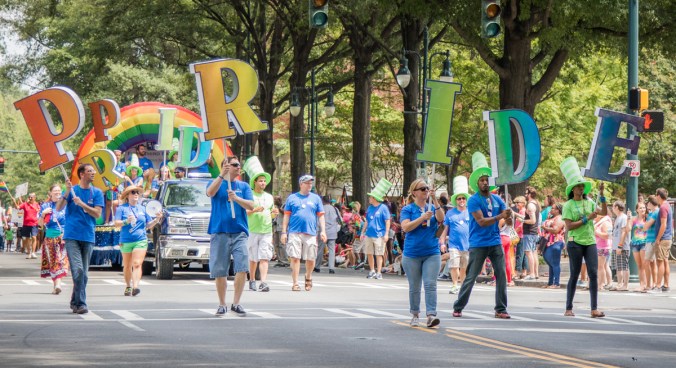
From The Law vs. Ethics File: The Discriminatory Charlotte Pride Parade

Brian Talbert, a member of “Gays for Trump,” submitted  an application to Charlotte Pride, Charlotte’s Gay Pride parade, so they could have a float in this year’s event. His application was rejected, with this explanation:


Charlotte Pride reserves the right to decline participation at our events to groups or organizations which do not reflect the mission, vision and values of our organization, as is acknowledged in our parade rules and regulations by all groups at the time of their parade application. In the past, we have made similar decisions to decline participation from other organizations espousing anti-LGBTQ religious or public policy stances.

Charlotte Pride envisions a world in which LGBTQ people are affirmed, respected and included in the full social and civic life of their local communities, free from fear of any discrimination, rejection, and prejudice.

Charlotte Pride invites all individuals, groups, organizations and causes which share our values to join our community’s celebration of the LGBTQ community, history, arts and culture during the Charlotte Pride Festival and Parade, Aug. 26-27, 2017.

In other words, because Charlotte Pride does not support Talbert’s political views, he is being denied the opportunity to present a minority point of view. Constitutional Law prof Eugene Volokh explains why this is entirely legal:

“First, Charlotte and North Carolina do not ban discrimination by parade organizers based on political affiliation. Only a few jurisdictions include political affiliation on their lists of prohibited bases for discrimination.

Second, even if a public accommodation law did ban such discrimination, it couldn’t apply to parades organized by nongovernmental organizations. Such parade organizers have a First Amendment right to exclude groups from their parades based on the messages the groups convey about their members’ sexual orientation, political affiliation, religion, race and whatever else to make sure that a parade conveys just the speech that parade organizers want to convey.”

The precedent Volokh cites for this principle? Why, it’s Supreme Court’s holding in Hurley v. Irish-American Gay, Lesbian, and Bisexual Group of Boston, Inc. (1995), declaring that the organizers of Boston’s St. Patrick’s Day Parade had a First Amendment right to exclude the gay/lesbian/bisexual group.

It seems that many groups advocate diversity, tolerance and fairness until they achieve the power to do their own discrimination. That is, good bigotry. Discriminating against gays is bad.  Gays discriminating against gays who support the President of the United States is good.

Sure it is. Golden Rule? What’s that? This is intolerance, bigotry, a failure of integrity, hypocrisy….and also bullying, as it aims to coerce group members to accept mandated political views that are not their own.

But it’s not illegal, so it’s all right! Continue reading

Ethics Alarm Check: What Do You Do If You Get A Text Like This One From A Close Friend?

Hypothetical:

A friend asks via text:

“What you do if you knew a friend was trying to commit suicide?”

You text back,

“Talk them out of it”

Then he texts you…

“The thing is i wanna help kill them. it be awesome. seriously im going to help her. Its like getting away with murder! Im so fucked up. I’m seriously not joking. Its going down in about a week or two.”

This was the actual scenario preceding the suicide of a 16 year old girl (above. left) in Utah.

Hunters found the girl’s body hanging from a tree.  A can of industrial strength air duster and a cellphone were nearby, and the latter  contained a video of the girl’s death.

It showed the girl with a noose around her neck, standing on  on a rock. She inhaled the contents of the air duster can, lost consciousness, and fell off the rock, causing the noose to tighten and slowly strangle her. The video captures the ten minutes  it took the girl to die.

Tyerell Przybycien, 18, arrived at the scene to claim credit for the video, telling officers that he knew the girl and was with her when she died. He told detectives that he had a fascination with death and wanted to see what it was like to watch somebody perish.

Yes, it was Przybycien who wrote the text message to a friend.

There are other disturbing aspects to the story, but my professional interest is in the conduct of Przybycien’s friend. Let us eschew, for now, the question of why anyone would have a friend like this sicko in the first place.

We know the friend has at least rudimentary ethics alarms, since his first response, “Talk her out of it,” was the right one. After that, however, his ethics alarms died. Przybycien told him that he was planning on helping a girl kill herself because it would be a turn-on, and the friend did nothing to stop him…or at least did nothing that did stop him.

We can speculate endlessly about what would work and what would not, but this tragic scenario lands squarely in the realm of the Ethics Alarms principle, “If you are in a position to stop unethical conduct, stop it.” Here a life was involved, activating the coda, “Whatever it takes.”

What might some measures be that could fulfill this ethical imperative?

Continue reading

“Cockholster” Update: Still Unethical, Not Illegal

Or to put it another way, Stephen Colbert’s ugly, vulgar and uncivil slur against President Trump may have been unfunny, biased, demeaning to the audience and the network (CBS), and corrosive to political discourse and the culture—it was all of these—but he didn’t violate any regulations or laws.

Yes, it’s always legal to be smug, pandering, hypocritical jerk.

The FCC spokesman confirmed the commission was not launching an investigation regarding the episode in which Colbert broke new ground in gutter language on network TV.For one thing, the “Late Show With Stephen Colbert”  is exempt from the FCC’s policies on profanity and indecency because its indecent rules only apply to TV and radio shows airing between 10 p.m. and 6 a.m.,  when children are supposedly not in the audience.

That would not save Colbert if his words were judged legally obscene (and thus not protected speech), but Colbert’s comments would not be found obscene under established court standards. Concludes Constitutional law expert (and Supreme Court appointee-in-waiting) Eugene Volokh:
Continue reading

Aaron Hernandez And The Weird Legal Doctrine Of Abatement Ab Initio

The predator priest, the corrupt CEO, and the murderous Patriot, all innocent because they’re dead….

Massachusetts judge Judge E. Susan Garsh ruled that the state’s law required her to vacate the 2015 murder conviction of former New England Patriots star Aaron Hernandez. Because Hernandez’s appeal was pending when he committed suicide in his cell, she said,  the common law doctrine known as abatement ab initio applied: a defendant’s death before an appeal erases his conviction. Prosecutors argued that Hernandez’s purpose in hanging himself on April 19 was to to void his conviction, but Judge Garsh responded that she was bound to follow state law anyway, especially since Hernandez’s motives were unknown. She had presided at the trial in which a jury found Hernandez  guilty beyond a reasonable doubt of the murder of semi-professional football player Odin Lloyd.

The fact that some legal and ethical puzzles have proven unsolvable despite troubling lawyers, judges, legislators and scholars for decades (and sometimes centuries) is one of the best proofs I know for The Ethics Incompleteness Principle, which holds that no rule or principle makes sense in all circumstances, and that human beings are incapable of articulating perfect laws and rules that will work as intended in every case. Abatement ab initio is a classic example.

Abatement is the dismissal or discontinuance of a legal proceeding “for a reason unrelated to the merits of the claim.” It is available in both a civil and  criminal context. Traditionally, the death of a criminal defendant following conviction  but before an appeal can be made mandates abatement. The effect of  the doctrine is to discontinue all proceedings  and to dismiss the appeal as moot, overturn the conviction, and dismiss the indictment. The deceased defendant reverts back to his status before being charged. In the eyes of the law, he is innocent…again. Continue reading

“Should Bystanders Have a Legal Duty To Intervene?” Of Course Not, But It’s Worth Thinking About Why It’s A Terrible Idea

The real mystery is why a law professor would ever conclude that it was a good idea.

Amos N. Guiora, a professor at the University of Utah’s S.J. Quinney College of Law, has authored The Crime of Complicity: The Bystander in the Holocaust, In it, he addresses the   bystander-victim relationship, focusing on the Holocaust. He comes to the remarkable conclusion that a society cannot rely on morality, ethics and compassion alone to move its members to come to the assistance of another human being in danger. He insists that it is a legal issue, and that society should make the obligation to intervene a legal duty, and  non-intervention a crime.

Wow. Here is a shining example of how bias can make smart people not only stupid, but blind. I have not read the book (I did listen to this podcast), because his contention is self-evidently anti-ethical, and typifies the attitude that has led to the criminalizing of so much in U.S. society that rigorous enforcement of the law would make the nation a police state. The Holocaust is the worst possible starting point for this issue: to state the most obvious absurdity, if the government is the victimizer, who would enforce the laws against not assisting victims? I get it, though: the professor is angry and bitter that the international community and Christians didn’t forcefully intervene before Hitler was on the verge of liquidating Non-Aryans from the face of the earth. But no law within imagination would have prevented this unique catastrophe. Nor would the kinds of laws he advocates improve the fate of most victims, or be practically enforceable.

Ethics Alarms has discussed the duty to rescue often and in great detail, and often notes, “when ethics fail, the law steps in.” The second stage of that statement is “and usually makes a mess of it.”  This is the compliance/ethics divide so exposed by corporate compliance rules, regulations and laws, which have done little to improve corporate conduct, and have provided cover for complainant and creative misconduct, like Wall Street leading up to the 2008 crash. Giving up on the teaching and strengthening of ethical values in society in favor of mandating what the state regards as “right” by inflicting punishment degrades society and insults humanity, treating it as if it is incapable of learning to care about others and society at large.  It also seldom works. The duty to rescue exists, but society must encourage and foster it by nurturing ethical society members, not by threatening them with punishment.

Society cannot mandate compassion—a law requiring charity?—kindness—a ticket for not rescuing an abandoned dog or helping a blind man across the street?—honesty–fines for telling a date that you’ll call the next day when you won’t?—-or courage —Sweep that child up whose in the path of a semi, or to jail. Of course it can’t. Increasing reliance on the state to force what a powerful group regard as “good behavior” is the catalyst of the current totalitarian bent of the American Left. Doesn’t the professor realize that what he is advocating leads directly to the Holocaust, and not away from it?

This is one slippery slope that needs a fence around it. Continue reading

Torturing Kids For Giggles And Profit: The DaddyOFive Videos And The Cultural Scourge Of Child Exploitation

The story on “The Conversation”: is headlined, “When exploiting kid for cash goes wrong on YouTube….” and there we have the problem in black and white.

Exploiting kids is wrong to begin with and in all respects; it can’t “go wrong.” The culture doesn’t just get it. This ethics alarm has been sounding at ear-breaking pitch for a long time. Too many adults and media opinion-makers have not just tolerated cruel and abusive uses of children by the very people who are obligated to protect them—their own parents– but encouraged it. In such a child-focused culture,where “Think of the children!” is an all-purpose emotion-bomb employed with regularity to obliterate  rational policy arguments, this ugly realm of ethics blindness still thrives.

Ethics Alarms has done its best to cast a light on the cultural scourge from the blog’s beginnings. There were “the Biking Vogels.”  There was Jon and Kate Plus Eight. But what chance do I have trying to explain that all child exploitation is unethical whether it is done for cash or not, when a late night TV star, Jimmy Kimmel, has been gleaning fans, applause ratings and YouTube hits by encouraging parents to “prank” their own children to almost no criticism at all? I even started a Facebook page to stop Kimmel from doing this, as he does every Christmas, Halloween, and whenever his child-hating writers have a sadistic brainstorm.

Maybe the exposure, shaming and punishment of Heather and Mike Martin, of Ijamsville, Maryland will finally have some impact, but at this point I am dubious. Yesterday these horrible people appeared on ABC’s Good Morning America to weep, lie, grovel and try to make the public feel sorry for them, as their torture videos threaten to cost them custody of some or all of their children.  Anyone who does feel sorry for the Martins is a fool, and perhaps one of the complicit millions of internet viewers who rewarded the couple for using their children as props, dupes and victims. When you make money by torturing your children to attract YouTube hits, that is signature significance. You are a vile human being, with your values and ethics rotting somewhere in your brain like a dead rat in the attic. The Martins are indefensibly ethics-free human beings, though just two of many. How much can the culture condemn them, when an even worse human being is paid millions by ABC—the hypocrisy of the network is staggering—to encourage the same conduct they are now being, finally, attacked for?

The YouTube video that finally served as a tipping point was the one where the Martins poured  ink on the bedroom floor of one of their five young children. The Washington Post describes it:

Heather Martin, a.k.a. “MommyOFive,” is screaming. “Get your f—— a — up here!” she yells at Cody, her young son. Mike Martin — DaddyOFive to his family YouTube channel’s 750,000 subscribers — follows along behind with the camera as Cody runs upstairs. Soon, he is yelling, too: “What the hell is that?” There is ink all over the floor of Cody’s room. The boy begins to cry. “I didn’t do that,” he says, his face turning red. “I swear to God I didn’t do that.” For three minutes, the parents scream and swear at Cody and his brother Alex, accusing them of spilling the ink. Suddenly, MommyOFive reveals a small bottle in her hand. She smiles and laughs. The ink was trick ink, she says, it will disappear from the floor. “You just got owned!” DaddyOFive says, pointing the camera in the faces of his children, who appear to be elementary school-aged. “It’s just a prank, bruh!” As the Martin parents laugh, their children remain sitting on the bed, faces still red from crying.

HAHAHAHAHAHA!!! This is hilarious!

With over 760,000 subscribers,  DaddyOFive earned between$200,000-350,000 each year from YouTube advertising revenue. The ink prank wasn’t the worst of the videos either, not at all. In addition to the emotional abuse being inflicted on the Martin kids, there was often physical abuse. Some videos showed them being pushed into furniture or walls by their father, or being struck by siblings. Here is a sampling of the videos, as they were promoted on DaddyOFive:

Nice. Although these have all been removed by the Martins or by YouTube for violations of their policies—which YouTube apparently only enforces vigorously when sufficient bad publicity is stirred up—they have been archived here. Continue reading

Ethics Dunce: Annie Peguero, Defiant Breast-Feeding Mom

Ah, yet another feast from the legal/ethical divide, with seasoning from the minority/majority ethics balancing dilemma, and a side-dish of favored group arrogance and entitlement! The beverage? Why breast milk, of course!

Yum!

Annie Peguero’s 19-month-old baby became unruly during the service at the Summit Church in Springfield, Virginia, so she nursed her, right there, in the church. She was quickly asked to move the operation to a private room, but Peguero refused.The church staff told her that it does not allow breast-feeding without a cover because the activity might make members of the congregation uncomfortable.

The mother of two left the church, and soon posted a livestream video on Facebook telling viewers her side of the story and urging women to stand up for breast-feeding.

“I want you to know that breast-feeding is normal,” she said.

Is it normal without any cover in a church? That church? Peeing is normal, but I wouldn’t rely on the “normal” categorization take a whiz in a pew. Farting is normal, but if I felt a big one coming, I would excuse myself. Eating is normal, but chowing down on a huge Italian sub during the hymns would be in bad taste. Sex is normal, but…well, you get the idea. Annie doesn’t.

To complicate the matter, breast-feeding is a legally protected right in Virginia thanks to badly written 2015 law that says women have a right to breast-feed anywhere they have a legal right to be. Dumb law, overly broad, and probably the result of pandering to the mommy lobby while assuming that mothers wouldn’t try to stretch the law to absurd limits. But Virginia also has a Religious Freedom Preservation Act, § 57-2.02, which says,

No government entity shall substantially burden a person’s free exercise of religion even if the burden results from a rule of general applicability unless it demonstrates that application of the burden to the person is (i) essential to further a compelling governmental interest and (ii) the least restrictive means of furthering that compelling governmental interest.

Do we really think that churches shouldn’t be allowed to have dress and decorum codes and policies? Continue reading