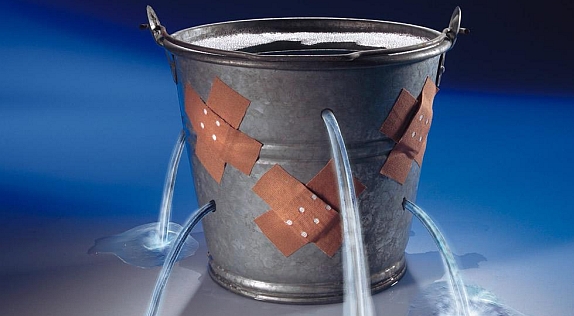
Salon Asks: “When Is A Leak Ethical?” NEVER. That’s When.

Ethically challenged left-wing website Salon somehow found an ethically challenged law professor, Cassandra Burke Robertson, to justify the leaks in the Trump Administration. Robertson,  despite being a Distinguished Research Scholar and the Director of the Center for Professional Ethics at Case Western Reserve Law School, advocates unethical and sanctionable conduct in a jaw-dropping post, “When is a leak ethical?

Here, professor, I’ll fix your misleading and dishonest article for you: It’s NEVER ethical to leak.

Never.

She begins by noting “I am a scholar of legal ethics who has studied ethical decision-making in the political sphere.” Wow, that’s amazing….since she apparently is hopelessly confused about both, or just pandering to Salon’s pro-“resistance” readers.

Robertson writes:

“Undoubtedly, leaking classified information violates the law. For some individuals, such as lawyers, leaking unclassified but still confidential information may also violate the rules of professional conduct.”

1. It is always unethical to break the law, unless one is engaging in civil disobedience and willing to accept the consequences of that legal breach. By definition, leakers do not do this, but act anonymously. Thus leakers of classified information, lawyers or not, are always unethical, as well as criminal.

2. Lawyers may not reveal confidences of their clients, except in specified circumstances.  Here is D.C. ‘s rule (my bolding): Continue reading

Ethics Fouls and Julian Assange’s Rape Case

Well, well, well, Mr Assange!

How does it feel to have your own embarrassing and confidential information leaked to the media and publicized to the world?

On the sound ethical principle that two wrongs doesn’t make a right, The Guardian acquiring and publishing the leaked police report relating to Assange’s rape charges in Sweden is no less unethical because Assange is a smug foe of confidentiality. Nevertheless, it is hard to recall an instance when seeing the tables turned on someone was so satisfying. Ethics foul: Whoever leaked the records, and The Guardian for printing them. But thanks anyway.

It is satisfying for reasons other than delicious irony. Continue reading

Daniel Schorr’s Ethical Legacy

It was interesting, though a little jarring, to read and hear the outpouring of admiration for the late CBS and NPR journalist Daniel Schorr, who died last week at the age of 93, even as the same sources were decrying the biases of Fox News. For Daniel Schorr was the herald of ideologically slanted journalism, though he never admitted it and was notable for his self-congratulatory dedication to what he called journalistic ethics. His legacy is what we have now: self-righteous journalists who refuse to separate fact from opinion, and whose definition of “fair and balanced” is “expose the bad guys—that is, those who we think are the bad guys.”

Some of the odes to Schorr’s career themselves defy any reasonable definition of objective reporting. During his 25 years at NPR, Schorr comfortably settled into reliably pro-liberal, pro-Democrat reporting, calling, for example, the Supreme Court’s decision in Bush v. Gore, “a judicial coup” by “the Gang of Five, philosophically led by archconservative Antonin Scalia.”

“Some critics of Schorr and NPR felt his analysis veered into opinion — that he had a profoundly liberal take on the world that became more evident over time,” said NPR in its obituary of Schorr.

Gee…How could they think such a thing? Continue reading

Ethics and Valleywag’s Apple Tablet Scavenger Hunt

Today is the day Apple will unveil its long-awaited tablet device, destined to be the most culture-altering advancement since, well, the Segway or something. Apple’s excited about it, anyway, and as is usual for that company, it has fiercely guarded against premature leaks regarding its newest innovation. In the process, it threatened to sue the proudly sleazy website “Gawker,” which had one of its misbegotten offspring, the Silicon Valley gossip site “Valleywag,” announce the “Apple Tablet Scavenger Hunt,” which dangled cash prizes for anyone who would uncover and leak tablet information to the website before January 27. Saying said it had “had enough of trying to follow all the speculation,” Valleywag published a bounty list describing what it would pay for and how much, ranging from $10,000 for photos to $100,000 for anyone who could put the tablet in its editors hands.

Apple’s lawyers responded with a cease and desist letter, saying that the scavenger hunt scheme violated trade-secret law and induced others to breach their confidentiality agreements with the company. Naturally, Gawker cried “First Amendment!”

It appears that the lawsuit won’t go forward, since the tablet announcement date is here; a pity, because a lawsuit couldn’t happen to a more deserving operation, and because a court decision would have clarified an interesting issue. We all know the media happily acts as information-launderers, accepting documents and secrets from lawyers, government officials and corporate whistleblowers who could be fired, disciplined, sued or prosecuted for leaking them, and publishing the illicitly acquired information with self-righteous pride, not to mention confidence, since the Constitution says the press can print anything. The issue is this: if the media can publish such leaks, can it also induce them directly with cash? Continue reading