Ethics Verdict: Stanford Law Prof. Mark Lemley and Law Firm Lex Lumina Are Unethical

…and their conduct in the Facebook matter is damaging to the profession of the law.

Intellectual property expert Mark Lemley, a professor at Stanford Law School and a partner at law firm Lex Lumina, represented Facebook in the copyright case brought on behalf of creators claiming the platform infringed their intellectual property. Yesterday he “fired” his client, despite believing that Meta’s case was strong. His stated reason was that he is outraged at Mark Zuckerberg and Meta’s “descent into toxic masculinity and Neo-Nazi madness.” His law firm then proceeded to back him up.

Here is Lemley’s Facebook post announcing his decision:
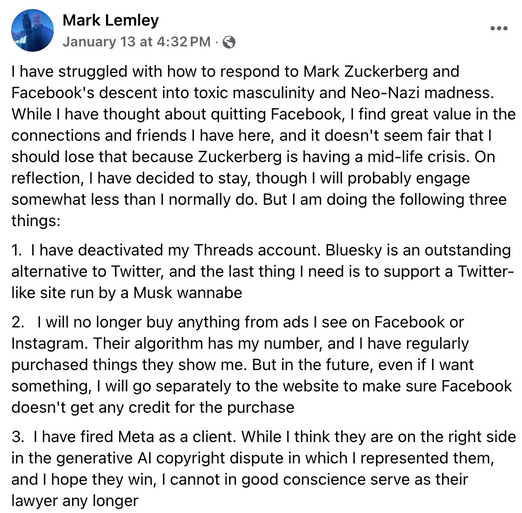
Meanwhile, the managing partner of his woke law firm followed with the statement that “Money can’t buy everyone. We’re proud to be a firm that doesn’t sell out our values. Sadly, it seems this is becoming a rarer and rarer quality in America today.” Another partner said, “When we started Lex Lumina, one of the things we committed to was only taking cases we felt good about, on the law and in terms of who we represented. Proud to be working with my friend and partner, Mark Lemley, who lived out our commitment today.”

This is labeling unethical lawyer conduct as ethical.

Lemley went on to post a reiteration of his decision on LinkedIn. It wasn’t “the right call.” If Lemley and his firm had refused to represent Meta in the case of Kadrey v. Meta Platforms initially, there would be no ethics foul: nothing in the Rules of Professional Conduct mandates that any lawyer accept any client, although the traditional ethos of the profession strongly encourages lawyers to do so. However, dropping a client because of what that client has done or said that has nothing to do with the case of the representation, while not a strict rules violation, is unprofessional and creates a dangerous slippery slope…one that many in the legal profession have been leaping down in recent years.

Noteworthy is the fact that Lemley is no legal ethics expert. His actions demonstrate that vividly, and his post is a flashing sign stating, “I am biased, Trump Deranged, a Democrat, and believe in good censorship.” Got it, Professor.

Naturally, the woke legal hacks at Above the Law love this, and ratioanalizes it with an argument that has been rife since the corrupted legal profession started behaving like the restaurants who won’t serve people wearing MAGA caps. Joe Patrice, the head ideologue at Above the Law writes,

A sanctimonious segment of the legal profession harps on the idea that “everyone is entitled an attorney.” Except no one is entitled to you as an attorney. Frankly, no one is entitled to anything in a civil case and to the extent society needs to extend more protections to indigent clients on the wrong end of life-altering civil actions — landlord-tenant cases for instance — there’s definitely no such entitlement for a multibillion-dollar company in a copyright dispute.

Representing a client is a business decision. Some lawyers thrive as counsel of last resort and model their business around the willingness to represent unpopular clients. Other lawyers build their business on crusading for good causes. A whole lot of lawyers exist somewhere between those poles. In fact, a lot of deep-pocketed clients also don’t want to work with firms associated with unpopular causes — that’s a business decision too.

There’s nothing wrong with any of these approaches. Lawyers should feel free to build their practice however they want.

What is wrong with that argument is that it violates Kant’s Rule of Universality, the “What if everybody did it” test that is part of the philosopher’s categorical imperative. Patrice’s standard, and accepting Lemley’s conduct, would mean that certain citizens and organizations could be left without legal representation entirely because they were regarded by a politicized legal profession (and an ethically addled public) as “bad.” While it is accurate to assert that the Sixth Amendment does not guarantee a citizen legal representation in a civil (as opposed to a criminal) case, the legal professional has long embraced the principle that the same ethical and practical justifications should apply. If we accept Patrice’s ethically ignorant (or deliberately misleading) argument that whether to accept a representation is purely a business decision, that allows lawyers and firms to avoid unpopular clients, leaving them potentially at the mercy of the polls and bias in a rigged legal system.

This is what the actions of Lemley and his firm are pointing to. It is the reason Donald Trump has had difficulty hiring lawyers and getting competent legal assistance. Firms and lawyers get threatened by clients, and in the constant tug-of-war between the profession of law and the business of law, business now prevails. Once, before the progressive bias in laws schools and among lawyers became the status quo, the mission of representing unpopular causes and clients, even when the attorneys for these clients personally disagreed with and even deplored their conduct was seen as part of the legal profession’s mission. Wall Street lawyers represented accused terrorists after the bombings of 9/11 after public figures called for their firms to be boycotted. When Coca-Cola virtually extorted their law firm into dropping its representation of the House Committee defending the Defense of Marriage Act before the Supreme Court, the partner handling the case, Paul Clement, wrote in his letter of resignation in protest of the decision, that “defending unpopular positions is what lawyers do.” Similarly defending unpopular clients is what lawyers must do and be honored for, or we have no longer have an equitable legal system.

The unethical principle Lemley is advocating is worse than opposing taking on an unpopular position: he seeks to justify abandoning a position he feels is valid because his client’s policies no longer please him. I have vowed to promote this section of the Rules of Professional Conduct because it is such a crucial one for maintaining the integrity of the profession and trust in its members:

“A lawyer’s representation of a client, including representation by appointment, does not constitute an endorsement of the client’s political, economic, social or moral views or activities.”

It should be obvious that if it becomes acceptable for lawyers and firms to refuse representations because they fear being regarded as endorsing a clients’ “political, economic, social or moral views or activities,” the legal profession will have nullified that critical standard in practice, and the public will be correct to assume that if a lawyer or firm represents an unpopular cause or individual, those lawyers agree with and endorse them. This is what ideologues like Joe Patrice want, a legal system as polarized as the political system, where one can tell the “good” lawyers from the “bad” lawyers by whom they choose to represent.

Dropping a client one has already accepted, which is what Lemley has done, is worse still. In his letter excoriating his former firm, Clement quoted Griffin Bell, a judge and former U.S. Attorney General, declaring that once a lawyer has accepted a case, it is the lawyer’s duty and ethical obligation to continue the representation. In 2011, when the DOMA controversy erupted, Clement’s position was almost unanimously praised within the profession. Theodore Olson, the late conservative attorney, praised Clement’s “abilities, integrity, and professionalism”.” Olson, who like Clement was a solicitor general during the George W. Bush administration and was a successful Supreme Court advocate, told the media, “I think it’s important for lawyers to be willing to represent unpopular and controversial clients and causes, and that when Paul agreed to do that, he was acting in the best tradition of the legal profession.” Seth Waxman, who served as solicitor general during the Bill Clinton administration, said, “I think it’s important for lawyers on the other side of the political divide from Paul, who’s a very fine lawyer, to reaffirm what Paul wrote. Paul is entirely correct that our adversary system depends on vigorous advocates being willing to take on even very unpopular positions.” In approving Clement’s stand, The Washingtonian observed, “There are countless examples of law firms taking on and standing by controversial clients, even at the risk of their public images.” There are fewer and fewer examples now, however. This is the dystopian legal landscape that Lemley and his firm are promoting, and it is an unethical one.


Continue reading

The 2024 Ethics Companion To “Miracle On 34th Street” [Updated, Expanded and with a New Introduction]

2024 Introduction

When I look back on what I wrote to introduce the greatest of all Christmas movies last year, I almost have to laugh, if I could laugh.

“What makes ‘Miracle on 34th Street” the most appropriate classic Christmas film for 2023 is its theme: the importance of conquering cynicism and  pessimism, and always keeping one’s mind and heart open to hope…. I know my year has been especially miserable on multiple fronts. Nonetheless, I remain, at heart, about 12 years old. The same things make me laugh; my level of optimism remains high; I believe in this nation’s miraculous ability to somehow get out of the fixes it gets itself into; I’m still a romantic, and, yes, I think with a little luck and one more starting pitcher, the Boston Red Sox can make it to the World Series next year. I am being constantly confronted with old friends, some much younger than me, who have suddenly decided to be old: they think old, they act old, and they seem to have given up the future as irrelevant. The Santa Claus myth represents faith in the possible, or rather the impossible. Yes, its easier when you are a child, but it is worth the fight to never lose the part of you that still believes in magic and miracles.”

What a joke on me. My wife died unexpectedly in February. Hidden financial horrors were uncovered that she had been hiding from me. My son decided he was trans; a lot of those friends who were acting old ended up acting dead, and rather convincingly. I lost my last connection to my mother’s family when Aunt Bea died at 96; my mentor and Most Unforgettable Person, Tom Donohue of the U.S. Chamber of Commerce, died as well; one of my closest lawyer clients died too. Another loss that I felt: Luis Taint, the Boston Red Sox pitcher who was at the center of some of my most cherished baseball memories, died this year. A big theatrical project I had been working on for six months was abruptly cancelled (the theater was condemned as structurally unsound). Worst of all, the Red Sox had a star-crossed, frustrating season: if there’s anything worse than watching baseball alone, it’s watching your team lose alone.

Indeed, I do, as Auntie Mame sang, “need a little Christmas,”  but it is very little indeed this year. Luckily for me, there’s a song for that: “Have Yourself a Merry Little Christmas,” from “Meet Me in St. Louis.”

So the Christmas movies are about it for me this holiday season. I’ve seen “It’s a Wonderful Life,” “White Christmas,” my favorite version of “A Christmas Carol,” “The Santa Clause,” and even “Holiday Inn.” (No, “Die Hard” and “Die Hard 2” are not “Christmas Movies.) “Elf” doesn’t make the cut; I suppose that I’ll see “A Christmas Story” eventually, though I am sick of it, and Grace’s complaints about Melinda Dillon’s hair haunt me. I will revisit “Home Alone” and “Home Alone 2.” I’m saving “Miracle on 34th Street” for tonight, Christmas Eve.

I confess, I believed n Santa Claus until I was 12. I didn’t want to give the fantasy up: I loved magic, and my parents always tried to make the season magical. (More of that later.) Grace and I tried to do the same with Grant, now “Samantha,” but he was a non-believer by the third grade. Is there anything more joyful to see than the look on a child’s face as he or she sees what Santa has delivered? Will anything feel that wonderful again?

“Miracle on 34th Street” is an ethics movie in part because its artists committed to telling a magical story and charming audiences by working as an ensemble selflessly and  efficiently. The director,  George Seaton also  wrote the screenplay, and it won him an Oscar. He cast his movie brilliantly, and making the correct but bold decision to stick with a matter-of-fact, realistic, unadorned style that keeps the story grounded in reality while it spins off into fantasy.

“Miracle on 34th Street” is about the importance of believing in good things, hopeful things, even impossible things. The movie reminds us that wonderful things can happen even when they seem impossible, and that life is better when we believe that every day of our lives. I’m trying.

One thing this film does well is to concentrate on the secular holiday without any allusions to the religious holy day, but not being obnoxious about it. “It’s a Wonderful Life” straddles the line very cleverly: it begins in heaven, after all. All the “A Christmas Carol” films include Bob Cratchit telling his wife that Tiny Tim mused about how his disability reminded people of Jesus’s miracles at Christmastime, and that’s Dickens’ only reference to Jesus in his story. On the offensive side is the Rankin-Bass animated “Rudolph the Red-Nosed Reindeer”—I can’t believe they still show that thing—when the “stormy Christmas Eve” causes Santa to decide to “cancel Christmas.” I’d say that’s above Santa’s pay grade, wouldn’t you agree? It also suggests that Christmas is only about gifts and children. (Do parents today explain that the singing snowman who narrates the story is based on (and looks like) the real person who also sings the most memorable songs? They should. Burl Ives had a fascinating life and a varied career, and those kids will probably be hearing him sing “Have a Holly Jolly Christmas” for the rest of theirs.

Last year I discussed the many remakes and the fact that they all fail to equal the original. I wonder why this, of all the Christmas classics, has inspired so many remakes. Nobody would dare remake “It’s a Wonderful Life.” I think it’s because the story connects with children as well as adults, and there is a sense that a black and white movie very obviously set in the 1940s seems too distant. 

Interestingly, all of the perennial Christmas movies have been made into stage musicals of varying success—“White Christmas,” “It’s a Wonderful Life,” “A Christmas Story,” “Elf”—- but “Miracle on 34th Street” flopped so badly when Meredith Willson [“The Music Man”] adapted it as “Here’s Love” on Broadway that nobody has tried again. The show included the song, “It’s Beginning to Look a Lot Like Christmas,” which Willson wrote long before the show was assembled, and it was still the best song in the weak score. At one point John Payne took over the part of Fred Gailey, reprising his role in the film. But as with all the movie remakes, the show missed Edmund Gwynn, the best Kris Kringle of them all.
Continue reading

Two Faint Cheers For the Colorado Supreme Court in “Jerk vs. Jerk”

It looks like the political correctness Furies who have been swarming around Jack Phillips, the Masterpiece Cakeshop owner whose refusal to bake, decorate and sell same-sex wedding cakes had him targeted for destruction have finally been foiled.The Colorado Supreme Court has dismissed the latest lawsuit against him, though not on the merits. Legal Insurrection has detailed coverage and a retrospective on this almost decade-long drama here.

Remember the old Mad Magazine series called “Spy vs. Spy”? This has been “Jerk vs. Jerk.” I sided with the baker in the original lawsuit over the same-sex wedding cake, though holding even then that the adversaries were being unreasonable. Ethics Alarms advised one, “Oh, bake the damn cake!” and the other, “So find another bakery!” That battle got all the way to the U.S. Supreme Court, where the baker won on what non-lawyers call “a technicality.” Then Phillips was targeted again, as LGTBQ activists apparently considered it a matter of honor to bend him to their will.

Continue reading

Why I Just Billed A Client For My Dog’s Evening Walk….

In “The Firm,” the corrupt lawyer played by Gene Hackman tells new associate Tim Cruise that he is supposed to bill for every second he is thinking about a client’s work, in the shower, on the toilet, at the movies. Inflating fees is one of the most flagrant and common of all lawyer misconduct, and it is almost impossible to prove unless a lawyer does something stupid like billing more than 24 hours a day (and an amazing number of lawyers have tried that). In the film version of “The Firm,” in fact (though not in the novel) Cruise’s character uses proof that the mobbed-up firm he worked for was over-billing clients to wiggle out of his own legal and ethical dilemma.

As a general rule, I think it’s generally dishonest to bill clients for every thought.

I am preparing an ethics report, and doing so with a famous, legendary, super-credentialed lawyer who charges four times what I do as my ethical adversary. His experience and credentials make me look like comparative piker, but 1) I’m on the right side of this issue 2) his ethics report was pathetic and 3) this case is in my wheelhouse, not his.

Continue reading

Gee, I Wonder Why the Public Is Losing Trust In The Justice System….

I am heading to Richmond to do a three hour legal ethics seminar, and in my preparation, I ran across this depressing story. The seminar is called “Legal Ethics Unmasked,” and man oh man, has watching lawyers, prosecutors and judges reveal the creeps beneath been disillusioning.

The ABA headline was certainly clickbait: “Judge settles suit accusing lawyer of threatening to release her intimate photos in bid to scuttle deposition.”

Continue reading

Is Marco Bisbikis The Most Unethical Lawyer Ever?

How could a lawyer be more unethical?

As unethical, sure: I am confident that there have been other lawyers who are tied with this Michigan lawyer for the title. But more? Consider:

Marco Bisbikis, a Michigan lawyer in good standing, worked as an attorney for the Dan Hutchinson and his wife, wrote himself into popular Oakland County jeweler’s will while he was preparing it for his client, who was also under the impression that his attorney was a loyal friend. (Can you blame him? Who wouldn’t trust a face like that?)

Then Bisbikis paid a hit man to shoot and kill Hutchinson so the lawyer could inherit millions of dollars in a trust fund. On June 1, 2022, outside an Oak Park pawn shop, the hit man did just that. Bisbikis and the hired killer, Roy Larry, were convicted of first-degree murder, conspiracy to commit murder, solicitation of murder, and felony firearm and in June they were both sentenced life in prison. Two other men involved in the plot were convicted and sentenced last year.

Continue reading

Ethics Villain: Ex-J.D. Vance Friend Sofia Nelson

“Villain” is the best I can muster right now. I really can’t find the right word for someone who would do what Sofia Nelson did, or who would be able to look at themselves in the mirror after she did it.

Nelson, a close friend of J.D. Vance’s in law school and for many years thereafter, sent about 90 of the emails and text messages they exchanged from 2014 through 2017 to The New York Times. Nelson is gay or a trans-male or a trans-female, or something, I couldn’t possibly care less. Nor will I read the Times’ article about what its partisan “Slime Trump and Vance!” posse found in the emails thus far. All that matters from an ethics perspective is the throbbing betrayal of trust represented by anyone the sharing past private communications with a media outlet without obtaining consent and permission from the other party to the exchanges. It’s revolting that the Times would accept such stuff: this is a National Enquirer level story. Trump’s running mate once wrote “Love you” to a guy who is now a chick! Ew! Does that mean Vance is gay, not that there’s anything wrong with that?

Continue reading

Yet Another Candidate For My Proposed New Standard For Disbarment…

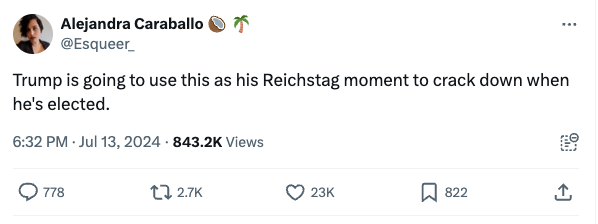
Alejandra Caraballo, a clinical instructor at Harvard Law School’s Cyberlaw Clinic, has joined the large cadre of fools who seem to seriously believe former President Donald Trump has a strong similarity to Adolf Hitler. After the assassination attempt on July 13, Caraballo posted on Twitter/”X”: “Trump is going to use this as his Reichstag moment to crack down when he’s elected.” See?

Continue reading

Ethics Dunce and Legal Ethics Dunce: The Connecticut Bar Association

This is concerning, but, frighteningly enough, not surprising. As Ethics Alarms has noted many times, the legal profession has been among the critical institutions most thoroughly corrupted, indeed lobotomized, by partisan bias and Trump Derangement. As if that wasn’t bad enough, I am also getting reports from various quarters about the deep corruption in many state bar associations. This is especially problematic for me, as bar associations are a significant market for my ethics training services (if they ares sufficiently corrupt, such organizations tend to say “We don’t need no stinkin’ ethics training!”). Well, the Connecticut Bar is in the minority of bar associations that have never sought my wisdom, so I am unencumbered by conflicts of interest.

Continue reading

The Nathan Wade Interview: Apparently Fulton County Lawyers Don’t Get That “Legal Ethics” Thingy…or Ethics Generally

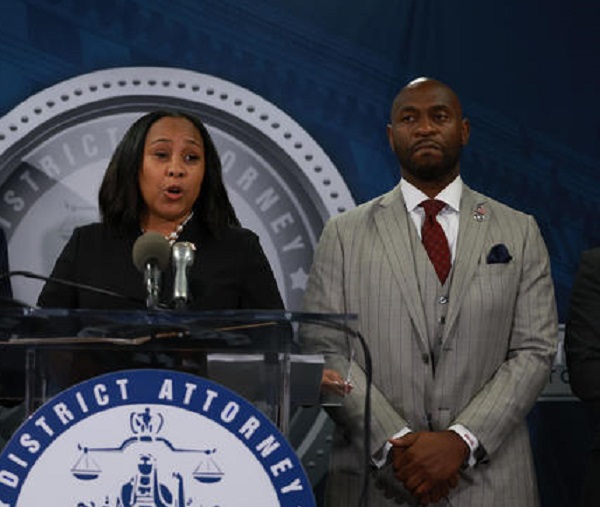
I find the transcript of the interview of deposed Fani Willis prosecutor and loverboy Nathan Wade many things: damning, outrageous, disgusting, shocking. Mostly I find it to be more evidence that I have wasted the last 25 years trying to make the legal profession more ethical. This guy, a “prominent and respected Atlanta lawyer,” not only doesn’t know what ethics is, he’s infuriatingly smug about his ignorance.

These are the people Democrats have placed in charge of “saving democracy” by using the criminal laws to keep Donald Trump from delivering condign justice to the Biden presidency, as in crushing, unequivocal defeat.

On Sunday’s “World News Tonight” and Monday’s “Good Morning America” ABC revealed two segments (here and here) from an “exclusive” interview with former Fulton County, Georgia special prosecutor Nathan Wade. He was, you’ll recall, forced to withdraw from the lucrative gig gifted to him by his girlfriend Fani Willis by the judge in the case, Willis’s prosecution of Donald Trump for “election interference.”

If there are more segments, I think I’ll pass: cleaning up the serial head explosions caused by what I’ve seen already is more than enough for me. Nothing in them could change my mind about Wade (or Willis) at this point. He’s not just an unethical lawyer.He’s a fick. And an asshole.

I’ll just repeat some of the more glaring statements so you get the idea:

  • Asked how he could endanger a high profile prosecution by letting an illicit romance pollute the prosecution: “You don’t plan to develop feelings. You don’t plan to fall in love. You don’t plan to  have some relationship in the workplace that we  you don’t set out to do that and those things develop organically. They develop over  over time. And the  the minute we had that sobering moment, we discontinued it.”

I see: he’s 13 years old, then….just so darned romantic or horny that he couldn’t help himself, even though this was exactly the opposite of professional behavior. Continue reading