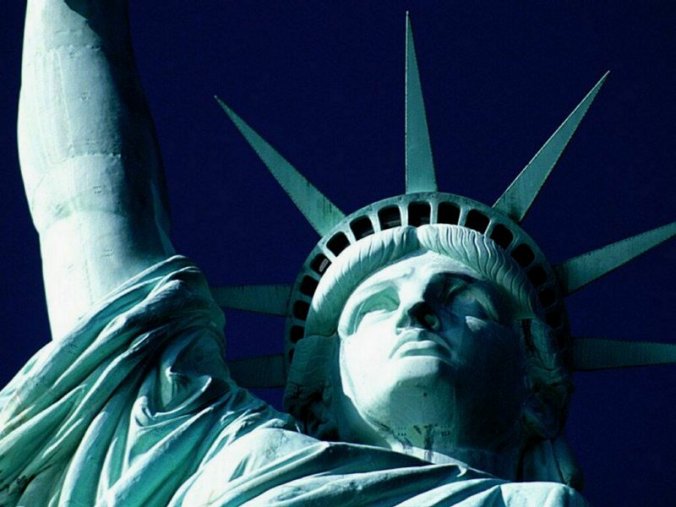
Mark Of The Demagogue: The Ignorant And Dishonest Appeals To Emma Lazarus

Friends and followers: Don’t let anyone get away with this. Using “The New Colossus,” the 1883 poem that appears on the Statue of Liberty as authority in any current debate over national policy is either fatuous, ignorant, dishonest, stupid, or a cynical effort to appeal to the emotions of those who have no grasp of history or logic.

There is are periodic outbreaks of silly Lazerus worship every now and then, and we’re in the middle of another one. Indignant memes showing Lady Liberty and some or all of Emma’s one hit poem are popping up all over social media. Anyone who posts one is either an ignoramus, a liar, or shamelessly trying to suck up to progressive friends who are dishonest and ignorant, hoping that nobody will notice. I notice, and so should you. Call them on it. Appealing to the words of “The New Colussus” is approximately as  valid as extolling the words of “Imagine,” “Jabberwocky,” or “Me So Horny.” Anyone who tries it should be mocked and shamed.

The Trump administration issued a final rule yesterday empowering federal officials to deny green cards to legal immigrants who have received certain public benefits or who are deemed likely to do so in the future. Good. This is sensible and responsible policy, and while polls are inaccurate and the public doesn’t understand what it says it approves or disapproves of much of the time, it is also policy about 3/4 of the public seems to agree with.

Of course, Democrats are calling it “racist,” since anything that the Trump administration does is racist. The negative stereotype of the immigrant who dashes to the welfare office the second he becomes a citizen has been around for decades…

but Americans don’t find the behavior funny, and should not. Expecting new Americans given the privilege of using our individual liberties to succeed to the extent their abilities, creativity and diligence will take them to be self-sufficient is completely reasonable and responsible. It also is 100% consistent with the expectations when Emma Lazarus wrote her poem. There was no welfare, public housing, food stamps or other public assistance waiting for those  tired,  poor,  huddled masses yearning to breathe free. There was just the air to breathe free, and the opportunity to succeed or fail. Continue reading

Comment Of The Day: “Morning Ethics Warm-Up Overstock, 5/15/ 2018: It’s Use Them Or Lose them…”

Good things can even come out of really dumb ethics episodes, like the effort to silence critics of illegal immigration by pointing out that they had legal immigrants in their lineage, a non sequitur if there ever was one.

This good thing is Greg’s Comment of the Day, on Morning Ethics Warm-Up Overstock, 5/15/ 2018: It’s Use Them Or Lose them…:

The notion that immigrants in the 19th and early 20th centuries assimilated much more quickly than today is largely untrue. In fact, most Americans in the early part of the 20th century believed that the failure to assimilate by Lahren’s ancestors and millions of others like them was a matter for grave concern. These days, we read over and over again that the laws passed in the 1910’s and 1920’s restricting immigration were motivated primarily by racism. But that is a gross distortion. If you read political commentary at the time when those laws were debated, you will certainly find discussion of race (usually referring to what we would now call “nationality,” not to what we now call “race”), some of it quite offensive to modern sensibilities.

But the most important concern expressed by immigration restrictionists was that too many immigrants were failing to assimilate. Most immigrants were not becoming citizens. Consulting my grandfather’s trusty, albeit brittle and yellow, 1924 World Almanac, I see that in 1914, the last year before the first restrictive immigration act was enacted, the Census Bureau reported that there were 1.2 million immigrants to the United States but only 0.1 million naturalizations.

The vast majority of immigrants moved to a few large cities in the North. Census figures in 1910 revealed that in most major northern cities, Americans born of parents who had been born in America (as shorthand, in order to avoid wordy repetition, I’ll call them “American-Americans”) were outnumbered by immigrants and their children. In many cities, the number of immigrants was more than twice the number of American-Americans, and the number of immigrants and their children (about two-thirds of them born to two immigrant parents) was often three to four times the number of American-Americans.

Moreover, most immigrants clustered in insular ethnic neighborhoods where they continued to speak their native languages and follow their native customs, standing largely outside the broader American society. In the 1910 census, the population of the United States was 92 million, of which 33 million were immigrants and their American-born children. Of those 33 million, 23 million told the census that English was not their primary language, with 3 million admitting that they did not speak English at all (although the actual number was generally believed to be much larger). Those heart-warming Italian, Irish, Jewish and other ethnic neighborhoods that you see in countless movies and books? There was a widespread conviction that those neighborhoods were a serious social problem. They were viewed, not unfairly, as encouraging their inhabitants to maintain dual loyalties or primary loyalty to their native countries, perpetuating European ethnic hatreds that imported from their native countries, breeding ethnic criminal gangs (Irish, Italian, Jewish and others), fomenting anti-democratic political tendencies, and most of all, undermining America’s sense of itself as a people joined by common values and purposes. Most Americans believed that something should be done to induce people in those neighborhoods to assimilate into the mainstream of American society; and that this necessary assimilation would never happen if immigration were not curtailed. Continue reading