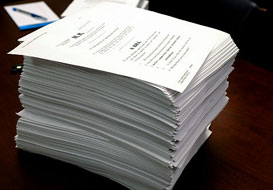
“Don’t blame us for all the mistakes in the law—look at how long it is!”
…on the Affordable Care Act and King v.Burwell, at his news conference. When President Obama was asked about the soon to be announced Supreme Court decision in King v. Burwell, he launched in an epic of unethical assertions and rhetorical games. I’ll highlight the unethical—not merely dishonest in some cases—statements and elaborate afterwards.
THE PRESIDENT: What I can tell state leaders is, is that under well-established precedent, there is no reason why the existing exchanges should be overturned through a court case. (1) It has been well documented that those who passed this legislation never intended for folks who were going through the federal exchange not to have their citizens get subsidies. (2)That’s not just the opinion of me; that’s not just the opinion of Democrats; that’s the opinion of the Republicans who worked on the legislation. The record makes it clear. (3)
And under well-established statutory interpretation, approaches that have been repeatedly employed — not just by liberal, Democratic judges, but by conservative judges like some on the current Supreme Court — you interpret a statute based on what the intent and meaning and the overall structure of the statute provides for. (4)
And so this should be an easy case. Frankly, it probably shouldn’t even have been taken up. (5)And since we’re going to get a ruling pretty quick, I think it’s important for us to go ahead and assume that the Supreme Court is going to do what most legal scholars who’ve looked at this would expect them to do. (6)
But, look, I’ve said before and I will repeat again: If, in fact, you have a contorted reading of the statute that says federal-run exchanges don’t provide subsidies for folks who are participating in those exchanges, then that throws off how that exchange operates. (7)It means that millions of people who are obtaining insurance currently with subsidies suddenly aren’t getting those subsidies; many of them can’t afford it; they pull out; and the assumptions that the insurance companies made when they priced their insurance suddenly gets thrown out the window. And it would be disruptive — not just, by the way, for folks in the exchanges, but for those insurance markets in those states, generally.
So it’s a bad idea. (8)It’s not something that should be done based on a twisted interpretation of four words in — as we were reminded repeatedly — a couple-thousand-page piece of legislation. (9)
What’s more, the thing is working. (10)I mean, part of what’s bizarre about this whole thing is we haven’t had a lot of conversation about the horrors of Obamacare because none of them come to pass. (11)You got 16 million people who’ve gotten health insurance. The overwhelming majority of them are satisfied with the health insurance. It hasn’t had an adverse effect on people who already had health insurance. (12)The only effect it’s had on people who already had health insurance is they now have an assurance that they won’t be prevented from getting health insurance if they’ve got a preexisting condition, (13)and they get additional protections with the health insurance that they do have.
The costs have come in substantially lower than even our estimates about how much it would cost. Health care inflation overall has continued to be at some of the lowest levels in 50 years. (14)None of the predictions about how this wouldn’t work have come to pass.(15)
And so I’m — A, I’m optimistic that the Supreme Court will play it straight when it comes to the interpretation. (16)And, B, I should mention that if it didn’t, Congress could fix this whole thing with a one-sentence provision. (17)
Wow, that’s even worse that I thought. Have there been more dishonest, deceptive, irresponsible statements by a President of the United States? Maybe. I don’t see how there could have been one that was much worse, though.
I’ll try to be brief, or else this will be a book. The numbers correspond to the bolded sections above… Continue reading

 Ethics Alarms