Morning Ethics Warm-Up: 8/2/17

Gooooood morning!

(I don’t know about you, but it’s always a good morning for me when the Boston Red Sox win the most exciting game of the baseball season so far with a three-run homer in the bottom of the ninth after what should have been the last out reached first because  a swinging strike three went through the catcher for a passed ball….)

1. Yesterday, the gang at HLN were laughing and guffawing over the fact that someone sent e-mails purporting to be from Anthony Scaramucci to various White House officials and fooled the recipients into responding. Such publicity is what hoaxers dream about. This is why we have despicable fake news sites like “The News Nerd” and others. This is why Facebook feels it needs a special task force to search out and destroy false representations. CNN and other news media also treated the e-mails as significant news—more newsworthy, for example, than the Pakistani crooks the Democratic party had handling sensitive e-mails and other data. Why is this news, other than the fact that the “bad guys” were fooled, in the warped perspective of “resistance” journalists? More to the point, why is it funny? Why is the news media encouraging hoaxes by rewarding them with the notoriety they crave, so they can puff up their little pigeon chests and say, “See? I matter!”

The reports attempted to bootstrap the story by explaining that fake e-mails are how cyber-predators can get access to e-mail accounts. Those phishing episodes, however, involve the credulous recipients clicking on links in the message, which did not occur here. That’s what Hillary Clinton and John Podesta did. I don’t recall HLN chortling about that, however.

2. I’m still waiting for the news media’s apology to Sarah Palin. The news from UK socialized medicine today:

“Obese people will be routinely refused operations across the NHS, health service bosses have warned, after one authority said it would limit procedures on an unprecedented scale.Hospital leaders in North Yorkshire said that patients with a body mass index (BMI) of 30 or above – as well as smokers – will be barred from most surgery for up to a year amid increasingly desperate measures to plug a funding black hole. The restrictions will apply to standard hip and knee operations. The decision, described by the Royal College of Surgeons as the “most severe the modern NHS has ever seen”, led to warnings that other trusts will soon be forced to follow suit and rationing will become the norm if the current funding crisis continues.”
Continue reading

The D.C. Court Of Appeals Handgun Decision [UPDATED]

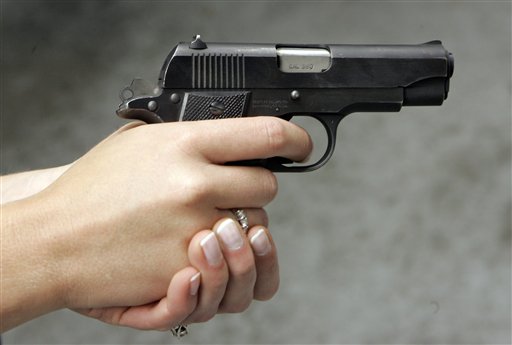
The U.S. Court of Appeals for the District of Columbia Circuit ruled this week that it is unconstitutional for the District government to restrict handgun licenses only to citizens who can prove a “special need for self-protection distinguishable from the general community as supported by evidence of specific threats or previous attacks that demonstrate a special danger to the applicant’s life.” D.C. now must follow a standard system approved by the Supreme Court as not unduly burdensome to Second Amendment rights: issuing permits to adults who pass a fingerprint-based background check and a safety training class.

You can read the whole opinion here.  Two cases were under scrutiny: Wrenn v. District of Columbia and Matthew Grace and Pink Pistols v. District of Columbia.  Circuit Judge Thomas B. Griffith wrote the opinion and was joined by Senior Judge Stephen F. Williams. Judge Karen LeCraft. Judge Karen Henderson, a Republican appointee, dissented.

This is a liberal court, but it properly upheld the Second Amendment while slapping down anti-gun talking points that I have always found obnoxious and totalitarian in spirit. “Why does anyone need a gun? Why do they need a semi-automatic weapon? Why do they need so much ammunition? I don’t need a gun. Guns are dangerous. If I don’t need one, you don’t need one.”

The government doesn’t have the right to tell me what I need. Strangers don’t get to tell me that my needs are unreasonable based on their beliefs and biases. In 2013, playwright and screenwriter David Mamet wrote an op-ed for Newsweek nicely articulating these principles. (If it is still available in its entirety, I lack the cleverness to find it. [UPDATE: Reader Frank Stephens was clever enough, and the link is here]. Newsweek banished the article to its ally The Daily Beast, where all links, including in my post about it, lead. That link is now dead: it just goes to the website. I searched the Daily Beast for the article: it isn’t there. But, oddly, a rebuttal to the article is. I suppose this is how the news media silences the apostates in its midst. Fortunately, this passage survives: Continue reading

Conundrum: Is CNN’s Dylan Byers An Ethics Dunce, Or An Ethics Hero?

http://www.youtube.com/watch?v=FHYeGDHe0lY

Midnight  Friday morning,  CNN was analyzing the GOP’s perplexing win in Montana’s special election for the House of Representatives—perplexing to Ethics Alarms because the winner, Gianforte, is a dishonest thug, but perplexing to CNN because their reporters were desperately hoping for a sign that voters were turning on President Trump, something their network has been working on for many months.  CNN’s Media reporter Dylan Byers then blurted out this remarkable statement:

“There’s this conversation that’s happening among people following the news industry, which is how can we bridge the sort of gap between all of those conservatives who don’t trust the media, and get them to start knowing that, you know, we’re acting in good faith, with good intentions? Maybe you can’t, because they’re not even listening. From the second, it’s not as though they’re reading the article and considering it, or listening the audio and considering it. They’re just not paying attention to it, because  they don’t trust us.

And this, by the way, you look at the tapes of Trump there. Two things have happened. One, over the course of several decades, the conservatives have done a masterful job at capitalizing the waning trust in media and using it to their advantage. But a second thing has happened, too, which is, on occasion, more than the media would like to admit, we have not told the story of conservative Americans, disenfranchised Americans, who believe that they are losing their country. The story we have largely been telling is a story that is more or less in step with the arc of history as defined by Barack Obama and Hillary Clinton. It does not mean we favor them to win. It just means that sort of vision of a progressive future, a global future, and that is not one that resonates with so many conservative American voters.”

“The story we have largely been telling is a story that is more or less in step with the arc of history as defined by Barack Obama and Hillary Clinton.”

It is notable that none of the three journalists on the panel with Byers challenged this damning characterization. Continue reading

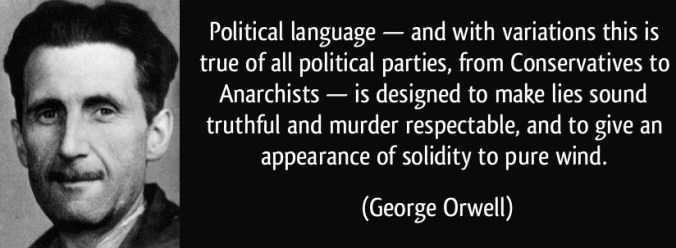
Orwellian Thought Manipulation As An Ideological Tactic: A Case Study

orwell-quote

Cognitive linguist  George Lakoff, a far left academic (but I repeat myself),  advises his partisan political brethren to build public opposition to the President’s regulation reform efforts by changing the word that we use to describe regulations:

President Trump has said that he intends to get rid of 75% of government regulations. What is a “regulation”?

The term “regulation” is framed from the viewpoint of corporations and other businesses. From their viewpoint, “regulations” are limitations on their freedom to do whatever they want no matter who it harms. But from the public’s viewpoint, a regulation is a protection against harm done by unscrupulous corporations seeking to maximize profit at the cost of harm to the public.

Imagine our minority President saying out loud that he intends to get rid of 75% of public protections. Imagine the press reporting that. Imagine the NY Times, or even the USA Today headline: Trump to Eliminate 75% of Public Protections. Imagine the media listing, day after day, the protections to be eliminated and the harms to be faced by the public.

Lakoff’s tactic is remarkable in its transparency. Increasingly, the Left has relied on misleading the public by injecting euphemisms and what I call “cover phrases” into policy debates and news reports to obscure the undesirable aspects of a favored measure, including its unethical nature, such as restricting  individual rights. Thus abortion, which involves trade-offs between two human lives and sets of rights, is referred to as “choice,” eliminating the life-taking aspect of the problem from the discussion entirely. Thanks to the efforts of Democrats with the cooperation of the communications media, race-based admission to educational institutions and hiring that may discriminate against whites and Asian-Americans are covered by the benign-sounding term, “affirmative action.” The most brazen of these linguistic cheats is the widespread practice of referring to illegal immigrants as immigrants, thus allowing advocates of unrestrained lawbreaking by uninvited aliens to tar good faith opponents  of open border and amnesty policies as xenophobes and racists.

Lakoff continues his cynical instruction  for aspiring Big Brothers: Continue reading

Ethics Quiz: The Smokeless Tobacco Ban

Chicago recently became the fourth city—Boston, Los Angeles and San Francisco—to enact a ban on using smokeless tobacco in sports stadiums. I initially ignored it, in part because I never use the stuff and have never known anyone who did, and in part because I knew that Major League Baseball has been trying, with some success, to discourage its ballplayers from chewing and especially spitting on camera, since it is a) disgusting and b) encourages impressionable tykes to take up an ugly and perilous habit. I’m inspired to make the issue an ethics quiz because of the pronouncements of law professor-blogger Jonathan Turley on the issue and the vociferous debate his comments sparked on his blog.

Turley wrote…

This is a lawful product like smoking tobacco. People have a right to make choices about their lifestyle so long as they do not harm others. That is why I always supported the bans on smoking in public areas due to the second-hand smoke research. That is an externalized harm. What is the externalized harm of smokeless tobacco?

…I happen to deeply dislike smoking and I find chewing tobacco disgusting. I also do not question the link to serious health problems like cancer. However, that should be the subject of an educational campaign by the government and MLB. Yet, in the end, people need to be able to make choices in our society rather than go down the path to paternalistic legislation regulating our good and bad choices.

His supporters on the blog were typified by this comment by Beth (not our Beth, I presume)…

“Tobacco, in all forms, is NOT a singular activity that affects no one else. Tobacco use weighs very heavily on the public at large in the form of health care costs, higher insurance premiums, toxic litter, poisoned air and ground spit. To suggest that limiting tobacco, smokeless tobacco and e-cigarettes should not be controlled substances goes against all manner of policy for the public good. Wrong stance, Mr. Turley.”

This comment, from “wonderer,” is a fair summation of the other side, which mostly came from the libertarian side of the metaphorical aisle:

“The efforts to ban “icky” behaviors are of a piece with the bans or taxes on sugared beverages. What seems to be happening is that some people want to push bans on behaviors of “out of favor” groups. Those “big soda” people are Walmart denizens, so they clearly need to be told what to do. But keep hands off urban bicycling. As risky as that is, it’s one of the things “enlightened” people do. Bans (at least here in California) seem to be all about the condescension.”

Your Ethics Alarms Ethics Quiz of the Day:

Is a ban on smokeless tobacco in ballparks an abuse of government power and an unethical breach of personal choice, autonomy and liberty, or is it a responsible use of government power to encourage public health and safety?

I’ll hold my fire on this one until sufficient numbers weigh in. Remember, the issue here isn’t policy, but ethics.


The Chris Davis Saga: How Much Money Is “Enough”?

Chris Davis is under there somewhere...

Chris Davis is under there somewhere…

I have too many political issues on the runway, and I’m about to be buried in snow. This seems a perfect time to reflect on Chris Davis, the slugging Baltimore Orioles first baseman who just re-signed with the team in a seven-year, $161 million deal. Yes, he’s a baseball player, but the ethics issue here is not confined to baseball, or even professional sports.

Two weeks ago, it looked as if Davis and the Orioles were at an impasse. The team had, we were told, offered a take-it-or-leave-it 150 million dollar package, and Davis and his agent had turned it down. Davis’s manager, Buck Showalter, told the press that he had asked Davis, who by all accounts loves playing in Baltimore,”How much is enough?”:  “I asked Chris during the season, ‘Chris, when you walk into a Target store, can you buy anything you want. So, how much is enough?'”

Sportswriters, not being reflective sorts,  even the smarter ones, who are always taking the players union’s position that the more money a player can squeeze out of fat cat owners the better, jumped on Showalter. Said CBS writer David Brown, “Showalter trying to shame him into taking less — so that ownership can keep more — is shameful in itself. Why isn’t Showalter asking Angelos ‘ How much is enough?'”*

Showalter, who is one of the most intelligent and perceptive people in the game, was not trying to shame Davis. He was trying to get him to think; he was trying to impart some wisdom…and some ethics. Continue reading

The Cost Of Rationalizations

Employee Theft

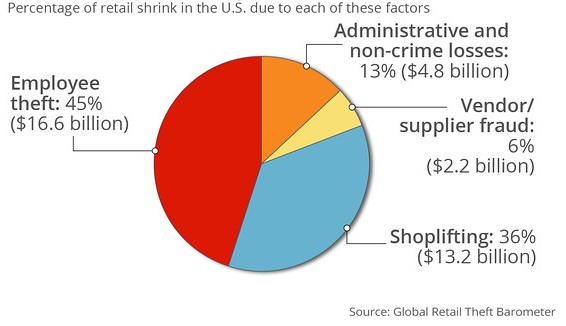
According to The Global Retail Theft Barometer released this month by Checkpoint Systems,  employees in the U.S. steal from their employers at significantly higher rates than workers in other countries. The direct cost to businesses, as you can see in the diagram above: a staggering 16.6 billion dollars.

Most of this is taken in incremental amounts, by people who would be shocked if you questioned their character. Why is this number is so high? As far as comparing to other countries are concerned, it’s the same factor that anti-gun zealots refuse to acknowledge, and that Bernie Sanders can’t seem to grasp. Our country is not like other countries; we guarantee our citizens more freedom, for one thing, and freedom unavoidably means more freedom to do bad things as well as good.  Our national character is not like other countries. Americans are not like other people.

Good. Continue reading

July Fourth Ethics: On Liberty And Freedom

US-original-Declaration-1776

“We hold these truths to be self-evident, that all men are created equal, that they are endowed by their Creator with certain unalienable Rights, that among these are Life, Liberty and the pursuit of Happiness.–That to secure these rights, Governments are instituted among Men, deriving their just powers from the consent of the governed, –That whenever any Form of Government becomes destructive of these ends, it is the Right of the People to alter or to abolish it, and to institute new Government, laying its foundation on such principles and organizing its powers in such form, as to them shall seem most likely to effect their Safety and Happiness.”

—-The Declaration of Independence

“It is my living sentiment, and by the blessing of God it shall be my dying sentiment, independence now and independence forever. “

—-Daniel Webster, U.S. politician and orator

“Liberty is the soul’s right to breathe, and when it cannot take a long breath, laws are girdled too tight.”

—-Henry Ward Beecher, abolitionist.

“Without an unfettered press, without liberty of speech, all of the outward forms and structures of free institutions are a sham, a pretense – the sheerest mockery. If the press is not free; if speech is not independent and untrammeled; if the mind is shackled or made impotent through fear, it makes no difference under what form of government you live, you are a subject and not a citizen.”

—- Senator William Borah (R-ID), 1917

 “If liberty means anything at all, it means the right to tell people what they do not want to hear.”

—-George Orwell
Continue reading

Missouri’s Unethical Food Stamps Bill

Sometimes you just need a good lobster. I'm from Boston. Trust me on this.

Sometimes you just need a good lobster. I’m from Boston. Trust me on this.

Years ago, my wise and wonderful first year Contracts professor at Georgetown Law Center, the late Richard Alan Gordon, made a permanent impact on my conscience with a spontaneous rant. He was discussing a case involving a welfare recipient who had been sued by a Washington department store for failing to keep up with installment payments on a Hi-Fi system. The court voided the contract, saying that it was unconscionable for the store to intentionally create incentives for poor people to spend public assistance money on “non-essentials” like music systems. (I wish I remembered the name of the case, but then I only got a C+ in the course.)

As the students nodded their heads in agreement with the opinion, Professor Gordon cut them short and thundered (I am copying from faded old notes: Dick’s rants were always eloquent and memorable, and I began reconstructing them after class for posterity):

“Outrageous! Who are you, or a court, or a government, or any authority to tell another human being that feeding his body is more important than feeding his soul? Music is “non-essential”? I suppose that means that literature, culture, inspiration, wisdom, knowledge…or a moment of joy, the thrill of discovery, experiencing a concert, admiring a great work of art, or sharing an intimate and timeless moment with the love of your life is “non-essential” too! Neither the law nor any court nor a government authority has a right to dictate what is essential to any human being, whether he is receiving public assistance or not. Being poor imposes its own cruel restrictions on liberty and autonomy. Imposing more still is both an abuse of power and a violation of basic human rights. This is an assault on human dignity.”

Continue reading

How Media And Academic Bias Make Us Stupid: The “Personal Freedom Study”

freedom

“STUDY: American personal freedom now ranks below 20 other nations…” reads a link in this morning’s Drudge Report.

That is NOT what the study shows….not even close.

The link goes to an Examiner story headlined “Under Obama, U.S. personal freedom ranking slips below France.” That’s a little better, but it’s also misleading. Both headlines are attempts to spin a study that tells nobody anything about how much freedom there is in the U.S., under President Obama or otherwise. The study, meanwhile, is easily spun because it was badly conceived, is itself of dubious value, and was also probably the result of a researchers grinding their own axes.

It is early, and I am pretty sure that the cable news sharks and the internet pundits will be latching on to this garbage study in droves, with the result being mass confusion in the public. That’s right: the world of scholarship and research, and the world of journalism, will conspire to make the public less informed than it already is, setting it up for the handiwork of future Jonathan Grubers and the parties that employ them.

You see, the study doesn’t even purport to measure “freedom” in any objective way across different nations. Continue reading