The word “lie,” one of the more basic terms in the ethics field, has been thoroughly blurred by a malign combination of ignorance, poor analytical skills, and partisan rhetorical dishonesty. A lie is an intentional misrepresentation of facts and truth in order to deceive. Genuine mistakes aren’t lies. Deliberate hyperboles made for effect but still obvious exaggerations are not lies. Jokes are not lies. Delusions aren’t lies. Opinions are not lies. Asserting a belief that one cannot reasonably know to be true is not a lie. A broken promise is not a lie if the promise was made sincerely. A prediction that does not prove accurate is not a lie. One contradicting what he or she once asserted as a strongly held belief does not prove hypocrisy—a variety of lie—if the individual has generally changed his or her belief in the interim.
In his brief interview with The New York Times last week former President Biden said that he orally granted all the pardons and commutations issued at the end of his term. Those who have suggested that the Presidential autopen was used without his knowledge by aides for such edicts are “liars,” Biden said.
“I made every decision,” Biden insisted.
What value is that interview? First, we know that Biden lies to enhance his own reputation: surely he wouldn’t admit that he was a cardboard cut-out POTUS if that is indeed what he became. Given what we know about Biden’s mental state, he may believe he made every decision, even if he didn’t. If fact, how would he know one way or the other?
There are few topics I have vowed to flag every time they raise their ugly metaphorical heads. The fake statistic about women earning only “76 cents” for every dollar a man earns for the same job. The implication that lawyers are endorsing the conduct or character of their clients. The lie that Al Gore won the 2000 election but that the Supreme Court “handed” the Presidency to George Bush. “Hands up, don’t shoot!” More recently, I have resolved to not let media hacks get away with the statement that the claim that the 2020 election was “rigged” is “baseless.” The rampant misuse of the term “ad hominem” is another one.
The annoying issue came up again in the exchange with an EA reader I referenced in this post (#7). He accused me of being a “phony ethicist” because I criticized Clarence Thomas’s flagrant breach of ethics in his accepting (and not disclosing) copious gifts and financial benefits from a well-known conservative billionaire, and yet, he claimed, didn’t criticize Present Biden’s complicity in the profitable influence peddling of his ne’re-do-well son. Of course, I have done the latter, multiple times, and in response to my tart message back that he didn’t know what he was talking about and couldn’t tell an ethic from a writing desk, he shifted his argument to saying I was a “fake ethicist” because I never wrote about Justice Sotomayor’s failure to recuse herself in Greenspan v. Random House.
I didn’t recall whether I had commented on that case or not (the complainer didn’t know either), but it didn’t matter. I resent being told that I am neglecting my mission because I didn’t write about what some reader wanted me to write about. My two standard answers to that complaint are 1) “Start your own damn blog!” and 2) “Bite me.” As I explained in my response,
President Biden went on Seth Myers’s late night show this week to bask in a fawning interview by a partisan supporter who wouldn’t ask him any questions harder than “What’s your favorite flavor of ice cream?,” and still managed to screw up.
After the show’s taping, Biden was confronted by reporters while licking an ice-cream cone and asked when a Gaza ceasefire might occur. “I hope by… the end of the weekend,” Biden answered. “My national security advisor tells me we’re close. We’re close. It’s not done yet. My hope is by next Monday, we’ll have a ceasefire,” Biden said. That was great news for anti-Israel progressives, and right before the Michigan primary, where Biden was likely to face Arab protest votes against his re-nomination.
I subscribe to ProPublica because the group often does valuable investigative reporting, just as I subscribed to Glenn Greenwald this year even after he took my substack subscription money and then produced nothing for months because he was sick or something. (Not again, Glenn, Sorry.) However, I will not give money to organizations who lie to me. This is how the year-end appeal I just received from ProPublica begins:
It’s no secret that American democracy is in peril. The 2020 elections were unlike anything our country has seen before — election deniers, an insurrection and bad actors sowing disinformation shed a harsh light on the fragile state of our democracy. As a ProPublica reader, I know you’ve been aware of these growing threats for some time now.
ProPublica is no bystander when it comes to ensuring a transparent government, regardless of who is in power. As a nonprofit, nonpartisan newsroom, we believe that investigative journalism is one of the most powerful tools we have to ensure a healthy democracy…
If I never had occasion to write another ethics post about Donald Trump again, I would be thrilled. Unfortunately, he won’t shut up or disappear, and the Axis of Unethical Conduct (the “resistance,” the Democratic Party and the increasingly outrageous news media), recently joined by the justice system, won’t stop their misconduct.
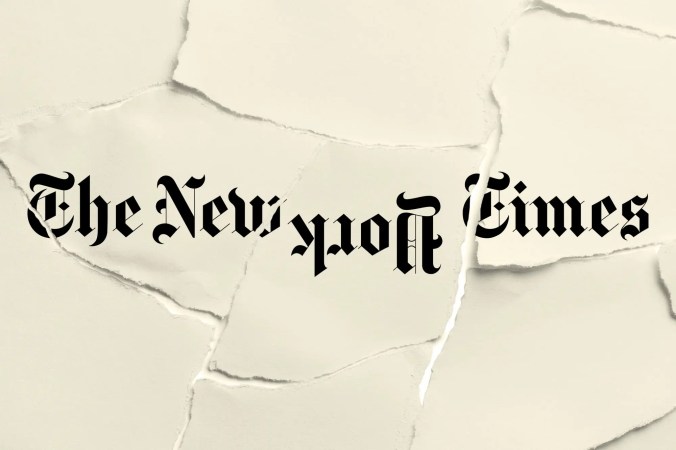
I decided to factcheck the fact check, suspecting what I would find but in the end stunned by how openly the Times failed to deliver on what it promised. It’s astoundingly deceitful, and aimed at readers who just want to see Trump punished because they hate his guts. I won’t fisk the whole thing, but here’s more than enough to show you what the Times has become:
“…In public, he made more than 800 inaccurate claims about the election from the time the polls began closing on Nov. 3, 2020, to the end of his presidency, according to a database compiled by The Washington Post.”
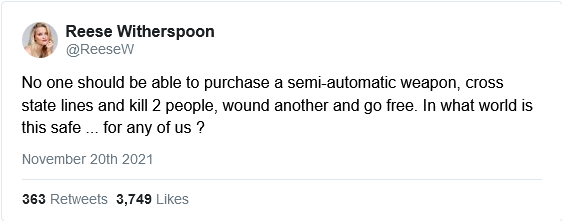
The five jagged prongs of the fantasy version of the Rittenhouse case are 1) He carried a semi-automatic weapon “across state lines” to cause trouble; 2) the teen is a white supremacist, hence a racist, and was “hunting” virtuous social justice crusaders justly and peacefully protesting ; 3) the three men he shot were innocent victims, and two of them were murdered, 4) the rioting Rittenhouse was opposing was a protest over a white police officer brutally killing an unarmed black man, and 5) the jury’s failure to convict resulted from the inherent racism of the justice system.
Within those prongs are at least (let’s see…) twelve lies that can no longer be excused by confusion over the facts. Nor is it an excuse that someone like Witherspoon has been reading and watching the wrong news reports (as well as getting her political views from within a progressive bubble), because every American knows or should knows that such sources cannot be believed or trusted.
What are the odds that Randy Newman’s satirical song would be attacked today as offensive and accused of making short people feel unsafe? I think pretty high in favor, don’t you?
I was thinking about this after watching “Movie 43” last night, an astounding 2013 project in which a huge, all-star cast was recruited into doing a series of sophomoric, gutter humor skits that had bad taste galore but not much humor or wit beyond “Oh my God, I can’t believe they did that!” Still, while the movie got horrible reviews (although the critics calling it “The Worst Movie Ever Made” beclowned themselves: I can name 20 worse ones off the top of my head) and bombed, I am pretty sure that it would spark boycotts and “cancellations” today for being so spectacularly politically incorrect. Watching it, I was nostalgic for the time when artists could cross lines and not have a virtual price placed on their heads. In just seven years, we have come to a place where Americans are terrified of enraging the woke. I think watching Movie 43 is good tonic for that, and also good practice for those who want to purge their inner weenie.
1. One more bit of proof that we should not trust “experts,” scientists, or academics. Harvard cognitive psychologist Steven Pinker has written several best-selling books, such as “The Better Angels of Our Nature: Why Violence Has Declined” (2011) and “Enlightenment Now: The Case for Reason, Science, Humanism, and Progress” (2018) and is regarded as a public intellectual. Yet when the New York Times asked him, “Do you see any irrational beliefs as useful?,” Pinker answered,
“Yeah. For example, every time the media blames a fire or a storm on climate change, it’s a dubious argument in the sense that those are events that belong to weather, not climate. You can never attribute a particular event to a trend. It’s also the case, given that there is an availability bias in human cognition, that people tend to be more influenced by images and narratives and anecdotes than trends. If a particular anecdote or event can in the public mind be equated with a trend, and the impression that people get from the flamboyant image gets them to appreciate what in reality is a trend, then I have no problem with using it that way.”
Yes, this respected intellectual believes that deceiving the public is justified if it leads them to support the “right” policies and beliefs. He, and those like him, are the real threats to democracy.
My Harvard diploma is already facing the wall; staring today, I’m going to spit at it when I pass by…
Coincidentally, today I was asked to write something for my class’s reunion book. What should I write?
Ah, memories! On the old Ethics Scoreboard, I had a feature called the David Manning Liar of the Month. From the description:
David Manning was an imaginary movie reviewer that Sony quoted when one of its movies was so lousy no real movie reviewer would praise it. When this long-running public fraud was brought to Sony’s attention, the company’s response was, in effect, “So who believes movie reviews?” Thus Sony’s phony critic and the company’s cynical defense of him stand for the dubious proposition that as long as your self-serving lie is in a trivial arena (usually entertainment) where dishonesty and misrepresentation are commonplace, or is a lie that nobody believes, it isn’t reprehensible. The fact is that these casual, obvious or trivial lies and the liars who spread them (almost always for profit) further degrade the value of honesty in American society, and pave the way for more destructive lies and liars waiting in the wings. All public deception is harmful, so The Ethics Scoreboard regularly recognizes The David Manning Liars of the Month, and urges the public to make them come clean…
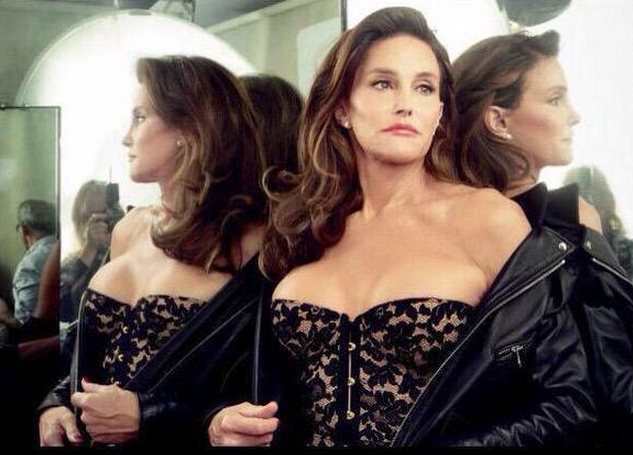
Thus it gave me a warm, fuzzy feeling, like finding an old toy, to read that Caitlyn Jenner, running for governor of California to revive her flagging celebrity now that the Kardashian gig is over, issued a completely pointless lie that was bound to be discovered.
CNN’s Dana Bash asked Jenner if the transgender former Olympic champions had voted for for Donald Trump in last year’s election.
“I didn’t even vote,” Jenner replied. “Out here in California, it’s like, why vote for a Republican president? It’s just not going to work. I mean, it’s overwhelming. It was voting day, and I thought, the only thing out here in California that I worry about, which affects people, is the propositions that were out there. And I didn’t see any propositions that I really had one side or the other. And so it was Election Day. And I just couldn’t get excited about it. And I just wound up going to play golf and I said, eh, I’m not doing that.”
But the record showed that she did vote. It was easy to check. Writes Politico, “Her claim to be a non-voter in that seminal 2020 election was baffling for a gubernatorial candidate trying to establish her political credibility, especially since records show she did participate in the contest.”
It’s not baffling. It’s typical: a disturbing number of Americans, especially celebrities and politicians, believe that lying is no big deal, so they don’t think being caught in obvious lies damages their reputation. Their attitude is “Hey, it’s worth a shot!” When they are caught, their reaction is, “Whatever.”
The U.S. entered The Great War on this date in 1917, surely among the most disastrous decisions the nation has ever made. Unfortunately, almost all of the debate over whether we “should” have gotten involved in the seemingly pointless quarrel among the European powers is polluted by hindsight bias, consequentialism, and a disregard for moral luck. Yes, it’s true that The Great War led to a far worse one, and that Germany winning what became World War I probably would have kept Adolf Hitler painting houses. But that’s cheating: we can only assess the legitimacy of the U.S. entering the war on the basis of what was known at the time.
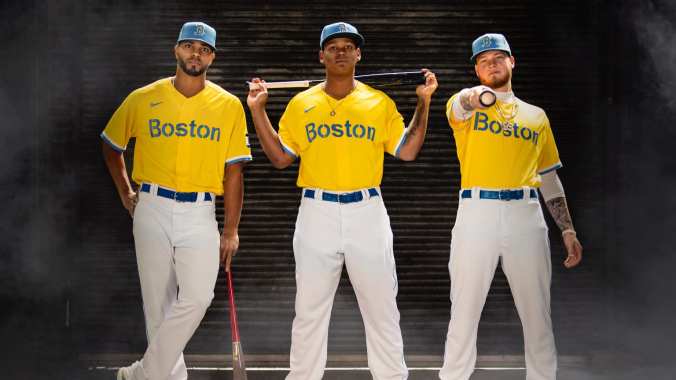
1. Baseball uniform ethics. Oh yeah, this makes a lot of sense. The Boston Red Sox uniforms have been red, white and blue for almost a century—perfect for the team’s annual Patriot’s Day game, which occurs in the morning so the crowd can watch the end of the Boston Marathon. Only Massachusetts, Maine and Connecticut celebrate Patriot’s Day, when Paul Revere (and his two friend) rode to warn the Boston suburbs that the British were coming in 1775.
Well, Nike is now pulling baseball’s strings (there is evidence that the company that employs Colin Kaepernick as a spokesperson helped push MLB into punishing Atlanta for Joe Biden’s made-up racist voting law claims), and part of its deal with the sport is that it will design new uniforms for many of the teams. Here are the uniforms the company thinks the Boston Red Sox should wear to celebrate Patriots Day, since those old colors just reflect the flag of the racist nation founded on the backs of slaves:
They look like eggs.
And of course, no red socks.
2. The rest of the story! Remember this post, about San Francisco’s lunatic school board declaring that one-third of the city’s school names, including those honoring Washington, Jefferson, Lincoln, James Madison and both Roosevelts , Presidents Monroe, McKinley, Herbert Hoover and James Garfield; John Muir, the naturalist and author; James Russell Lowell, abolitionist poet and editor; Paul Revere, Robert Louis Stevenson, Henry Wadsworth Longfellow, Daniel Webster, and current California Senator and former city mayor Diane Feinstein must be replaced so as not to honor individuals who were, in the words of an over-acting character in “The Birds”,
Rendering the equivalent of Tippy Hedren’s slap to these idiots has been, well, just about everybody, from historians, scholars, parents, anyone with an IQ above freezing, and even San Francisco’s reliably woke mayor. Implementing the re-naming was also expected to embroil the city in litigation. So now, the school board, after pausing its grand cancellation project, is expected to overturn its decision after wasting a lot of time and money, and making the city appear even more absurd than it usually does, which is quite an achievement.
You would think that someone on the school board would have been sufficiently smart, competent, responsible grounded in reality to predict the fate of such a mass historical airbrushing. Nope!
This isn’t called The Great Stupid for nothing, you know.
I always like to look at the law, and at the charges, to see if they are particularized and actually allege a violation.It seems to me the particular law at issue is 18 U.S. Code § 241 – Conspiracy against rights. The relevant text would seem to be paragraph 1:
“If two or more persons conspire to injure, oppress, threaten, or intimidate any person in any State, Territory, Commonwealth, Possession, or District in the free exercise or enjoyment of any right or privilege secured to him by the Constitution or laws of the United States, or because of his having so exercised the same; orIf two or more persons go in disguise on the highway, or on the premises of another, with intent to prevent or hinder his free exercise or enjoyment of any right or privilege so secured—“
What the government is alleging here, apparently, is essentially a conspiracy to cyber-bully. Attempting to convince others to vote a certain way or not to vote at all is called “electioneering” and is not only legal in the United States, but protected speech under the First Amendment, as well as widely practiced by all political parties 24-7-365, legally and peacefully. The law criminalizing conspiracies to deprive persons of rights was passed during the civil rights era and was plainly directed at the Klu Klux Klan and similar organizations.
As we all know, those groups would intimidate voters of all races, but primarily black people and their sympathizers, by burning crosses, lynchings, threats, and other violent actions to suppress or affect voting against the groups’ interests. Most of their methods were illegal under state and federal law to begin with, but the law in this case provided an additional tool to attack those who plannedlawless actions against the rights of others as well as those who carried them out. It is a bit like the Civil RICO laws, which were primarily aimed at those who directed corrupt mob actions but almost never participated in overt criminal activity.


 Ethics Alarms