Virginia Campaign Lies: the Unethical Use of the Dishonest “Would”

The next U.S. Senator from Virginia? You could do worse! In fact, Virginia might.

I’m going to vote for Tim Kaine, the ex-Democratic Governor of Virginia running against George Allen, the Republican trying to regain the seat he lost in 2006 to James Webb. After the slimy, dishonest campaign Allen ran against Webb ( full disclosure: I went to law school with the Senator, and know him personally. A more honorable, courageous, principled man doesn’t walk the earth), Allen lost any chance of a vote from me forever, and it wouldn’t matter if his opponent was a toilet brush.

Nonetheless, Kaine’s ads are making me think he’s only a step or two above toilet brush level. Especially outrageous is this line, from a “war on women” ad “approved” by Tim Kaine, intoned by an announcer as the camera shows a woman:

                   “Allen would take away her Constitutional rights by reversing Roe v. Wade.”

Even counting “v.” as a word, this inexcusable statement includes four misrepresentations in just twelve words, an impressive total, though I’m sure Bill Clinton has topped it at one point of another. Let’s see: Continue reading

The Spectacularly Unethical Angela Buchanan, Making Life A Little Meaner For Us All

According to court documents, Angela Buchanan, 30, of Lufkin, Texas, desperately wanted to be in a romantic relationship with a long-time female friend. She contacted the friend on Yahoo Messenger in March, explaining that she was diagnosed with breast cancer in 2008 and was now suffering from a pre-cancerous mass. She told her concerned friend that she was being treated by a local gynecologist. Then the gynecologist contacted the friend too, also on Yahoo Messenger.  The doctor confided to the friend that the pre-cancerous mass in Buchanan’s breast could possibly be delayed or even reduced and cured by an increase in hormone production, which, the doctor helpfully suggested, could be stimulated by sexual intercourse. The doctor recommended that the friend agree to participate in sexual activity with Buchanan in order to bolster this vital hormone production—if she really wanted to save her friend’s life, that is. Continue reading

Forget Balancing: Lance Armstrong Is a Villain

A constant conundrum faced by every culture is how it should categorize significant individuals whose positive contributions to society and civilization are marred by other acts that range from the unethical to the despicable. How much bad can a great man do and still be called “great”? How much wrong can a good woman engage in and still fairly be remembered as “good”? Can one wonderful act erase a lifetime of bad conduct? Are some bad acts so terrible that nothing can compensate for them? Every real human being is going to yield to some temptations, make some bad choices, be selfish, be cruel, lie, or worse. If we insist that all our heroes have an unblemished record in every aspect of their lives, we simply forfeit our heroes.

One reaction to this persistent dilemma is that we tend to be reluctant to look under the rock of a heroes accomplishments for fear that we will be disillusioned, or once the rock is lifted, we will attempt to rationalize into invisibility the ugly things we find there, or insist that they don’t matter. Of course they matter. It matters that Thomas Jefferson, who gave this nation its beating heart, didn’t pay his debts, cheated his friends and refused to live up to his own ideals. It matters that Clarence Darrow, who saved over a hundred men from execution, was a terrible father and husband and an unethical lawyer. It matters that Arthur Miller, whose plays dramatized the plight of the aging worker and the dangers of political persecution, rejected his mentally-challenged son, leaving him institutionalized and without contact from his father, though he knew who his father was. Charles Lindbergh, Jackie Kennedy, Diane Fossey, Thomas Edison, George Washington, Andrew Jackson, Frank Sinatra, Ted Kennedy, Pete Rose, Lillian Hellman, Walter Cronkite, Hillary Clinton—the list of the great, near-great, lionized and admired who behaved less than admirably or worse in significant ways can circle the globe. In assessing their character, as well as whether their lives deserve to be regarded as positive or negative influences on their society, fellow citizens and civilization, all we can do is apply a complex balancing formula, with factors in their lives weighted according to ethical principles, experience and our own priorities.

The question of how this balance should be applied has been raised in recent weeks in the wake of the final verdict on Lance Armstrong’s cycling career, which was decisively removed from the categories of “alleged misconduct,” “controversies,”and definitely “witch hunts” for all time as mountains of documentation, lab tests, and testimony moved it squarely into the categories of “outrageous cheating’, “criminal activity”, “corruption” and “fraud.” Continue reading

The Ryan Soup Kitchen Photo: Everybody Does It, But It’s Still Unethical

In the early 1960s, as the Great Leap Forward led China into political, social and economic disasters, the opposition to Mao Zedong’s leadership grew; Chairman Mao’s reaction was to purge the party leadership of intellectuals and officials in what is now termed, “the Great Proletarian Cultural Revolution.”

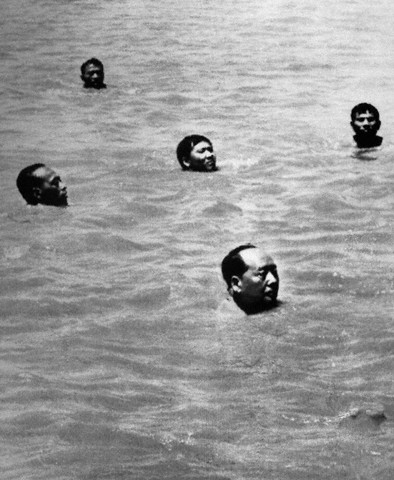
Mao Zedong’s hold on the leadership of China was shaky as he passed 70; even slaughtering more of his enemies and rivals wasn’t working. On July 16th 1966, Mao sought to debunk rumors that he was frail and ill by staging photographs of him vigorously swimming in the Yangtze River.  It was called, “The Swim Seen Round the World.” The Chinese press did its job, describing Mao’s cheeks as “glowing” and “ruddy,” his stroke steady and strong. “Our respected and beloved leader Chairman Mao is in such wonderful health!” one press report enthused.

In the West, however, there was more skepticism. Time reported that Mao swam “nearly 15 km in 65 minutes that day–a world-record pace, if true.” The photos of the swim, which showed an oddly solemn group of floating heads, were widely believed to have been doctored. As it turned out, the photos were real; Mao really did take a swim, though the event was staged, and nobody knows how long the swim lasted or how far Mao paddled. What are such photo ops? Are they deceptive? Are they ethical? Continue reading

Ethics Alarms Verdicts: The Second Debate

Some Ethics-related conclusions on Wednesday’s second Presidential debate:

Were the candidates uncivil?

I didn’t think so. There were a lot of Twitter comments about Gov. Romney being disrespectful to the President. The deference due to the President of the United States isn’t an issue when debates hew to the formal, detached format of the past. In those debates, the tone of the exchanges are so muted that the two candidates could be in different time zones. Once a different tone is set, with either candidate directly challenging statements while the other candidate is speaking, that tradition has fled, as it did last night. The challenger to a sitting President can hardly be told that he needs to be deferential in a debate; that is the equivalent of asking him to fight with one hand tied behind his back. I thought that both candidates were within the bounds of civility under the circumstances. It was certainly not the civility that I complimented in the second debate—it was a heated, sometimes rancorous argument, but it was the argument of two passionate, forceful, serious public servants, and it served the public well. Neither candidate displayed the contemptuous, rude attitude that Joe Biden adopted in the Vice-Presidential debate. Biden crossed the civility line, but the President and his challenger did not.

Was the moderator biased? Continue reading

Debate Alarm: The Fake Statistic Strikes Again

Outrageous.

That damn statistic again. Well, there goes THAT head!

Candy Crowley, disgracefully, chose another question at a Presidential debate—the last one was 12 years ago—based on the completely false and misleading statistic, made up by activists, that women earn “72%” of what men do in the workplace, suggesting that there is widespread gender discrimination in wages. It’s not true; it hasn’t been true for decades. It’s a myth, and one that misleads the public by being given this kind of publicity and credibility. ( The question Crowley allowed even lowered the fake percentage an extra, and fake, 5% from the “77%” Bernard Shaw negligently used in a question to Joe Lieberman. in 2000.) I’m glad Romney didn’t dignify it with a direct answer—he was placed in the position of either telling the questioner, “That stat is imaginary,” or furthur imbedding it by treating it as reality.

I’m generally a fan of Candy’s, but this was irresponsible, and I’m disappointed in her. Public policy debate shouldn’t be framed by simple-minded, misleading factoids, and it is the duty of journalists to insist on facts.

Unethical Quote of the Week: Vice-President Joe Biden

“With regard to the assault on the Catholic Church, let me make it absolutely clear. No religious institution, Catholic or otherwise, including Catholic Social Services, Georgetown Hospital, Mercy — any hospital — none has to either refer contraception. None has to pay for contraception. None has to be a vehicle to get contraception in any insurance policy they provide. That is a fact. That is a fact.”

—– Vice-President Joe Biden, in a rare moment during Wednesday’s Vice Presidential candidates debate when he wasn’t interrupting, mocking, shouting, or otherwise setting new lows for national debate civility and decorum, on the topic of the Administration’s contraception and abortion mandate. The problem: it isn’t a fact. In fact, it isn’t true at all.

I was not going to touch on the substance of any of the debates, because I do not want to play the “fact check” game that has already warped the campaign and given partisan journalists the opportunity to misrepresent any the statement of any politician—usually a Republican—whom they disagree with as “a lie.” Perhaps inspired by this trend, the Obama-Biden campaign’s strategy has devolved into calling Mitt Romney and Paul Ryan “liars” when 1) they may be mistaken, they may be inexact, they may be overstating, and they may be wrong, but are not lying, and 2) President Obama and Vice-President Obama, not to mention other Democrats involved in the campaign, have not set their own bars for accuracy, honesty and fairness any higher than the GOP side. But the refrain of “Liar!” has been so emphatic and repetitive that the fans of the Democratic ticket are adopting it as a rallying cry, usually without the slightest idea of whether there have been any actual lies or not. Meanwhile, the tactic demeans the electoral process and our democracy. Columnist Dan Henniger expressed my feelings on this topic well when he wrote, before Wednesday’s debate: Continue reading

Ethics Quiz: Conspiracy Theories and the Disrespect Follies

One of the problems with the hateful, vicious, hyper-partisan politics that now grips the nation is that its most severe sufferers, inevitably the so-called “bases” of the two political parties and their most vocal advocates, end up making themselves look like fools because of it. Their fervor drives out rationality, and by refusing to assign decent and reasonable levels of  respect to their political opponents, they devalue their own credibility, sometimes to the vanishing point. They may not really be fools (though some of them are), but in a real sense, they have been driven insane…by hate, by lack of proportion, and a respect deficit that banishes both fairness and responsible conduct.

Crazy Accusation A: Republicans/Conservatives… Continue reading

Lori Stilley And The Deception That Makes Society Cruel

Lookin’ pretty healthy there, Lori!

If you want to identify the opposite of an ethical human being, you need look no farther than New Jersey resident Lori E. Stilley.

Stilley, who is 40, told her family and friends in February of 2011 that she had been diagnosed with Stage III bladder cancer, and that things were looking grim. She had  undergone radiation and chemotherapy treatment, she said, and posted about her dire condition on Facebook and a personal website. Later, she said the cancer had progressed to Stage IV. Alas, she lacked health insurance health insurance, too. So her concerned friends and relatives raised money for Stilley, including a T-shirt sale, a fundraising banquet, a third fundraising event and a raffle. There was a meal calendar organized, so friends could bring the probably mortally ill woman food every day. Continue reading

Liars and Lies: Cal Thomas, Bob Beckel and USA Today’s Deceptive Debate Feature

Beckel, Thomas…Liberal, Conservative…Liar, Liar…Disgrace, Disgrace.


Yesterday, after the first Presidential debate had concluded, USA Today columnists Cal Thomas and Bob Beckel’s joint feature was posted on the USA Today website; this morning, the same feature graced the newspaper’s print edition, on its op-ed page. Thomas and Beckel do a regular “point-counterpoint”-style debate which is presented as a conversation, and this one was about sprucing up the presidential debates.

“Cal Thomas is a conservative columnist. Bob Beckel is a liberal Democratic strategist. But as longtime friends, they can often find common ground on issues that lawmakers in Washington cannot” is how USA TODAY always introduces the hackneyed format. The most recent feature began like this:

BOB: Wednesday ‘s debate was déjà vu all over again. It made me wish for a fresher format. The two major party candidates for president looked and sounded presidential, standing behind two lecterns with a nice television-friendly backdrop facing a single moderator. But we’ve seen it many — too many — times before.

CAL: Don’t forget the television-friendly ties both wore after their handlers probably spent hours coming up with the right color.

BOB: And then there was the “spin room” where surrogates for both candidates claimed victory for their guy. It resembled a summer TV rerun: same script, but with different “stars.” The debate was broken into six segments, each with a question chosen by the moderator. Each was given the same amount of time to respond to the question followed by a period of discussion. The moderator, Jim Lehrer, did try to keep the candidates focused on the question at hand, but each response was obviously practiced. Except for those with HD quality sets, debates haven’t changed much since 1960.

Wait—what debate did these guys watch? Obviously, none at all.  Continue reading