Morning Ethics Warm-Up, 3/21/18: Ethics Observations As The Snowflakes Fall

Good Morning!

1 Moral luck.  In Great Mills, Maryland, a student with a handgun entered a high school and began shooting. He was brought down by a lone, armed and trained officer before anyone was killed. In the Parkland shooting, the equivalent officer chose to avoid a confrontation. There were other material differences: yesterday’s student shooter seems to have had a specific target in mind (his ex-girl friend) whereas the Parkland shooter was juts out to kill as many kids as possible. One student carried a hand-gun (which is very difficult for anyone to acquire legally in Maryland, which has among the toughest gun laws in the country), while the Florida shooter had a semi-automatic rifle. However, the primary difference was moral luck: if a competent and courageous officer had entered Marjory Stoneman Douglas High and shot Nikolas Cruz before he could inflict carnage, and Deputy Blaine Gaskill, instead of almost immediately entering the school and shooting 17-year-pld Austin Wyatt Rollins dead, had done a Scot Peterson impression and remained outside, the results in Parkland and Great Mills might have been reversed. In any case, the results would not have been changed by different gun laws or demonizing the NRA and lawful gun owners, only by different responses by human beings, and the vicissitudes of moral luck.

I think Marjory Stoneman Douglas High has serious cultural and management problems that played a larger role in the massacre than gun policies. Today’s news certainly suggest that…

2. This is how puppies end up dead in airplane luggage bins…The headline that caught my eye was “Pit bull goes on rampage in elementary school.” What actually happened was that a pit bull -mix puppy got out of the yard and ran onto a nearby elementary school playground where small children were playing, they started screaming and running because their parents had either taught them to be terrified of dogs or never instructed them how to interact with them, the puppy chased the kids into the school, and began jumping and nipping, as puppies tend to do. I was taught not to run from dogs at about the age of four. The consensus later was that the dog was not aggressive, but was just stimulated by all the commotion and playing. A teacher calmed the dog. You know, dogs are a feature of our neighborhoods and communities, and failing to teach children basic dog-interaction skills is as irresponsible as not teaching them how to cross the street. Anti-pit bull hysteria doesn’t help either. “Rampage.”

Then, this morning, I watched an episode of “My Cat From Hell” on the Animal Planet cable channel. In the first segment, one of a family’s two cats was behaving aggressively, biting and scratching in response to any human contact. The reason became apparent to the cat therapist quickly: the family’s two little girls were abusing both cats, treating the more passive of the pets like a stuffed animal as the  parents laughed and took photos. The second segment was even worse. A couple had bought a Munchkin cat—which is an ethics issue itself, since these are deformed cats bred to have such short legs that they can’t climb or jump—

and apparently thought of the creature as a cute animated decoration. They had no toys or comforts for the cat, just a bare room and a litter box. “Have you ever played with your cat?” the therapist asked. “Play? Well, no, we’re both really busy,” came the response.  And the couple wanted to know why was the cat was behaving so neurotically… Continue reading

Comment Of The Day: “Life Competence, Social Media, And Crisis Situations”

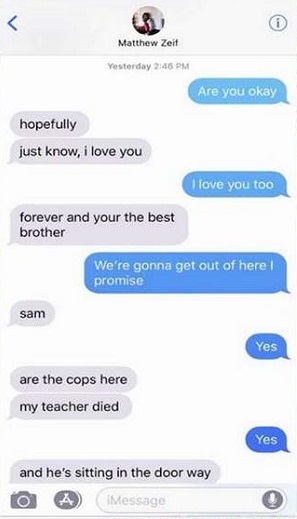
Night commenter Zanshin—he is one of the participants whose commentary frequently greets me in the morning–delivered a fascinating exercise expanding on my post about students in crisis situations defaulting to texting and social media rather than actively considering survival and defense alternatives.  He was responding to yeoman commentator Chris, a teacher, who appeared to take deep offense at my suggestion that the texts of the Stoneman High School students reflected an unhealthy obsession with electronic devices rather than a healthy acculturation in self-reliance and fortitude in the face of danger.

I’ll mention here what I have said in the relevant comment thread: I know the issue flagged by commenter (and also a teacher)  Andrew Myette was not the one I wrote about based on the link he sent me, but my job is to get everyone thinking about values and ethics even when it hurts, and I knew this angle would be especially uncomfortable to explore.

Here is Zanshin’s Comment of the Day on the post, Life Competence, Social Media, And Crisis Situations:

I can’t speak for Jack, but I sure can come up with,

a specific action the students could have taken that had a strong likelihood of being a better alternative than staying where they were.

Disclaimer 1. The text below is a possible scenario for a fictitious class involved in a school shooting. This is in no way intended to criticize schools, teachers, students and others who have been confronted with real school shootings.

One specific action could be … Oh, this is so good; this one is for you Chris … Haven’t you seen MacGyver? I believe he was part of (y)our generation. He would be so proud of this fictitious class who by relying on their unconventional problem-solving skills saved not only theirs but also other lives.

The teacher and about 5 of the strongest kids, may be members of the wrestling club, and yes, someone like Mack Beggs, who was born female and is transitioning to male while taking steroids, can also participate.

The entrance, the closed door is the one spot where one can get very close to the shooter if he/she tries to get in. That’s his/her vulnerable spot.
So, the other kids hide in the safest spot. But the ‘welcoming committee’ stands on both sides of the door. With all the weapons and shields they can garner. Sticks and stones, a sharpened pencil, a can with hot water, pepper spray may be, certainly some chairs and tables. [I am here assuming the door opens to the outside.] On one side of the door you stack a few tables with one of the smaller kids on top with the can of hot water or a bag with the content of the waste bucket or what-ever one can throw on him from above (and that will not endanger the attackers on the ground).

On the other side of the entrance one of the kids has a broom. Continue reading

Life Competence, Social Media, And Crisis Situations

Cross the Parkland shooting with the ethical problems created by technology, and you get this..

One of our engaged readers sent me this story, about how real-time texting and tweeting have become standard fare during mass shootings and other crisis situations. The story is full of positive words for the phenomenon….

The texts hit a nerve with people because they’re so gut-wrenching and real, Pamela Rutledge, director of the Media Psychology Research Center, tells Yahoo Lifestyle. “They are highly emotional, and enable people to feel empathy and a connection to what the students were feeling at the time,” she says. Social media in particular is good for sharing these texts, Rutledge adds. “Removing the sense of mediation in connection is what social media does best,” she says. “It transports people into events and allows them to share the feelings more intensely.”

The messages are also stimulating to people and create a horror-story-type feeling — except they’re not made up, clinical psychologist John Mayer, author of Family Fit: Find Your Balance in Life, tells Yahoo Lifestyle. That can also make the experience more real. “They bring the reality of the dangers in the world into one’s life and right into your personal space,” Mayer says. “Therefore, it becomes even more frightening.”

The texts also allow people to experience the events vicariously, albeit from a safe distance, and can prompt feelings of gratitude and appreciation for the safety they do have, Rutledge says.

But these kinds of texts really resonate because they’re authentic and straight from the source. “They are real-time reporting of feelings and events,” Rutledge points out.

Well, it’s certainly nice that vivid reporting comes out of massacres! What would we do without social media and cell phones!

My reaction is completely different: Why are these people texting and tweeting in the middle of a crisis? Continue reading

Comment Of The Day: “Morning Ethics Warm-Up: 8/2/17”

From Emily, a marvelous Comment of the Day so full of wisdom and good advice that it stands on its own:

I’m not from flyover country, but I live on the Eastern Shore of Maryland, red counties that include the poorest counties in the state (the lower shore has Baltimore City beat.) My family of three hovers around the federal poverty line.

However, my husband and I were both raised middle class. And while there are no major economic differences between us and our friends and neighbors, there are a lot of differences in the choices we make, which allow us to use the same amount of money to give our daughter opportunities that other parents in our economic class are unaware of or neglect.

This, more than money, is what affects the opportunities that my daughter has access to (as well as the ones my husband and I have access to.)

Despite the economic hardship, I’m a stay at home mom, which allows me to be dedicated full time to my daughter’s developmental delays. I could go to work and make *slightly* more money for us, after childcare expenses, but that would be a very different level of care for my daughter, and it turns out she needs it. The expert we’ve consulted is almost certain she’ll catch up, and has indicated me being home with her is an important part of that certainty.

I mentioned above that my daughter does have a tablet, a $30 one from Amazon. I found that tablet because I got a $20 Amazon giftcard for Christmas, and I was saving it for something special. I had to dig in the library’s website to find the link to borrow ebooks, but I figured there must be something like that.

We have internet, despite having no long distance for our phone (and no cellphone service where we live.) My husband and I manage to pick up extra money doing work online, despite neither of us having college degrees. This is part of what allows us to get by while still having plenty of time for our daughter.

These are just examples of things *we’ve* figured out. Everyone’s situation is different, especially among the poor. The thing that most people don’t seem to see is that down here social capital (the network of friends and family you have and what they’re willing to help you with,) knowing how to allocate resources carefully, and understanding how to navigate the various systems — both private and government — are more important to the kind of life you have than income, and those are highly individual things. Continue reading

The Good Luck Jet Engine Sabotage

China Southern Airlines Flight 380 from Shanghai to Guangzhou was held up at the Shanghai Pudong International Airport after an elderly female passenger threw coins into the plane’s engine to ensure “good luck.” An investigation into the incident is under way, the airlines says.

This bizarre story raises a serious and difficult ethics question. At what point should there be severe societal penalties for egregious life incompetence?

The elderly are obviously the most prone to this sort of thing. At some point many of them just stop paying attention, or lose the ability to keep up. In criminal law, we do not typically punish people for harm they do as a result of ignorance, but there are limits. There have to be.

I have a long delayed post on life competencies on the Ethics Alarms drawing board; it will eventually be a permanent free-standing page, like the Rationalizations List. The topic is difficult. What skills and knowledge are all of us obligated to have, if not master? If our inattention to Continuing Life Education makes us menaces to society, how should society respond? With pity? Sympathy? Compassion? Pat the fools on the head, and give them a stipend?

Being an ethical member of society mandates being able to participate in society’s activities without constantly screwing up. That, in turn, requires a level of personal responsibility. Society needs reasonable, fair, not overly harsh or intrusive ways of persuading everyone to meet this minimum requirement of citizenship. What are they?

It doesn’t have to be as ludicrous as an old lady nearly crashing a jet by throwing good luck coins into its engine, either. As we are increasingly dependent on technology, and as technology moves up a J curve, the damage that can be done by, just to take a wild example that could never happen, someone in a sensitive position using “password” as their computer password, thus enabling a foreign governments to steal confidential data and use it to set off an Ethics Trainwreck, is terrifying. How does a responsible society send a message that is sufficiently persuasive to people before they blunder into chaos ?

I don’t know the answer yet.

I’m just asking.

And now, a song!

Three coins in the engine
Each one risking air distress
Thrown by one stupid granny
How should she pay for the mess?

Three coins in the engine
Each as deadly as the first
There they lie in the engine
See the flames there as they burst!

Which will make the airplane crash?

Three coins in the fountain
Through the turbines how they shine!
Just one wish will be granted
Hope the charred corpse isn’t mine…


________________________

Pointer: Fred

Source: Boing Boing

A Life Ethics Lesson: The Washington Nationals And The Duty To Improve

Tex Ritter’s much-covered recording about the soldier whose deck of cards reminded him of the Bible has a parallel for me in the relationship of baseball to ethics. Like cards, baseball is a pastime, a game, but if you pay attention, there are profound lessons in ethics to be gleaned from the history, characters, and events of the game. In my official bio that I use for speaking engagements, I suggest that intensely following the travails of the Boston Red Sox since I was 12 was a major factor in sparking my lifelong interest and fascination with ethics. And it is true.

I live in the Washington, D.C. area now (unfortunately), and the local team is the Montreal Expos in exile, the Washington Nationals. The Nats’ mission is to bring Washington its first MLB World Championship since Walter Johnson was pitching and Coolidge was President. So far this goal has been elusive. That 1924 World Series-winning team, with the best names any team has had ever (Muddy Ruel, Ossie Bluege, Goose Goslin, Joe Judge, Nemo Liebold, Firpo Marberry, Mule Shirley, Pinky Hargrave, Curly Ogden, and more) has faded into forgetfulness while two Washington Senators franchises fled (to become the Minnesota Twins and the Texas Rangers, respectively) after decades of failure. The Washington Nationals, not nick-named Senators on the theory that the name was cursed, have proven cursed themselves. Despite having won more games over the last five seasons than any National League team, and having won the National League Eastern Division three times, the team has never sniffed the World Series, having lost repeatedly in the first round of the play-offs.

This season the Nats were loaded from the start, and even after terrible injuries to two of their best players, they have the best offense in the league, the best hitter (Bryce Harper) and arguably the best starting pitcher (Max Scherzer).  They are also in a lousy division where they don’t need to be great to win it without breaking a sweat.

But like the gorgeous woman with a wart on her nose, there is an obvious imperfection. The Nationals have no closer, that pitching specialist whose job is to get the last three outs (and sometimes more) to lock down victory in a close game.  This is not a new development, by any means. After the team decided to let last season’s (excellent) closer to leave via free agency, fans and sportswriters wondered how and when the team would replace him. One by one all of the established closers available by trade and free agency were snapped up, and it became clear that the Nationals ownership’s position was, “Never mind. The team is good enough. Maybe we’ll get lucky and some pitcher will surprse us, but even if we don’t, this team is good enough to win anyway. And we can save ourselves a bunch of money.Continue reading

Ethics Dunce: Mediaite

feldman

Mediaite is a frequent source here. The news and opinion website actively strives for balance by maintaining a stable of ideologically diverse reporters. It also received a big boost in credibility recently by finally dumping the embarrassing Tommie Christopher, whose left-wing bias was so extreme that it bordered on parody.

However, the site grossly abandoned ethics and accountability this time.

Yesterday I cited a Mediaite story about how Twitter dolts thought they saw a KKK sign in the stands during the World Series, a mistake caused by a bad hybrid of race-obsessed derangement and utter ignorance of the National pastime. What I did not know, because Mediaite was engaged in a cover-up, was that reporter Josh Feldman had filed the original post in which HE accused Cleveland fans of promoting the Klan. As you can see above, the original Mediaite story was not about Twitter morons mistaking the cards representing three strikeouts for Cleveland starter Corey Kluber, but a “scoop” by an ignorant and irresponsible reporter who made that mistake.

After Feldman was quickly schooled  on Twitter, Mediaite cleaned up the embarrassing story, removed Feldman’s byline, and turned it into a “Boy are some people stupid!” post. Feldman restricted his apology to Twitter, writing, “Apologies for the fuckup. Need to do more reading up on sportsing things.”

No, need to show some responsibility on reportsing things, Josh. Mediaite’s handling of this botch was unethical, and seriously implicates their trustworthiness. In the revamped post, a note was added saying,

UPDATE- This post has been updated to reflect the fact that it was NOT a KKK sign, it was signifying the number of strikeouts,”

Yes, and it was also updated to remove the name of the guilty reporter. Josh Feldman should been named as the one responsible, he should have apologized to Mediaite readers , not Twitter followers, for false reporting, and Mediaite had an obligation to apologize as well for its poor oversight. Instead, the site chose to cover for its reporter.Ethics Verdict: No transparency, no accountability, and an effort to deceive readers rather than admit to incompetent and careless reporting.

How can anyone trust a website that would do that?

___________________________

Pointer and Facts: Daily Caller

World Series Ethics: No, You Morons, That Wasn’t A “KKK Sign”!

kkk-world-series

The divided, confused, betrayed American public owes a debt of gratitude to the National Pastime this morning, and not for the first time. The stirring World Series win by the Chicago Cubs in Cleveland, and the joyous celebration afterwards, is exactly what this besieged and angry republic needed.

Well, that and a competent and respectable Presidential candidate to vote for, but you can’t have everything.

On social media, however, one was reminded why we have such miserable options to lead the country: ignoramuses. For during the game, multiple social justice warriors, doubtless confused because no players protested the National Anthem during the game, took to Twitter to exclaim that there was a Klu Klux Klan sign at the World Series!

Morons.

Some thoughts: Continue reading

Note To The Over-Forty Crowd: The Obligation To Be Culturally Literate Has No Age Limit, And The Duty To Be Aware Is Forever

ignoranceIn the Washington Post’s weekly crank section “Free For All,” a reader chastised the paper for not quoting more extensively from Bob Dylan’s works in its piece about his Nobel Prize, writing:

“It may come as a shock to the young people who now write and edit the paper, but there are many of us who are not familiar with the lyrics of “popular” music.”

Granted, in respect to Dylan, the complaint makes no sense. “Blowin’ in the Wind” was written in 1963; I’d expect “young people” to be more unfamiliar with Dylan than seniors. How old IS this guy? Still, the letter raised a crucial ethics point related to life competence, an ethical obligation for all of us. Being willfully ignorant of current popular culture is as much of an ethical lapse, and as great a threat to societal cohesion, as young people not bothering to learn about “Moby-Dick,” minstrel shows, Will Rogers, Stephen Foster, Babe Ruth, Charlie Chaplin, Fred Astaire or Lee Harvey Oswald.

In 1987, University of Virginia English professor  E.D. Hirsch wrote “Cultural Literacy,” making the argument that nations require common cultural reference points for generations to communicate with each other. He argued—correctly— that teaching this cultural vocabulary was a primary duty of the schools, in part because cultural literacy is an inextricable element of individual autonomy and power. Since then, the problem of the fracturing of society and the breakdown in communications between segments of the population has worsened considerably, its deterioration propelled by the loss of common information sources and the rise of the internet. Continue reading

Groupon Celebrates National Incompetence and Ignorance With A Presidents Day Double KABOOM!

Hamilton-exploding_head2

The Ethics Alarms KABOOM!—a special designation for ethics-related stories that make my head explode—has a new variation, thanks to Groupon: the repeating KABOOM!, triggered by two related KABOOMs in the same episode. My head has been exploding repeatedly since I learned about this late last night.

Hold on to your craniums, for here is a Groupon press release sent out earlier this week, the first of the KABOOM! twins:

Groupon Celebrates

Presidents Day

by Honoring

Alexander Hamilton!

Commemorate a man historically powerful enough to be on money with $10 towards $40 on a local purchase while they last!

CHICAGO, Feb 14, 2014 (BUSINESS WIRE) — Starting tomorrow, Groupon ( http://www.groupon.com ) (NASDAQ: GRPN) will be kicking off Presidents Day weekend by giving customers 10 dollars off 40 dollars when they purchase a deal for any local business. The $10 bill, as everyone knows, features President Alexander Hamiltonundeniably one of our greatest presidents and most widely recognized for establishing the country’s financial system.

Beginning Saturday, Feb. 15 at 9 am CST, shoppers will be able to redeem this offer by using the promo code “10OFF40LOCAL”, which isn’t very catchy, but neither was President Hamilton’s famous saying, “Nobody expects to trust his body overmuch after the age of fifty.”

President Hamilton is best known for the fiscal sensibilities that led him to author economic policies, establish a national bank and control taxes. Customers can honor our money-minded commander-in-chief and find deals by searching Groupon.com for local deals all through President’s Day weekend. Promo codes are limited, and more information can be found at: https://www.groupon.com/faq#faqs:content-269

The emphasis is mine, and I’m paying for every bit of it, let me tell you. My head is doing a terrific Dante’s Peak impression as I type this.

But that’s not all: here comes Groupon’s KABOOM! #2. Is the company embarassed? Chagrined? Are heads rolling? Oh, noooo! For when an enterprising American, one of the few who received a competent fourth grade education, was kind enough to alert Groupon to its unforgivable gaffe, this is what he received in return:

GOUPON IDIOTIt would all be hilarious if it were not so ominous….and unethical. Continue reading