Fevered Musings on Abortion, Love Canal, and the Broken Ethics Alarms of American Women

(This may end up as more of a rueful observation than a post.)

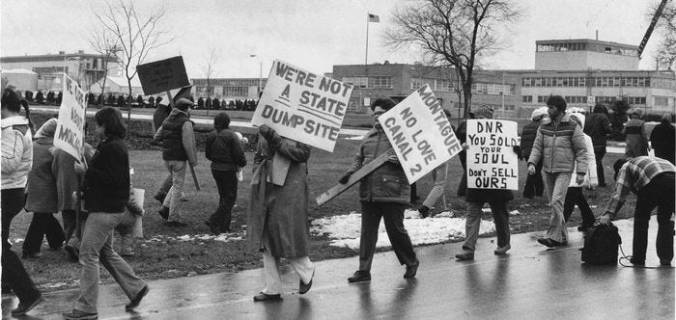
Last night I watched PBS’s “American Experience’ because it was late, my satellite package has amazingly few channels that aren’t commercial junk (No TCM for example, and I miss it) and no baseball games were on. It was a new episode about the Love Canal protests during the Carter Administration, something I hadn’t thought about for a long time.

It was the first toxic waste dump scandal—PBS was celebrating “Earth Day”—- and a landmark in the environmental movement: one can get some sense of the kind of things going on from “Ellen Brockovich,” about a another community poisoned by chemical manufacturers. That account focuses on the legal battles, but Poisoned Ground: The Tragedy at Love Canal centers on the local activists, mostly housewives and mothers, who organized, protested and kept the pressure on local, New York State and national government officials to fix the deadly problem, something the bureaucrats seemed either unwilling or unable to do.

One feature of the tale I had forgotten: the furious women briefly held two EPA officials hostage, and released them promising a response that would make that crime “look like Sesame Street” if President Carter didn’t meet their demands for action in 24 hours. And Carter capitulated to the threat! It doesn’t matter that the women were right about the various governments’ foot-dragging and irresponsible handling of the crisis: a competent President should never reward threats from people breaking the law. Jimmy just didn’t understand the Presidency at all, the first of four such Presidents to wound the U.S. from 1976 to 2024.

That wasn’t my main epiphany, however. It was this: In the late 1970’s, before the feminist movement took hold, so-called ordinary women, mostly mothers, became intense and dedicated activists fighting for the lives, health and futures, of their babies and children, as well as their unborn children because the Love Canal pollution was causing miscarriages and spontaneous abortions. The women were heroic, and the public and news media were drawn to them because they projected moral and ethical standing by fighting to save lives.
Continue reading

Chicago Justice, Rights, And Pop Culture Malpractice

Dick Wolf, the “Law and Order” creator, is in the process of taking over NBC prime time. He now has four linked dramas dominating the schedule—“Chicago Med,” “Chicago P.D.,” “Chicago Fire,” and the latest, “Chicago Justice.” (Soon to come, at this rate: “Chicago Sanitation,” “Chicago Pizza,” and “Chicago Cubs.”)

Yesterday was Episode #2 of “Chicago Justice.” The story in involved a “ripped from the headlines” riff on the Brock Turner case, where a woman was raped while unconscious and the rapist received a ridiculously lenient sentence. In Wolf’s alternate universe, however, the judge was murdered, and the rape victim and her ex-husband were suspects. There was another wrinkle too: one of the prosecutors had a close relationship with the dead judge, and was with him right before he was killed. She was going to have to be a witness, and her colleague and supervisor, prosecuting the case, asked her if she had been sleeping with the victim. Such a relationship would have been an ethical violation for the judge, and at least a pre-unethical condition for the prosecutor, requiring her to relocate to a Steven Bochco drama, where lawyers have sex with judges all the time.

The female prosecutor indignantly refused to answer the question. After the case was resolved—I won’t spoil it, but the name “Perry Mason” comes to mind—the two prosecutors made up over a drink. She said that she would have never slept  with “Ray” (the dead judge–when he was alive, that is), but that she remembered reading “in some old document” that we all had “unalienable rights,” she believed one of them was “the right to be respected by your fellow man.”

There is no “right to be respected.” The Declaration of Independence, the “old document” she referenced, lists three rights only, though they are broad ones: life, liberty and the pursuit of happiness. None of those encompass a right to be respected. The speaker, Anna Valdez (played by Monica Barbaro, a Latina dead ringer for Jill Hennessey, who played the equivalent “Law and Order” role for many years), is a lawyer, and should understand what a right is. It is a legally enforceable guarantee of an entitlement to have something, seek or obtain it,  or to act in a certain ways. As a lawyer, she must understand that this is different from what is right, just or honorable. Her statement, coming from the mouth of a character with presumed expertise and authority, misleads much of the public, which is constantly getting confused over  the difference between Jefferson’s use of “rights” and what is right. So do journalists and, sadly, too many elected officials. Continue reading