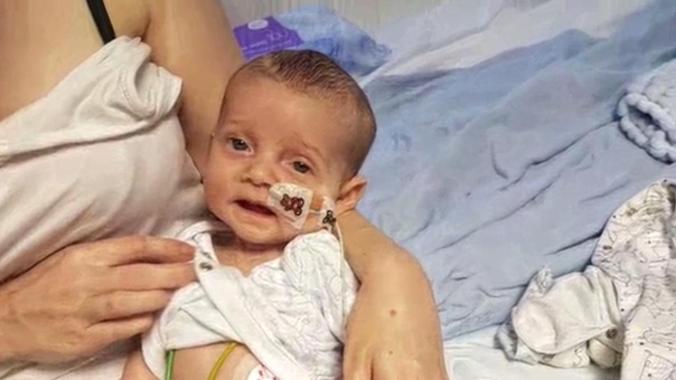
The idea of the state telling me I could not seek medical aid for my child when I had both the money to pay for it and a provider willing to give me the services is terrifying. My sixteen-month-old daughter has been receiving the majority of her sustenance through a feeding tube for the past six months. Prior to that, we had been struggling to get her to eat enough calories so that she would gain just an ounce or two, only to find that weight gain vanish when she caught a cold or a stomach bug. Granted, the gastroparesis she suffers is not a severe condition, but without the feeding tube she would risk starving. The thought that the state might step in, tell me that they not only would not pay for my daughter’s tube and care any more, but also expressly forbid me from feeding my daughter through the tube, makes me shake uncontrollably. If I have to fight for my daughter without the state’s help, fine by me. But for the state to forbid me from fighting for my daughter? That is unconscionable.
However, at this time, I don’t have to face that issue. I live in a place and a time when I don’t have to contend with general threat, and my daughter’s condition is not terminal and readily treatable. I hope that my child-rearing and my fear for my daughter helps me to have empathy for the parents of Charlie Gard. I also hope that I can step back away from the emotional turmoil this issue raises and try to understand what is happening here.
The principle dilemma in the case of this poor baby boy lies in the fundamental tension between the fact that human dignity demands we do fight for life, while at the same time we know that we will all ultimately die. Because human life bears an intrinsic dignity, its wrong to deprive a human being of what it needs to survive. Because all humans ultimately die, it can become, through the use of extreme or unethical means, against human dignity to fight against death when death is inevitable.
Why would it be wrong, in some circumstances, to keep fighting against death? The most clear-cut examples are when the means of preserving life are unethical. Bathing in the blood of virgins, selling one’s soul to the devil, killing an innocent to harvest his organs, transferring one’s consciousness into the unwilling body of another — all these (fantastical as some of them are) represent tactics to extend life that obviously violate ethical principles.
What about less obvious examples? Let’s consider a man in a coma. His state is persistent, perhaps even vegetative, but his body is capable of processing food and drink, although he is incapable of eating and drinking orally. A feeding tube could provide him with all the nourishment he needs, and he could be kept alive for years in such a fashion. To stop feeding him through the tube would be to deliberately deprive him of sustenance he needs to survive, and thus would be unethical. Death is not inevitable in this case, except in the most sweeping sense.
In times past, a feeding tube would not have been possible, or if possible, not recommended because of infection, and thus this would not have been a serious alternative. Absent any means of delivering food to the man in the coma, no one could be faulted for not providing food. And if trying to use a feeding tube would actually kill him quicker, or have negligible effect, then the extreme measure of using a feeding tube would not be ethical. However, since we are at time with the technology that makes the use of a feeding tube fairly easy and safe, we no longer have that excuse to deprive a person of nutrients.
What about a slightly different case, when the man in the coma can no longer process foods even through a feeding tube? Then providing food actually causes harm without any gain. Perhaps nutrients could be provided through an IV, but one would be justified, and perhaps is even obligated, to stop providing food through the feeding tube.
Now, the most challenging cases are when a person is terminally ill, but there are procedures that exist that can extend life. To what extent are we obligated to provide care? It depends on the nature of the treatment, the cost of the treatment, and the effects of the treatment. A person is fully justified in accepting that death cannot be stopped and let the terminal illness run its course. A person is not justified in taking steps to deliberately end that life, but is justified in procuring palliative care that eases the pain of the dying, even if it hastens death. But one is not obliged to pay for or undergo an extensive, dangerous, expensive procedure that will not provide a cure, but only a short extension of life.
It should be clear, though, that just because one is not obliged to pay for or undergo extreme care, it does not follow that one is obliged to never pay for or undergo such procedures. If a person has the money and desire to attempt such care, and that care is available, that person should not be denied.
Is there any instance, then, when that person could be denied that extraordinary care? Again, we are assuming that the person can pay for it and the care is available, so we aren’t discussing an instance in which the terminally ill patient is displacing someone else’s care.
I personally cannot think of an instance in which we could rightly deny that care. What I do know is that, in Catholic theology, death does not mark the end of the existence of a person. The soul survives death, and the soul will be reunited with the body at the Resurrection. There is danger in pursuing treatments at any cost, and that danger lies in the denial of the afterlife. That has consequences for one’s eternal soul. Continue reading →
 Ethics Alarms
I thought that the Charlie Gard story would stimulate some excellent thoughts on ethics and public policy from readers, and for once I was right. This is the first of two superb Comments of the Day it generated, and there were several others as well.
Here is Ryan Harkins’ Comment Of The Day on the post, “Observations On Britain’s Charlie Gard Ethics Fiasco.”