What Lawyers Can Teach Doctors About Ethics

So THAT'S why they wear masks!

So THAT’S why they wear masks!

Sandeep Jauhar is a cardiologist, the author of “Doctored: The Disillusionment of an American Physician” and “Intern: A Doctor’s Initiation.”and a contributing op-ed writer for the New York Times. He recently penned a column for the paper that raised concerns about threats to doctor-patient confidentiality, specifically from the case, in Washington state, of Volk v. DeMeerleer.

Howard Ashby, a psychiatrist, was sued after his patient, Jan DeMeerleer, shot and killed an ex-girlfriend and her 9-year-old son before shooting himself.  The estate of the victims, Rebecca and Phillip Schiering sued Dr. Ashby, alleging that he breached a duty to warn DeMeerleer’s victims even though the killer had made no specific threats toward the Schierings during his treatment.  Last year, however,  that judgment was reversed by an appeals court, which held that doctors could be required to warn “all foreseeable victims” of their potentially dangerous patients in their care.

It’s a terrible decision, and Jauhar does a good job explaining why. Unfortunately, he also writes this..

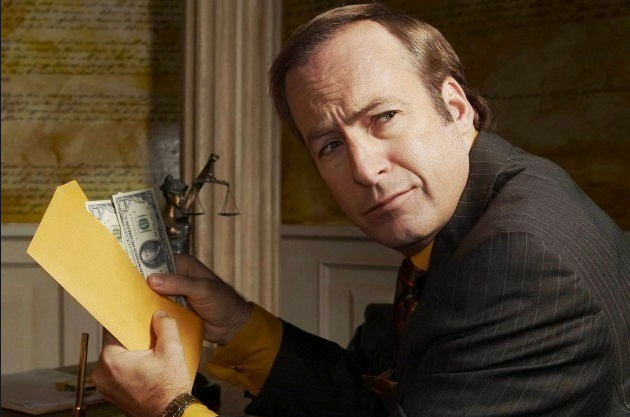
“I once took care of a business executive in the emergency room who had hired call girls during a weekend drug binge. When he saw a police officer outside his room, he quietly handed me an envelope containing a large amount of white powder. I wasn’t sure what to do with it, so I discarded it. For the next several hours the patient eyed me suspiciously, probably wondering whether I had ratted him out. But it never occurred to me to do so.”

Well, it should have. Confidentiality is one thing, assisting in a crime is another. The Hippocratic Oath says“What I may see or hear in the course of treatment, I will keep to myself.” That only means, however, that doctors who learn about criminal activity a patient may be involved in is bound not to report it (lawyers have the same obligation).  Jauhar did more than not report criminal activity; he participated in it. He crossed the line by disposing of contraband. Continue reading
Have A Happy Thanksgiving Everyone, And Don’t Forget To Review The Ethics Alarms Complete “It’s A Wonderful Life” Ethics Guide Before The Annual TV Screening!

It’s right here!

Ethics Musings On An Open Letter From A Rejected Son

Patrick Bradley is a New York-based food columnist and founder of TheGayFoodie.com. I’ve never heard of him, which doesn’t matter; somebody does need to explain to me why a writer’s sexual orientation has anything to do with food, and why this isn’t just blatant group identification tribal exploitation of the kind that is dividing this country and culture. But I digress…this stuff annoys me, but I digress.

Bradley sent to the gay website Out an open letter he wrote (and sent? Let’s hope so) to his parents, who refused to attend his wedding to his same sex partner more than two years ago, and who have been estranged from him ever since. I would call the letter an ethics bomb, an action that hurls ethical dilemmas and problems in all directions, for good or ill. I’m publishing it in its entirety, and will have comments afterward.


Dear Mom and Dad,

It’s been 890 days since the day that you both decided not to partake in my wedding. I don’t know why it’s taken me this long to say anything about it. Perhaps I’ve been afraid of what the family will think, what the family might say. Or perhaps I’ve been afraid of losing even more of my wonderful, beautiful family, whom I think about day and night.

But the time is now because I’ve finally grown too tired of the 890 days and nights of being haunted by your presence—by your lack of presence, to be more precise. I’m tired of night after night of dreaming of you. And tonight, I had the most unpleasant of dreams—one that jolted me from my sleep and disallowed me to return to it. So at 6:22 a.m., after little more than three hours of sleep, I’m writing this letter to you—knowing that it is taking from my opportunity of getting a full night’s rest before work; but I’d rather work on little sleep than on little dignity.

As not to keep anyone in the family excluded (any longer), I’m sending this letter to everyone involved. I want everyone to know what had happened on my last visit to you, before my beautiful, wonderful wedding. I’m not writing this letter in an act of vengeance (even though it feels like it is), but rather, I’m doing it because I’m tired of walking on eggshells around my siblings, godchildren, nephews and nieces. I’m tired of having to be “civil” with both of you, “for the sake of the family.” I’m also tired of the unwanted holiday and birthday gifts, and I’m tired of you having the audacity to speak to my husband (and myself) as if nothing has happened. Have you no shame?

Continue reading

Ethics Dunce: President George H.W. Bush

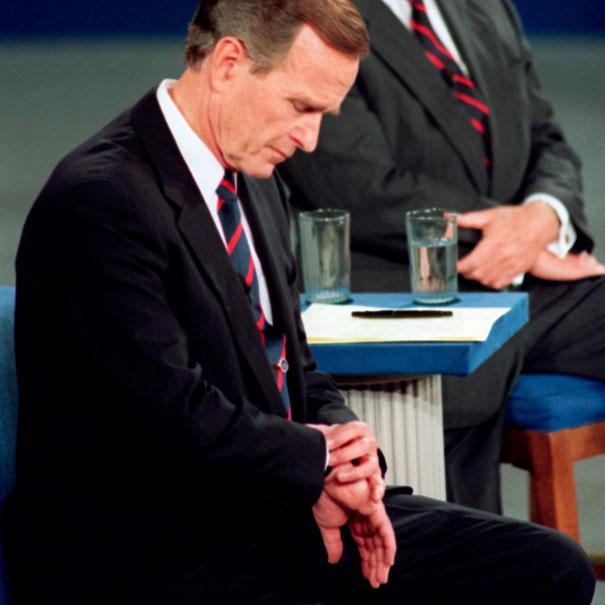
Bush watchThe big news on the Bush-bashing front is that Papa Bush, #41, has a biography coming out next week, and section released by the publisher shows that he didn’t care much for his son’s (#43) staff, as well as containing other critiques.

To begin with, Bush I is a selfish jerk for allowing his biography to be released during the 2016 campaign, when it can only be used as a weapon against his sons and his party. His publishers want that, of course, because it means sales, and other than the campaign controversy angle I cannot imagine a one-term President whose biography anyone but family members would be less interested in reading. Benjamin Harrison, maybe. (But I’ve actually read not one biography of Ben, but three: Harry J. Sievers’s three-volume biography of Harrison, published between 1952 and 1968. It wasn’t my idea.) Bush, however, doesn’t need the money. His ego has obviously swallowed his common sense and loyalty, or he is being manipulated in his dotage.

That’s one obnoxious feature of the book. The worst, however, is this passage from the Times story describing a section in which Bush confesses that nearly didn’t run for re-election: Continue reading

The Unlikely Ethics Dunce, And Why Nobody Pays Attention To Ethicists And I Don’t Blame Them

Wait, how can the nation's most famous ethicist be an Ethics Dunce? It's not easy...

Wait, how can the nation’s most famous ethicist be an Ethics Dunce? It’s not easy…

Ethicists have managed to make ethics nearly invisible in our cultural debates, and nearly useless as a decision-making tool, when it ought to be the most useful tool of all. They accomplished this over centuries of work, making the discipline of ethics abstruse, elitist, abstract, and worse of all, boring. Nobody should be bored with ethics, hence my statement, “Ethics isn’t boring, ethicists are.” Once ethics was pigeon-holed in the realm of philosophy, however (it belongs with “crucial life skills” and “critical thinking”) and philosophy became associated with scholarship, advanced degrees and academia, the jig was up.

The problem is that academic ethicists teach and write about abstract ethics, and life is not abstract. Their quest is for one formula to determine right from wrong, and life and human beings are more complicated than any one formula can encompass. When I started this blog, I got a lot of grad students writing me who demanded to know whether I was a Utilitarian,  Kantian Deontologist, a follower of Natural Law Ethics,  a Virtue Ethicist or a devotee of Stakeholder theory. My answer was “all of the above and none of them.” All of these and more are useful tools of analysis, but none work all the time, and the amount of words loaded into jargon to explain and debate the nuances of any of them render them all useless except for  writing scholarly papers.

The ethics that the public learns, as a result, are what pop culture and society teach them, and most of that isn’t ethics at all. For example, in the cable series “The Affair,” a well-educated older man was advising a young woman, the mistress in the affair, about how to think about the illicit relationship that broke up he lover’s marriage. Wise and thoughtful, he described his own adulterous affair, and then said, “What you did wasn’t wrong. You didn’t kill anybody. You didn’t break any laws.  Don’t be so hard on yourself.”  There is no ethics in that statement. Itis just employs two popular and facile rationalizations (#4. Marion Barry’s Misdirection, or “If it isn’t illegal, it’s ethical,” and #22, the worst of all, #22. The Comparative Virtue Excuse: “There are worse things.”) with another lurking but unspoken one, the Cheater’s Special, #23. Woody’s Excuse: “The heart wants what the heart wants,’ underlying the whole scene.

That’s ethics, I would guess, to about 90% of the population. Scary. This is, however, where ethicists have taken us. They could be so important to the culture, if they would get their heads out of their asinine models and explain ethical principles that are relevant to real lives in a manner that doesn’t make normal people become hostile to the subject.

This brings us to Peter Singer, Princeton’s acclaimed professor of bioethics who has been called the most influential ethicist alive. It is admittedly faint praise, but probably correct. Continue reading

Ethics Musings I : The Dark Side Of Personal Injury Lawyers

better-call-saul

I’ve been reflecting, since yesterday, on the bizarrely angry and intellectually dishonest protests registered here and on his own blog by trial lawyer Eric Turkewitz regarding the aunt who sued her 12-year-old nephew. His arguments, if you can call them that, consisted of constantly shifting the issue from ethics (what the aunt should have done) to law (what the aunt had a legal right to do), denying the core problem (Why would anyone assume that a child is harmed by dragging him into court, subjecting him to examination in front of strangers, and focusing on him as a wrongdoer and responsible for his aunt’s alleges misery, all mandated by the aunt who supposedly loves him?), and appealing to a dizzying list of rationalization and fallacies. He then made his exit by accusing me, a lawyer, of “knowing nothing about the law” (I made no assertions about the law at all—this is not a legal issue) making everyone stupid, and being a narcissist, a full-bore ad hominem attack ending in an ominous “May God have mercy on your soul!” Why would he act like that?

The reason, I realize, is that my posts challenge the basic belief system of the plaintiff’s bar, which I know very, very well having worked in an executive position and run such diverse programs as the research data base, conventions, sections, litigation groups and more over seven years with the Association of Trial Lawyers of America. Now ATLA is called “The American Association for Justice,” a name chosen purposefully to disguise the fact that it is a plaintiff’s lawyer’s lobby by keeping “trial lawyers” out of the name because it had a negative response in marketing studies. (I kid you not.)

Trial lawyers have done a lot of good and important things and continue to, but the profession is corrupting. There is a lot of money to be made, and ATLA–excuse me, AAJ, is devoted to eliminating any limits on their members’ ability to sue anyone for any amount, no matter what harm it does to the economy, the nation, the cost of health care, the bonds of trust in society, personal liberty, or public respect for the civil justice system. Individually, members of AAJ are among the top donors to the Democratic Party, in part to make sure that they can block all Republican efforts to limit jury awards, spurious lawsuits, and damages that have to be paid by negligent corporations when they destroy lives through shoddy products, conspiracies, and other conduct. The other reason is that Democrats support the redistribution of wealth, and trial lawyers profit by it.

In the matter of keeping corporations accountable, the AAJ is, as they will constantly remind us, on the side of the angels. But like other interest groups (the NRA, the ACLU, NOW, and may more) that stake out  extreme, self-serving and unethical positions in defense of legitimate rights, trial lawyers often feel that they must take the position that every injury and misfortune deserves compensation by someone else. Eventually, they believe it. Justice is taken out of the equation for all but the plaintiffs bar’s clients. Justice means that someone else is always at fault. Continue reading

My Reply To Eric Turkewitz’s Criticism Regarding “The Worst Aunt Ever”

This guy would have given The Bad Aunt the right advice...

This guy would have given The Bad Aunt the right advice…

Eric Turkewitz is a New York trial attorney, by all accounts a terrific lawyer, by the evidence of his writing an ethical and astute one, in our brief encounters a very nice guy, and the proprietor of “The New York Personal Injury Law Blog.” In a recent post, he defends the decision of Jennifer Connell to sue her young nephew for a four-year old injury she received when he hugged her too enthusiastically at her birthday party. He notes, correctly, that the decision to sue was based on the client accepting a “bad call” by her lawyer. He also includes a lot of information not mentioned in the early posts on the matter, including mine. Still, he defends Connell. He also specifically criticizes my post. Eric writes,

And this is from Jack Marshall, who says he actually teaches ethics and has a blog called Ethics Alarms (coded “no follow“):

“What’s going on is that Aunt Jennifer is pure hellspawn, a mysteriously animated pile of human excrement that embodies the worst of humanity.”

This is what happens when people elect to post stuff on the web based on an initial news report that was, shall we say, very selective on what it chose to report. This site is getting quite a bit of traffic, most likely from many who never knew it existed. So let me answer a question some of you may have: Yes, I know what it’s like to be on the receiving end of lawsuits, and they weren’t nearly as benign as this run-of-the-mill kind: On Suing and Being Sued.

Yes, I “actually teach ethics,” and I could, in fact, teach Eric some things that he would find useful and enlightening. I’m not going to get in a pissing match with him, in part because, as I learned from another tiff four years ago (in which I was wrong, and duly apologized), he has some very, very nasty pals, and I don’t want to throw blood in the water. This is, however, an excellent example of how lawyers often end up seeing the world, and in fact I may use his post, unattributed, in seminars to show where legal ethics and ethics diverge. It is wise for lawyers to be atuned to both.

Here was the response I made to Eric on his blog: Continue reading

The Greensboro College “It Stops Here” Ethics Train Wreck

Everybody’s unethical here.

As usual, however, it starts at the top.

It Stops HereGreensboro College in North Carolina  adopted a new policy on student sexual misconduct, and it requires all first year students to attend a performance of  a one hour play, “It Stops Here,” written and directed by student Michaela Richards, based upon “accounts of sexual assault submitted by survivors.”

Ethics Foul 1 (Greensboro): A female-authored play based on “survivors” accounts is a one-sided, biased and ideological work by its very nature. Do we know that the real incidents are being fairly represented, or would the claims of a “Mattress Girl” be included? Presumably proof of “sexual assault” is being validated by the infamous “Dear Colleague” letter from the Obama Administration that has led to multiple examples of male students being harshly punished in violation of basic due process principles.  It is entirely written from a woman’s/alleged victim’s point of view, and thus certain to be received as hostile and unfair by male students.

Ethics principles violated: Responsibility, honesty, fairness, competence.

Ethics Foul II (Greensboro): Using a work of fiction to inform students about a policy is incompetent. Fiction is always infused with the viewpoint, agendas and biases of the playwright; in this case, such a work is bound to be political. A sincere effort to instruct students on policy should have no political content at all.

Ethics principles violated: Abuse of power, responsibility, respect, competence.

Ethics Foul III: Forced viewing of a work of art isn’t instruction, but indoctrination. In a play, any audience member should have the option of walking out. This is especially true of a play written and performed by amateurs. “The student actors on stage are telling stories of an extremely sensitive nature that should be viewed in a respectful manner,” the president of the college said. “We expect no less of our students, who should know better than to make light of an extremely serious subject that affects us all.” WRONG. Forcing students to watch a play consisting of a slanted view of the sexual assault issue on campus is not respectful. It is, in fact, an insult and a provocation.

Ethics principles violated (Greensboro): Abuse of power, respect, fairness, prudence, regard for personal autonomy.

When people, especially young people and especially American young people who, thank heaven, are still imbued by the culture with a natural detestation of arrogant authority and the courage to defy it, are commanded to do something they shouldn’t be, like to watch an agitprop play, they tend to resist. They did, too:

Members of the audience frequently heckled the cast and shouted sexually explicit remarks.“Many of the boys started calling out ‘She wanted it, it’s not rape,’ and making masturbation noises,” stage manager Claire Sellers told a local news station. Sellers said the remarks were so excessive that cast members “became physically ill and vomited after the show because they were so vulgar.”

Continue reading

“Unethical Presidential Candidates Sunday” (EXTENDED): Hillary’s New Public Corruption Plan? If They Won’t Willingly Vote For Her After They Learn What She’s Like, Make Them promise To Vote For Her No Matter What They Learn

Loyalty Oath

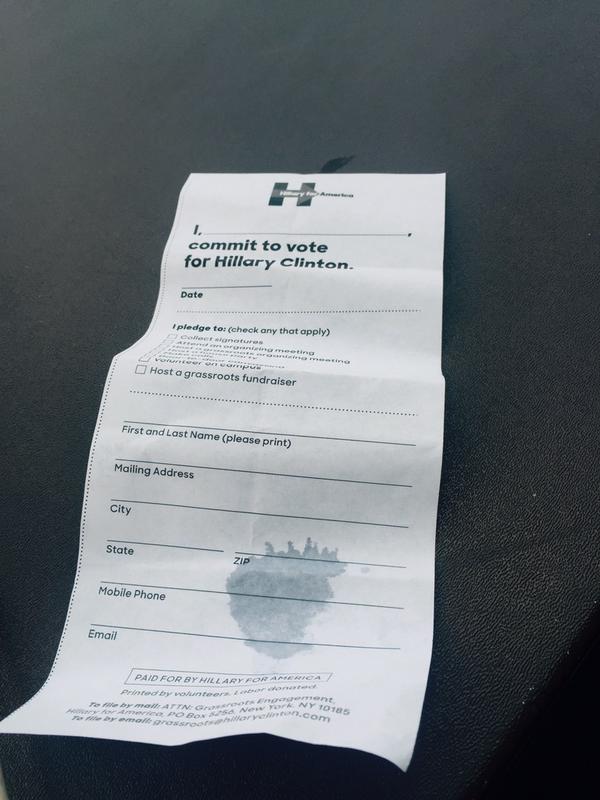
From the Pittsburgh Tribune-Review‘ via Mediaite: Attendees at a Hillary Clinton campaign event in Cleveland, Ohio, were asked to sign a pledge promising to vote for the candidate before they were allowed into the venue.

Yes, this is basically a loyalty oath. Loyalty is the most confounding of ethical values, because it so frequently leads to unethical resolutions of ethics conflicts, when loyalty requires the rejection of other ethical values that should be given priority. Many unethical organizations and leaders insist on loyalty even if they will disdain honesty, integrity, responsibility, accountability, fairness and decency. Used like this, loyalty becomes a virtue that enables unethical conduct. A mother refuses to report her murderous son. A wife abets her raping husband (Hello, Camille Cosby!) Another wife supports her husbands lies about his adultery. (Now who could this be?) Blind loyalty directs Southerners to insist that their forebears weren’t rebelling in support of slavery, African-Americans to insist that a black President is a great President, and patriots to spit “Disloyal!” at principled protesters of national policies abroad.

Obviously, loyalty is very useful to leaders who are untrustworthy or corrupt. They seek support out of quid quo pro transactions that insist, “You owe me! I was there for you, so you must be there for me, no matter what happens,” “no matter what happens” meaning “no matter what awful things I do and what unsavory things you learn about me.” It isn’t patriotism is the last refuge of a scoundrel, as Samuel Johnson famously said, but loyalty. Loyalty was the main bulwark of power and survival for Don Corleone, Colonel Jessup (“A Few Good Men”), Auric Goldfinger,  Darth Vader…and in the real world, Richard Nixon, Mao, Jesse James, Bill Clinton…and obviously, Hillary. Continue reading

Morning Pop Quiz On Ethics And Leadership: What’s Wrong With White House Spokesman Josh Earnest’s TSA Quote?

Here’s the quote, from Earnest’s  statement on behalf of the President:

“The President does continue to have confidence that the officers of the TSA do very important work that continues to protect the American people.”

Your pop quiz:

What’s wrong with it?

(It is very wrong.)

I’ll give you a minute (It took me 3 seconds) “Final Jeopardy” style:

Got it?

Here we go…. Continue reading