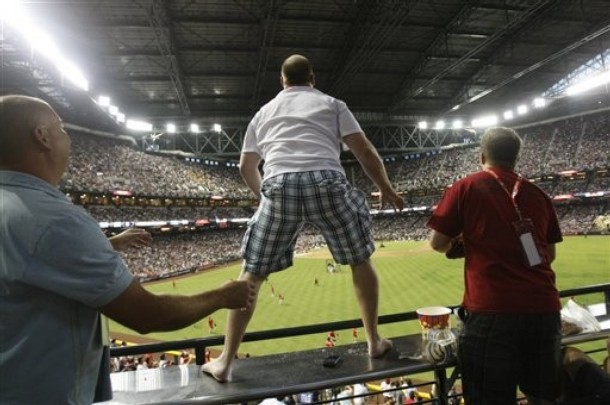
Don't try this if you're not a firefighter
Many commenters were upset with me for characterizing the tragic death of Shannon Stone, who fell to his death while trying to catch a ball during a Texas Rangers game, as the result of his own bad judgment, suggesting that I was impugning the character of a dead man. (I wasn’t.) That reaction sparks the second Ethics Alarms quiz question relating to the incident.
NBC baseball blogger (and lawyer) Craig Calcaterra put up a post this morning headlined “Idiot nearly falls from the stands chasing a ball at the Home Run Derby”:
“Just days after Shannon Stone died from a fall while reaching for a baseball at a Texas Rangers game, a fan at last night’s Home Run Derby nearly fell out of the outfield stands while lunging for a home run ball hit by Prince Fielder. He was spared serious injury or death only because his friends grabbed him by his feet, held him and then pulled him back as he dangled over the railing above a concrete deck 20 feet below…His name is Keith Carmickle, and common sense is not his forte. His fall came after he stepped up onto the narrow metal table which abutted the railing — the kind you stand in front of and set your drink on while watching the game — and then, while still standing on it, reached down low to catch the ball as it came in…He missed the ball, but his momentum carried him forward and he fell headfirst over the rail. If it wasn’t for his brother’s and his friends’ quick action, down he would have gone. Despite his idiocy, he (a) escaped this dangerous situation of his own making unscathed; and (b) was allowed to stay at the Derby by security. Both of these factors have been added to the “evidence that there is no God and/or that He is not just and fair” side of the big ledger I keep on my desk and in which I tally the wonder and folly of Humanity as I encounter it…”
Your questions to answer, if you dare: 1) Is it fair for Calcaterra to call Carmickle an idiot, and Stone just a random victim of circumstance? 2) Why or why not? Continue reading
 Ethics Alarms