Ethics Dunce: Major League Baseball

MLB Wild Card play-off, 2020

I dislike baseball’s play-offs, especially the fact that a team that finished second over a 162-game season can still win the World Series and be called a champion. I really dislike the addition of a second “wild card” team to the post-season formula this year, which theoretically means that a team can finish third and end up as a champion. Yes, I know this is the way it has been for decades in football, basketball and hockey, but they are lesser sports, after all.

Baseball’s rules for the new one-game play-off between the wild-card teams, however, marks a new low in baseball’s integrity. Since it the single game is a separate play-off round, the suits who run the game have decided that managers can devise a unique 25 player roster for that game alone, and reconstitute the team if it goes on to the next round, a three-out-of-five series. The practical effect of this rule is that two teams will face each other not only bearing insufficient resemblance to the teams that actually earned the play-off slot, but will also play with a roster that would be disastrous over the course of  a season. Continue reading
Ethics Dunce: Suspended Giants Outfielder Melky Cabrera (And Not For The Reason You Think)

Who is “Melky Cabrera” really?

Melky Cabrera shocked Major League Baseball by getting caught mid-season using banned metabolic steroids, it’s true. It is also true that this marks him for all time as a cheater, and something of an idiot, since the penalties for PED (performance enhancing drug) use are devastating to a baseball player’s reputation and wallet, and because, unlike when Barry Bonds was breaking records and racking up MVP trophies while being juiced, the game has belatedly decided that it isn’t going to let games, championships and records be distorted by chemical means.

Melky, however, is special among baseball’s cheaters. Only he, as far as we know, decided to attempt an elaborate internet deception to try to duck responsibility after he had been caught.

From today’s New York Daily News: Continue reading

The Melky Cabrera Affair: When Fair Isn’t Fair

A useful tool, when the government decides that what you did should have been illegal.

Let me bring the non-baseball fans among you up to date, reminding you that while the immediate subject is baseball, the ethical implications of this story are far broader.

Melky Cabrera, until last season, was a standard issue major league outfielder of substantial but undistinguished abilities and accomplishments. Last season, playing with the frequent destination of such players, the Kansas City Royals, Cabrera suddenly and unexpectedly emerged as a star, surpassing all expectations and his previous levels of performance. The Royals traded him, like an over-priced stock, to the San Francisco Giants in the off-season, getting a package of players in exchange for one they probably thought was as valuable as he would ever be.

This season, however, he was even better.  Not only was he selected to the All-Star team for the first time, he was also on the way to leading the Giants to the play-offs and possibly a World Series appearance. Then, this week, a drug test came in positive for testosterone: steroids. By MLB’s rules, Cabrera was suspended from play for 50 games, effectively eliminating him from the Giants season and post season and, not incidentally, marking him as a cheat and an idiot.

And maybe a batting champion. When he was suspended, Cabrera was second in the National League in batting average, and had already amassed the necessary at bats to qualify for the championship (actually, there are some complications with that, but for all intents and purposes, that’s true). He’s only 13 points behind the leader, and averages tend to come down as the season drags on. Not only is Cabrera’s high average a likely product of pharmaceutically-aided cheating, but his suspension for getting caught at cheating may actually help him win the prestigious batting crown, by freezing his average at a lofty .346. Is this fair? Certainly not. Continue reading

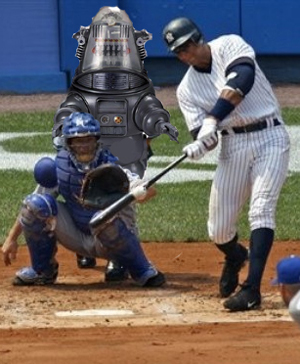
Umpire Accountability, As The Day of the Robots Fast Approaches

If Robby replaces you, Larry, it's your own fault.

Are baseball’s umpires trying to get themselves replaced by machines? Or perhaps baseball’s brass are conspiring to allow incompetent and lazy umpires to do themselves in, as their miserable work wins over the traditionalists and the Luddites to mechanical ball and strike-calling and their overseers refuse to take decisive action against the worst officials they have. Whatever the explanation, today’s debacle ending the Tampa Rays-Red Sox game in Boston showed an appalling lack of accountability and professionalism in a segment of the game that is critical to its credibility and integrity. Continue reading

The Real Meaning of Manny Being Manny

The only surprising aspect of the news yesterday that former baseball slugger-savant Manny Ramirez had been arrested for allegedly slugging his wife—the one alleging being said wife—is that any baseball fans were surprised. If anything was written in the Book of Fate, it was that this man, so completely lacking in respect for basic ethical values, was destined for trouble with the law.

While he was playing, of course, Manny’s uncivilized and cheerful contempt for basic rules and principles of right and wrong were tolerated by his employers, amused sportswriters and evoked cheers from fans. He was a great, great hitter, you see: who cares if he was habitually rude, unprofessional, slovenly, careless, disloyal, disrespectful and above all, selfish to his core? Look! He’s having fun! Isn’t that charming? Stop harping on little details, like hustling, sportsmanship, or being honest. Let Manny be Manny! Continue reading

An Ethics Lesson From the All-Star Game

It really is one of the most enduring sports deja vus—every year, sportswriters and fans engage in thousands upon thousands of words of complaint regarding baseball’s annual All-Star Game, the 2011 edition of which will occur tomorrow night in Phoenix. This year was no exception, and as is always the case, no consensus or conclusions were reached, except that everyone agrees that the game is mishandled, mismanaged, unfair and illogical in every possible way.

I have been thinking of the game’s plight as an ethics case study that proves a core truth: you can’t do the right thing if you don’t know your objectives, stakeholders, and how to prioritize them. In the All-Star Game as it has evolved, there are competing interests and stakeholders with no clear agreement regarding which takes priority over the other. It is literally impossible to do be fair: somebody always will be disadvantaged, and because there is no single objective either, utilitarian balancing doesn’t work.

It was not always this way. When the All-Star game was first conceived in 1935, it was intended to raise money for the players’ pension fund, the players then being generally paid little more than grocery clerks.  Since the game had to draw as much of a paying crowd as possible to make money, the rosters and starting line-ups were constructed to include the biggest stars and most popular players. It didn’t matter whether Babe Ruth was off to a great start or not: it wouldn’t be an All-Star Game without him in the starting line-up, so he was the right-fielder. Managers picked the team that they thought would both be the “starriest” and that would give them the best chance to win the game. Continue reading

All-Star Election Cheaters: The Boston Red Sox and the San Francisco Giants

The Major League Baseball All-Star Game team voting by the fans is hardly a model of fair democracy. Most fans vote for their favorites rather than the best qualified players, and are not very informed even about their favorites. They also are guided more by loyalty than analysis, choosing local heroes over more accomplished players from another team. In other words, it’s basically the same as political elections.

Well, there are other factors that make the All-Star Game voting less than admirable. You can vote up to 25 times from each e-mail address, giving an edge to computer geeks. The teams in the biggest cities and with the best attendance have an advantage over the rest, because there are more of their fans voting. And players on teams like the Phillies, Dodgers, Red Sox, and Yankees that are on national TV a lot, along with last season’s World Series adversaries, the Texas Ranger and the San Francisco Giants, have more name recognition nationwide, giving their players another unfair edge.

Still, it is an election, the votes count, and the various franchises should be trying to uphold whatever minuscule smidgen of integrity the current system has. The Boston Red Sox and the San Francisco Giants, however, don’t think they have enough advantages in the  All-Star voting already, and have found a loophole in the rules that allows them to cheat. Continue reading

Manny Post Script: The Signature of a Jerk

Manny Ramirez, the now-retired ex-baseball slugger, provoked the predictable responses from the media and fellow players in the wake of his sudden retirement after being notified that he would be the first major league player to face a 100 game suspension for failing a mandated PED test (that’s “performance enhancing drugs” for all of you who don’t know who Barry Bonds is), because no player had ever been caught TWICE before.

Everyone was in agreement that this meant: Continue reading

Manny Ramirez’s Perfect Exit

The most unethical baseball player since the Black Sox

From  Major League Baseball:

“Major League Baseball recently notified Manny Ramirez of an issue under Major League Baseball’s Joint Drug Prevention and Treatment Program. Rather than continue with the process under the Program, Ramirez has informed MLB that he is retiring as an active player. If Ramirez seeks reinstatement in the future, the process under the Drug Program will be completed. MLB will not have any further comment on this matter.”

Perfect. Perfect.

Manny Ramirez was an impressively talented baseball player with discipline of an untrained Irish Setter, and the selfishness of a six-year-old. Throughout his career, he was a textbook example of the management fallacy known as the star principle, in which an extremely talented individual is allowed to break the rules and defy an organization’s culture in direct proportion to his perceived value. Continue reading

Baseball’s Free Agent Follies: Dumb Clients, Conflicted Agent

Baseball’s super-agent Scott Boras has his annual off-season conflict of interest problem, and as usual, neither Major League Baseball, nor the Players’ Union, nor the legal profession, not his trusting but foolish clients seem to care. Nevertheless, he is operating under circumstances that make it impossible for him to be fair to his clients.

This year, Boras has three aging outfielders in his stable, all with some Hall of Fame credentials, all with fading skills, and all without jobs. Their names are Manny Ramirez, Johnny Damon and Andruw Jones. Thanks to a glut of unsigned hitters still on the market, the price for each of these three—once, when they were young, in the 8-figures a year range—is falling fast. According to an analysis by ESPN, only six, and possibly as few as three, possible teams are still looking to fill slots on their rosters suitable for Ramirez, Damon, and Jones, and none of them will sign more than one, if any. Continue reading