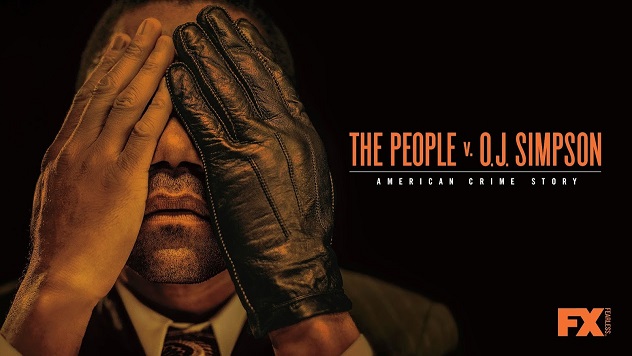
I never got to see all ten episodes of last year’s ambitious and star-studded mini-series about the O.J. Simpson trial before this weekend. Thanks to Netflix, I was able to watch them all in two nights. I watched most of the televised trial at the time, so the program brought back a lot of bad memories.
Overall the production was excellent, and some of the casting was creepily good, especially Sarah Paulson as Marcia Clark, Sterling K. Brown as Chris Darden, Kenneth Choi as Judge Ito, Courtney B. Vance in a magnificent portrayal of Johnnie Cochran, Rob Morrow as
Barry Scheck, Robert Morse, unrecognizable as Dominick Dunne, and Joseph Siravo as Fred Goldman. Unfortunately, Cuba Gooding, Jr., an excellent actor, is so unlike O.J. that it kept reminding us that this was a TV show. Nathan Lane and David Shwimmer also were unable to disappear sufficiently into their roles as F. Lee Bailey and Robert Kardashian. I couldn’t help thinking of “The Bird Cage” and “Friends.”
The script was remarkably even-handed, and for the most part, accurate. However, there were three legal ethics howlers that require some exposition, as well as some other matters that came to mind.
1. The Defense’s Secret Redecoration of O.J.’s home.
In the episode “The Race Card,” Johnnie Cochran was shown redecorating O.J. Simpson’s house before the jury came for a judge-approved viewing. Pictures of half-nude models were replaced by benign photos of Simpson’s mother and children, and Cochran scattered pieces of African art around the rooms, taken from his own collection.
Could the lawyers do this? Of course not! It’s a visual lie, and an attempt to mislead the jury. Ito ordered that the heroic statute of Simpson in his back yard be covered with a sheet to avoid biasing the jury in favor of the defendant. Had the prosecution team suspected that Cochran had pulled such a stunt, as the dramatization suggested, it would have alerted the judge, a mistrial would have been likely, and Cochran as well as every lawyer involved would have faced serious bar discipline.
The question is, did this really happen as portrayed? Defense attorney Carl Douglas said in a Dateline NBC’s special THE PEOPLE vs. OJ SIMPSON: What the Jury Never Heard that it did, and that he organized the redecoration. Douglas said the intention was to make the estate look “lived-in and stand with all of its regalness so that the jurors would say ‘O.J. Simpson would not have risked all of this for this woman.'” Douglas said that “photos of Simpson with white women were swapped out for pictures of him with black people. A Norman Rockwell painting from Johnnie Cochran’s office and a bedside photo of Simpson’s mother were placed in prominent view.”
Douglas should be suspended from the practice of law at the very least for this confession of outrageous ethics misconduct. (Cochran, who is dead, is beyond punishment.) Clark, Darden and Ito also failed their duties to justice and the public by allowing such a deception to warp the jurors’ perceptions. Continue reading
 Ethics Alarms