Annals Of The Ethics Incompleteness Theorem: The Snuggle House And “The Dress Code Effect”

Awww! Who could object to a little snuggle?

Awww! Who could object to a little snuggle?

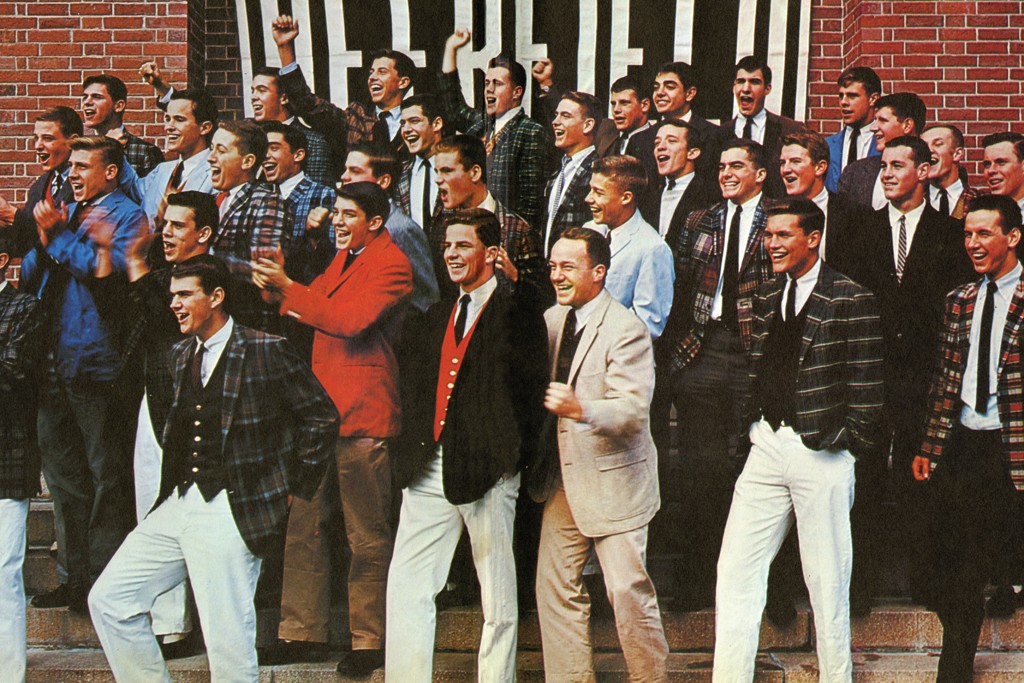
Almost any rule, low or ethical principle can be deconstructed using what I call border anomalies. The first time I was aware of it was as a Harvard freshman in the late Sixties, when all assumptions, good and bad, useful and not, were considered inherently suspect. The college required all students to wear jackets and ties to meals at the student union, and up until my first year, nobody objected. But that fall, my classmates set out to crack the dress code, so they showed up for meals with ties, jackets, and no pants, or wearing belts as ties, or barefoot. (Yes, there were a lot of future lawyers in that class.) Pretty soon Harvard gave up, because litigating what constitutes ties, jackets and “proper dress” became ridiculously time-consuming and made the administration look petty and stupid. Of course, there are good reasons for dress codes—they are called respect, dignity, community and civility—-but never mind: the dress code couldn’t stand against those determined to destroy them by sending them down the slippery slope.

If any rules are to survive to assist society in maintaining important behavioral standards, we have to determine how we want to handle the  effects described by  the Ethics Incompleteness Theory, which holds that even the best rules and laws will be inevitably subjected to anomalous situations on their borders, regarding which strict enforcement will result in absurd or unjust results. The conservative approach to this dilemma is to strictly apply the law, rule or principle anyway, and accept the resulting bad result as a price for having consistent standards. The liberal approach is no better: it demands amending  rules to deal with the anomalies, leading to vague rules with no integrity—and even more anomalies. The best solution, in my view, is to regard the anomalies as exceptions, and to handle them fairly, reasonably and justly using basic principles of ethics, not strictly applying  the rule or law alone while leaving it intact. Continue reading

Comment of the Day: “Ethics Hero: David Blankenhorn, Former Same-Sex Marriage Opponent”

eeyore1

In many ways, I love this post. I love it because it is passionate and serious, and from the heart, and because I am certain that it reflects what many Americans, especially those of a certain age, feel with frustration and a little fear and anger.  I also agree with much of what it concerns, the lack of respect for accumulated wisdom in many aspects of the culture, and the rush to discard old standards not because they have failed us, but just because they are old. The comment comes from a regular commentator, Eeyoure (not his real name, you’ll be relieved to learn, and yes, we both know how to spell the A.A. Milne character he honors) who is educated, decent, smart and articulate.

But regarding his lament’s  applicability to the controversy at issue, gay marriage, he is absolutely, utterly, tragically wrong. The conventional wisdom is that we should just try to ignore Americans who feel similarly to Eeyoure, because demographics are relentlessly removing them from the scene. As the politically active public becomes younger, the support for equal rights for gays, trangendered and bi-sexual citizens will grow into an overwhelming majority.  I think that’s a lazy and obnoxious way to win an argument, even when you are right. Smart but misguided people, like Eeyoure in this matter, should be able to evolve, learn, and realize when what they once thought was right, isn’t.  Realizing that one aspect of entrenched belief was, upon knowledge and reflection, wrong does not mean the whole foundation of civilized society has to crumble—this is the classic, irrational, self-defeating fallacy of conservatism. Change in the presence of enlightenment and experience is the essence of ethics, which constantly evolves. We should be able to explain what is wrong with this post so that even the poster agrees.

Here is Eeyoure’s Comment of the Day, on the post (and comment thread t0) Ethics Hero: David Blankenhorn, Former Same-Sex Marriage Opponent: Continue reading

Ethics Hero: David Blankenhorn, Former Same-Sex Marriage Opponent

Same sex

In a well-reasoned and sharply written op-ed in the Los Angeles Times, former gay marriage opponent David Blankenship writes eloquently and persuasively about why he has reversed his position. He writes in part:

“In the end, I didn’t change my mind on gay marriage because I stopped believing in the importance of intact biological families. Nor was it because of new studies or additional facts. (Gay marriage still strains biological family bonds, although research also points to the potential stability of gay marriage and family structures.) And I didn’t change my mind because I got tired of being criticized. I changed my opposition to gay marriage because of personal relationships. In my case, it began with the writer Jonathan Rauch, who I’d been publicly debating on the gay marriage issue. But at some point we stopped debating and started talking about our lives, including about my wife, Raina, and his husband, Michael. Did Jonathan’s marriage threaten the idea of marriage? Perhaps in theory. But in real life, was I able to see it? No. In fact, quite the opposite. It may sound trite, but for me the key was the gradual breakthrough of empathy. I found that as friendships develop, empathy becomes at least possible, no longer kept at bay by a wall of fixed belief. Put simply, becoming friends with gay people who were married or wanted to get married led me to realize that I couldn’t in good conscience continue to oppose it.”

Bingo.

_______________________

Pointer: Advice Goddess

Sources: LA Times

Ethics Dunce: Susan A. Patton

Oh, yeah, ladies, if you can't hook one of these gems, you should just kill yourself...

Oh, yeah, ladies, if you can’t hook one of these gems, you should just kill yourself…

Ethics are built by values, and those whose values are warped and flawed are very likely to engage in unethical conduct consistent with their rickety ethical foundation. Thus it is that I have serious doubts about Princeton grad Susan A. Patton, who in a letter to the Daily Princetonian not only proclaimed her own lousy values but did so as “advice” to co-eds. (I hope the link starts working; it was not earlier today.) In her letter, she wrote…

“Forget about having it all, or not having it all, leaning in or leaning out … Here’s what nobody is telling you: Find a husband on campus before you graduate. Yes, I went there…. Men regularly marry women who are younger, less intelligent, less educated. It’s amazing how forgiving men can be about a woman’s lack of erudition, if she is exceptionally pretty. Smart women can’t (shouldn’t) marry men who aren’t at least their intellectual equal. As Princeton women, we have almost priced ourselves out of the market. Simply put, there is a very limited population of men who are as smart or smarter than we are. And I say again — you will never again be surrounded by this concentration of men who are worthy of you.”

How misguided, jaded and warped is this advice?

Allow me to take inventory. Continue reading

Tales From The “Ick!” Files: If Luke Married Leia…

Luke and Leia

Emily Yoffe, who is not Ethics Alarms’ favorite advice columnist, gets one right at Slate—a weird one, but then, that’s the only kind of question she usually chooses to answer. If I had to bet, I’d place my money on this question being a fake. Emily acknowledges that possibility, but couldn’t pass this one up, and neither can I.

A loving husband who already knew that both he and his wife (it was virtually love at first sight when they met in college) were raised by lesbian parent couples who conceived via sperm donors found out that they both have the same donor to thank for their conception. Now he thinks “sister” every time he sees his spouse, and ask 1) what should he do? and 2) should he tell his wife that he has learned that they are half-siblings? Yoffe tells this poor guy to stop feeling guilty, and that he hasn’t done anything wrong. She also advises him to get some counseling, and to suck it up and tell sis about their dilemma….but not to reveal the secret to their kids, Anteater Boy and Tilly the Boneless. Continue reading

Worst Apology of the Month: First Baptist Church of Crystal Springs, Mississippi

A prominent member of the First Baptist Church of Crystal Springs, Miss.

It’s time to add a new Ethics Alarms category— the Worst Apology. Apologies seem to be flying around faster than usual as campaign season intensifies, though some individuals who desperately need to apologize—like, say, Harry Reid, are not.

I’ll be using the Ethics Alarms Apology Scale to rank the rotten apologies in our future. Ironically, the first winner in the category is a rare form of putrid apology that doesn’t even appear on the scale. The lowest ranking on the scale is a 10 ( “An insincere and dishonest apology designed to allow the wrongdoer to escape accountability cheaply, and to deceive his or her victims into forgiveness and trust, so they are vulnerable to future wrongdoing”), but the recent apology by the First Baptist Church of Crystal Springs, Miss. pulls an 11. Continue reading

Ethics Dunce: Rev. Stan Weatherford

Rev. Weatherford with a parishioner

The First Baptist Church of Crystal Springs, Mississippi has never hosted the wedding of a black couple in its 150 year history, so you can imagine how important it was to the congregation not to break a perfect record. All right, that’s unfair: only a handful of white church members protested to Rev. Stan Weatherford when they learned that he was preparing to wed Charles and Te’Andrea Wilson at First Baptist, but their threat that they would have him voted out of his job if he did was sufficient to cause him to tell Charles and Te’Andrea, just two days before the scheduled ceremony, that they would have to move the event to another church.

“I didn’t want to have a controversy within the church, and I didn’t want a controversy to affect the wedding of Charles and Te’Andrea. I wanted to make sure their wedding day was a special day,” Weatherford told local reporters. Continue reading

Ethics Quiz: Who Is More Unethical…the Coward Who Left His Girlfriend and Child to Die, Or the Girlfriend Who Agreed To Marry Him Anyway?

Would an ethical woman marry George?

I am a great fan of the old Seinfeld show in general and the George Costanza character in particular (all ethicists love George, who  exemplifies how messed up a life without ethical instincts can be), but I didn’t laugh at the episode when he smelled smoke at kids’ birthday party and trampled the children as he escaped in panic from the apartment. And that was just a TV sitcom; the actions of Jamie Rohrs, the Colorado man who ran out of the Aurora movie theater when James Holmes started shooting and drove away in his truck, leaving behind his girlfriend and her two young children—one of whom was fathered by him— go beyond unfunny to revolting. Luckily, and no thanks to Rohrs, Patricia Legaretta and her kids did not die, because a stranger, Jarell Brooks, helped them escape the theater and the massacre.

Then comes the rest of the story, revealed to Piers Morgan on CNN: after his act of aggravated cowardice, Rohrs had the gall to propose to the mother of his child, and Legaretta, incredibly, accepted.

Your Ethics Quiz:

Who is more unethical—Legaretta, or Costanza, er, Rohrs? Continue reading

Ethics Dunce: France

France

France doesn’t seem to comprehend it yet, but it is embarking on an uncharted and dangerous journey by installing a leader whose lifestyle argues for the irrelevance of marriage.

Valérie Trierweiler, the partner of France’s newly-elected president François Hollande, is being referred to world-wide as France’s new, and unmarried, “First Lady.” She seems like a serious, admirable professional, and there are certainly benefits to any nation by having a woman of substance, intelligence and talent at or near the top of that country’s public figures. I know very little about Hollande, but I am assuming that he is qualified for the difficult job he is undertaking, and that he, like Trierweiler, are mature adults who have every right to structure their personal relationships however they please. That assumption, however, requires the omission of the duties of leadership from the calculation. Leaders cannot make personal decisions based only on their own needs, but must make those decisions while acknowledging an immutable and long-proven fact: leaders have a disproportional, almost frightening power to influence, shape and change a culture, and the more successful and popular  leaders are, the greater that power is. Continue reading

More Advice Column Incompetence: The Case of the Jealous Sister

"My wife is behaving irrationally. Is it me, or might she have a teeny problem of her own?"

Once again an advice columnist’s response has me considering whether there needs to be a standard of malpractice for the profession, especially when desperate, trusting people rely on them in times of crisis. I agree that anyone who is prepared to adopt the recommendations of a stranger that are based on a probably inadequate and incomplete description of a dilemma, especially when the columnist could well be a college intern, the janitor or a lunatic, is in desperate straits indeed.  Still,  if you are going to give advice, it had better meet some bare minimum of competence—even if you are just an intern.

A sad and remorseful man wrote “Annie,” the Boston Globe’s advice maven, about whether there was hope for his marriage, which recently and unexpectedly exploded. Continue reading