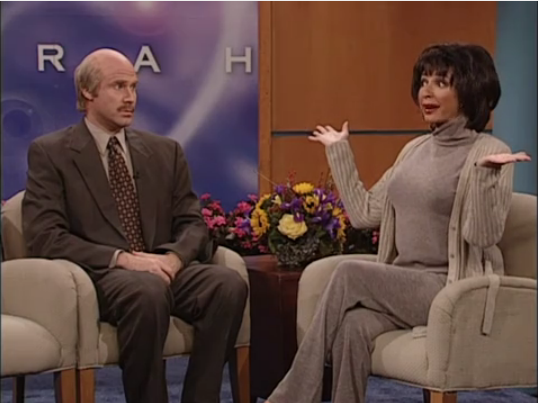
Maya Rudolph being Oprah, being funny, and nothing else should matter.
In a spontaneous call for more black cast members to be added to NBC’s long-running late-night satire show, “Saturday Night Live,” veteran cast member Jay Pharoah told an entertainment reporter that he wanted the producers to add actress Darmira Brunson. “Why do I think she should be on the show? Because she’s black first of all, and she’s really talented,” Pharoah said. “She’s amazing. She needs to be on ‘SNL.'”
By logic, rights and justice, Pharoah should be fired for such a statement. He is pushing his show, and therefore his producers and his bosses, into a controversy that they neither want, need, nor deserve. Sure enough, his comments have already ignited debate and commentary in major dailies and in the blogosphere. He can’t be fired, of course—no producer in Hollywood would dare fire a black performer for advocating politically correct causes like diversity and affirmative action, no matter how inappropriate and unfair his comments were—and Pharoah knows that. Breaking reasonable rules of the workplace—criticizing your own boss in public and causing trouble for your employer are pretty basic taboos—because you know you’re immune from punishment doesn’t make the conduct any better.
He’s not the producer, and casting isn’t part of his job. To announce his own candidate for a hire is as outrageous and out-of-bounds as for a Pentagon general to tell reporters who President Obama should appoint as his Secretary of Defense.
Then there is the statement itself, which in the context of entertainment and show business, is an endorsement of racial bias and discrimination, even more than with most workplace diversity and affirmative action advocacy. “Because she’s black first of all?” First of all must only be “because she’s funny, and the funniest female comic available.” Saturday Night Live’s goal, which it fitfully achieves, is to make its audience laugh. If Brunson is the best performer to accomplish that, then it makes sense to hire her. Her skin color is irrelevant, except to the extent that it opens up comic opportunities for the show. Otherwise, Brunson is pressuring his employers to hire Brunson over superior white, Hispanic or Asian performers because of some theoretical diversity formula.
The resulting media focus on the imaginary problem to which Pharoah’s comments alluded is full of reflections, names and statistics, but the basic facts are these:
- Professional performance comedy is completely utilitarian: if a cast entirely made up of black performers of any gender mix could be shown to be the optimum way to get laughs, ratings and make money for the network and SNL’s producers, that’s what we would have.
- A funny, talented, improvisational skilled black actress has obvious benefits for a weekly satire show, as the reign of Maya Rudolph amply demonstrated. There is no reason to presume that the producers would not immediately hire such a performer if one was available.
- The pool of top-rate improvisational comic actors in general isn’t large (if it were, SNL would be funny more often), the pool of such performers who are African-American is much smaller, and the number of female black improvisational comics is tiny. When the African-American Wayans brothers wrote and produced their own satire show (Jim Carrey was the token white), they included only one full-time black female in the cast, and she was their sister (also the weak link in the cast.)
We can argue about the general principle of affirmative action at another time and place, but applying them to entertainment, sports or any field that must be a pure meritocracy is irresponsible and unfair. Saturday Night Live “needs” funny, talented performers who its audience finds funny…like, say, Eddie Murray. It does not need any black performer, male or female, just to have more black performers, and to take away performing and career opportunities from superior performers whose sole deficit is skin color or ethnicity while simultaneously getting fewer laughs and lower ratings.
Oddly, nobody has ever argued that Saturday Night Live discriminates against improvisational comic actors over the age of 35. Only once has it cast an actor of that age—Randy Quaid, in 1985. 1985 was also the most disastrous and unpopular season in the show’s history. Why no middle age or senior cast hires? The reasons are legion: 1) Improv comedy is demanding physically and psychologically. Few older performers practice it, or are capable of doing it on a regular basis. 2) SNL’s audience is very young (as well as very male and white). Comedy is generational. 3) Older performers are seldom “new faces.” The ensemble’s called the “Not Ready For Prime Time Players” for a reason. 4) Young actors playing older real life figures and comic characters can be funny; old actors playing younger celebrities or characters is seldom funny, and often creepy. Age diversity, in brief, would not improve Saturday Night Live. Diversity is only an asset to the extent that it allows more comic opportunities. The U.S. does not require, not should ikt ask for, a contemporary satire TV show that “looks like America.” What it needs is a show that is good.
All of which makes Pharoah’s comments irresponsible, unfair, disloyal, and racially offensive.
And not funny.
______________________________________
Sources: Washington Post, Policy Mic
Graphic: Hello Giggles
 Ethics Alarms