The Last Ethics Alarms Word on George Santos, and Let Us Never Speak of Him Again [Clarified]

Frequent commenter JutGory suggested the George Santos commutation as an Ethics Quiz. I don’t think that should be necessary. Yes, Trump pardoned—technically commuted the sentence of— Santos, who was slated to serve 7 years in prison, and the Trump Deranged are freaking out. As usual, they are embarrassing themselves. You may have missed it because my Santos comment was appended late to yesterday’s ‘No Kings’ is Desperate and Stupid post: “This morning one of my once astute Facebook friends, a Harvard grad, was moaning about how Trump pardoning George Santos proves he’s a king. George Santos! The pardon power, which includes commutation, is 100% Presidential, legal and traditional: EVERY President who pardons anyone is acting like a king. (Biden, or his autopen, pardoned his criminal son.) Santos is a petty crook, but he’s not a threat to society, like say, the killers, rapists and drug dealers my friend’s party let into the United States over the previous four years.”

Over to you, Portia:

Continue reading

Another Ethics Issue Highlighted By Biden’s Hunter Pardon [Corrected]

President Biden’s controversial and extreme pardon of his black sheep son did more than call into (further) question his honesty, integrity and trustworthiness. It also highlighted another ugly facet of his failed Presidency.

The power to grant clemency is enshrined in the Constitution is an important failsafe device against legal injustice.  When judges or juries convict an innocent person or impose an unjust sentence, often after unethical prosecutorial conduct, Presidents and governors, in the case of state crimes, possess the  irreversible power to either commute a sentence to issue a pardon, which wipes the slate clean and removes the conviction altogether. Sure the power, like all powers, can be abused, has been abused and will be abused, but it is still necessary. However, President Biden has used that power appropriately less frequently than any modern President, though our criminal laws have multiplied.

“Mr. Biden has granted 25 pardons and commuted the sentences of 131 other people, according to the most recent Justice Department data,” wrote law professors Rachel E. Barkow and Mark Osler in a September 2024 editorial in The New York Times. “That is a mere 1.4 percent of the petitions he has received, based on our analysis…Mr. Biden has issued fewer clemency grants so far than the 238—144 pardons and 94 commutations—issued by Mr. Trump during his first administration,” the Times’ Kenneth Vogel noted this week.

True, there is still time for Biden to do some good with his pardon and clemency powers, but he should have been using them all along. Biden is extending a pattern in which Presidents increasingly eschew the pardon power. “Between 1932 and 1988 the percentage of total cases acted on by the president that had been sent to him with the Justice Department’s blessing averaged around 30%,”  a 2015 piece by the Collateral Consequences Resource Center revealed. “The percentage of cases sent forward with a favorable recommendation dropped to single digits beginning with the presidency of George H.W. Bush, and it has dropped even lower in the past 15 years…The absolute numbers also tell a tale: President [Barack] Obama…granted more sentence commutations than any president since Richard Nixon, but fewer full pardons than any president since John Adams.”

Ah yes, Obama. He was a notable hypocrite on the matter of pardons. Continue reading

Gee, Mary, That Sounds Tough, But You Still Stole Millions Of Dollars…

I guess I’m just a hard-hearted bastard.

Last  September, art world luminary and art dealer Mary Boone, whose gallery  have been a prime feature of the New York art community since the Seventies, agreed to plead guilty to charges of filing false federal income tax returns, defrauding the government of millions of dollars. They had her dead to rights: the evidence showed that she used business funds to pay for more than $1.6 million in her personal expenses such as remodeling her  Manhattan apartment, and then falsely claimed those expenses as business deductions, prosecutors said. Then she failed to report on her personal tax forms the profit from her gallery, claiming losses to offset what she had declared as her personal income.

Now it’s sentencing time, and Boone’s lawyers are sawing away at the world’s smallest violin. Facing up to six years in prison, Boone is asking for compassion and minimal sentencing, indeed, her lawyers argue that she shouldn’t go to prison at all. Why? She had a troubled and unstable childhood, apparently. These led to mental health issues, a suicide attempt and drug and alcohol abuse. Most importantly, the poverty of her early life made her fearful that, despite her success, she would end up destitute and dependent upon others.

Funny…I’ve had those same fears at various times during my life. It never occurred to me that this might be a Get Out of Jail Free card.

“Behind the facade of success and strength lies a fragile and, at times, broken individual,” her lawyers wrote in the filing to the court made last month. The Times further reports, Continue reading

Introducing Rationalizations #25B, and #25C: “I’m Just Doing My Job,” and “It’s Policy!”

Here are two  more rationalizations for the list, bringing the grand total to 89.

#25B  The Nuremberg Rationalization, or “I’m Just Doing My Job!”

Amazing: 87 previous rationalizations described, and the word “Nuremberg” did not appear once.

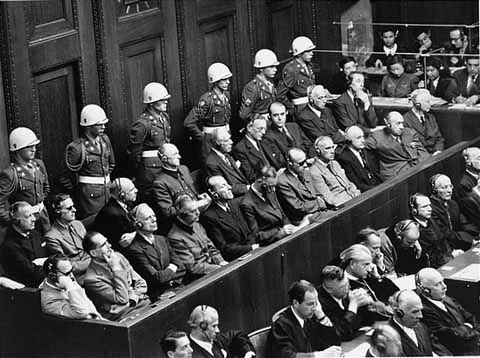
Rationalization # 25. The Coercion Myth, covers the excuse for unethical conduct that the actor “had no choice,” and # 25A. Frederick’s Compulsion or “It’s My Duty!” posits that duty excuses wrongdoing. #25 B follows the theme of denying free will by using the fact of employment to justify or excuse unethical conduct. It embodies the defense of the Nazi officers at the Nuremberg Trials that because they followed the orders of others, they were simply agents, and their horrible crimes against humanity should not bring them punishment…after all, they had no choice. It was their duty to follow orders, because that was their job.

We all need jobs, but we all have a choice whether to remain in a job or not. Sometimes it’s not a very attractive choice, and even a frightening one, in which choosing the ethical course requires personal sacrifice. Nonetheless, when a job requires one to commit unethical acts, the choice is this: quit the job and refuse to perform the unethical act, or commit the unethical act, following orders but accepting the responsibility, accountability and consequences of doing so.

For inspiration, we need look no further than the first admittee to the Ethics Alarms Heroes Hall of Honor, the amazing Henri Salmide.

From the Ethics Alarms post:

In 1944, Salmide was a German officer in the 159th Infantry Division of the German army occupying the French city of Bordeaux, the largest seaport on the west coast. It was August 19, and Allied Forces were spreading out from the beaches at Normandy and taking control of the war. An order came from Berlin calling on the Division to destroy the entire seven miles of port infrastructure before abandoning the city. The port’s destruction was scheduled to occur within a week.

“It fell to me,” Salmide recounted in an interview, because, as head of the bomb disposal unity, he had expertise with explosives. “I couldn’t do it. I knew the war was lost. What was the point of this, I asked myself. People would die and suffer, and the war would still be lost by Germany.”

On  August 22, he filled a bunker at the docks with detonators, plungers, timers and other hardware needed for the planned demolition. But instead of using them to destroy Bordeaux, Salmide blew them up with dynamite, in a terrifying explosion. “It was all I could do,” he said later.

French historians estimate he saved 3,500 lives by refusing to carry out his orders. About fifty Nazi soldiers died in the blast instead. “I could not accept that the port of Bordeaux be wantonly destroyed when the war was clearly lost,” he explained in an interview. “I acted according to my Christian conscience.”

Salmide deserted, and was hunted by both the Gestapo and the French authorities. He hid with the French Resistance for the remainder of the war. Then Salmide adopted a French name, married a local woman, became citizen of France, and raised his family in the very city his conscience had rescued. The Germans regarded him as a traitor, and even the French were reluctant to give him the recognition he deserved, according to his wife.

“No one wanted to admit that he had done it,” Mrs. Salmide told the New York Times. “If he had been French, it would have been easier for him.”  It was not until 2000 that the French government finally awarded him the French Legion of Honor,* and the Bordeaux City Hall said this week that it wants to erect a memorial to Salmide.

His best and most lasting memorial, however, would be for his story to be known around the world, and taught in every school, of every nation. For when any of us finds ourselves being required to act under authority to accomplish unjust and cruel ends—to blindly do our job, knowing that the results would harm others unjustly, and we wonder if it is fair for us to be accountable for our actions when, in reality, we seem to have no choice, we should recall Henri Salmide. His moment of courage should remind us that we are always accountable, and we always have a choice, provided we also have the ethics and courage to take it.

Continue reading

Ethics Quiz: Punishing The 12-Year-Old Killer

debrow

Texas Monthly this month has a troubling profile of Edwin Debrow, who is 37 years old,  has been behind bars since he was 12, and may have to stay there until he is 52. On September 21, 1991, Debrow shot a San Antonio school teacher named Curtis Edwards in the back of the head. Edwards’ body was found sprawled across the front seat of a taxi that he drove part-time at night. Edwin, police determined, had shot Edwards during an attempted robbery. Above is the photo of the 12-year-old in custody.

Texas law, you will not be surprised to learn, allows very harsh punishment for  juvenile offenders.Other states will sometimes try 12-year-olds as adults. Last year’s documentary “Beware the Slenderman” tells the strange story of Anissa Weier and Morgan Geyser, two 12-year-old Wisconsin girls who attempted to stab another 12-year old girl to death in 2014. Under Wisconsin law, Weier and Geyser will be tried as adults for attempted first-degree intentional homicide, and if convicted, they could be sentenced to up to 65 years in state prison.

Your Ethics Alarms Ethics Quiz of the Day is this:

Is it ethical for society to punish children with such long prison sentences, no matter how serious the crime?

Continue reading

Ethics Hero: President Barack Obama

President Obama granted clemency to 231 deserving individuals, yesterday, the most individual acts of clemency granted in a single day by any President inU.S. history. He also issued 153 commutations, and has now commuted the sentences of 1,176 individuals, including 395 life sentences. The President also granted pardons to 78 individuals, bringing his total number of pardons to 148.

Good.

The pardon and clemency powers of the President are underused, and until the last two years, Obama underused them more than any modern President. Now, presumably in a last minute flurry to enhance his legacy, Obama has embraced these acts of mercy as one thing he can do that Donald Trump will not be able to reverse. Obama’s motives are irrelevant, however. The “quality of mercy is not strain’d…” and it also shouldn’t be criticized. We must assume that the beneficiaries of Obama’s mercy are deserving, and that there aren’t any Marc Rich-types in the group.

There is so much that is right with Obama’s commutations and pardons. They match the spirit and ideals of the season; they provide second chances to Americans who need them; it returns citizens to their families. Let’s hope that he has begun a permanent competition, and that every President will now strive to exceed the number of official acts of mercy of his or her immediate predecessor.

Thank-you, Mister President.

You just made the United States  a little more ethical.

A lot, in fact.

A Horror Story From The Law vs. Ethics Files: The Mario Hernandez Saga [UPDATED and BACKDATED!]

Mr. Hernandez? Mr. Unger would like a word with you...

Mr. Hernandez? Mr. Unger would like a word with you…

This is complicated.

Occasionally a trusted source sends me to a link or a news item that turns out to be old, sometimes many years old. I assume it is current (I need to learn to check the dates), write the post, and then find out that what I wrote about took place in 1978. I usually trash the post. There have been a few like this. Now this story came to me from a trusted source, and linked to a current story, or so I thought. The post, on a site called “America Now,” is dated August 25, 2016. But WordPress pointed out, right at the bottom, that I had in fact written about Mario Hernandez’s citizenship problems two years ago. What? For a second I thought there were TWO Marios (Mario brothers?), who had the same problem, but no, they are the same guy.

The story  I was given today, based on this New York Times story from May of 2014, led to the post below. There is an ending to the story, which was explicated by me in the post of two years ago. However my two posts were on two different ethics issues, and today’s though inspired by a stale story, is still ethically useful. Pretend Mario plight isn’t two years old: that doesn’t alter the principles involved, or my analysis. I’ll tell you what happened at the end of the post..

***

Continue reading

More “Blue Bloods” Ethics

Blue Bloods 2

Tom Selleck’s “Blue Bloods,” or “The Conflict of Interest Family” as we call it around our house, continues to explore difficult unethical dilemmas for an all-law enforcement family. Its latest episode’s message, however, was troubling.

Forget the secondary plot of Police Chief Frank Reagan’s staff squabbles. The meat of this installment was police detective Danny Reagan’s discovery that the well-oiled bank robbery he was on the scene to witness (it’s amazing how often the main characters in procedurals  just happen to be in banks when they are robbed) has been carried out by a group of three military combat veterans—just like Danny!. They have banded together to raise $100,000 so the female member of the trio can pay for expensive medical treatment for her wounded veteran husband. He lost his legs and sustained brain damage in Iraq.

Danny is seething at the injustice of the wounded hero being in an endless line writing for help from the Veterans Administration, and perplexed that the three perps who he has personally identified from his observations of them during the robbery—the loving spouse’s voice, one of the men’s scarred wrists, a neck tattoo on the other—are acting out love and loyalty, not greed. Continue reading

The Petraeus Deal and Justice In America

broadwell

I’m in a rush to get ready for a law firm seminar, so I’m going to mostly let Ken White at Popehat do my work for me, as he is very qualified to do in this case. In his comments on the David Petraeus plea deal, Ken quite appropriately raises questions of why such serious crimes as the acclaimed general and former CIA head engaged in do not warrant prison time, and he answers thusly: Petraeus is rich, famous and has powerful friends.

Ken obvious believes those aren’t good reasons, and I agree with him. Nor are the other rationalizations that the general has suffered enough, that he isn’t really a criminal, that the nation owes him, or that he is a valuable resource for the nation that we are better served by not storing behind bars.

I believe that Petraeus has less excuse for his conduct than the typical defendant, and that as a celebrity, war hero and tole model, his defiance of the law is more serious, and more deserving of punishment, than the majority of non-violent criminals who go to jail. Indeed, Petraeus had styled himself as a moral exemplar. I read yesterday—I don’t have time to find the link—that Edward Snowden’s lawyers sent a cheeky message to prosecutors that Snowden would be happy to accept a similar deal to Petraeus’s.  Exactly.

These incidents do terrible damage to the public’s trust in the justice system’s fairness, and they should. Plea deals like this, bought with lawyer fees, bias and influence, are unequivocally wrong.

President Lincoln’s Misunderstood Ethics Crisis: The Great Sioux Uprising

Dakota hanging

As part my so-far futile efforts to leave Ferguson in the rear view mirror, let’s revisit one of the Abraham Lincoln’s great ethical dilemmas during the Civil War, in which today’s date, December 1, was pivotal.

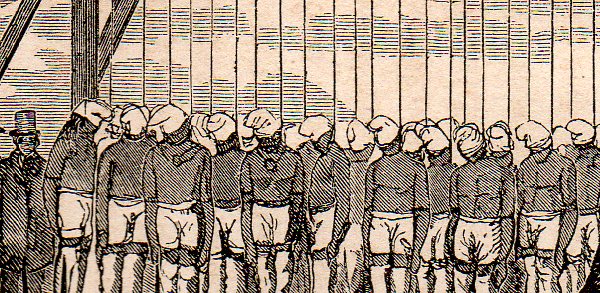
Minnesota’s Great Sioux Uprising, now usually called the Dakota-U.S. Conflict, was among the bloodiest Indian wars in the West, with hundreds of Native Americans, settlers and military casualties. The Sioux were defeated soundly, and the U.S. Army tried 303 Native Americans by military commission, finding them guilty of war crimes and sentencing them to death by hanging. Federal law required Presidential approval of the death sentences, and this was a problem Abraham Lincoln, the President at the time, did not need.

For it was 1862, and the Civil War was raging. This was a year full of Union defeats, indeed, disasters, like Fredericksburg, and both the war and Lincoln’s ability to lead it were in peril. Lincoln was also calculating all the political angles before issuing the Emancipation Proclamation. On top of the burdens of war and politics, he was coping with personal tragedy: his young son Willy had died nine months earlier, and Mary Todd Lincoln was teetering on emotional collapse from grief.
Now he had to decide whether to allow the execution of more than 300 Indians convicted in trials that were no better than kangaroo courts. Few Americans were concerned about the fate of the Native Americans, but Lincoln, with all of his other worries, took on the task of reviewing the trial records. What he found was manifest injustice.  Continue reading