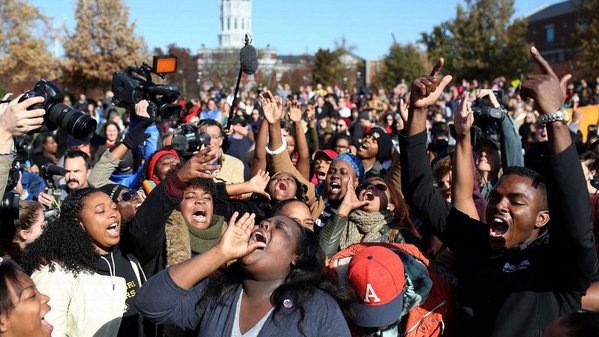
Comment Of The Day: “Morning Ethics Warm-Up, 12/31/2017: The Too Many Year Ending Ethics Issues To Handle In One Day Edition”

JP’s Comment of the Day actually was sent in today, and so, despite the injustice of allowing him to jump in line (for there still are Comments of the Day from the Holiday Challenge of two days ago awaiting their honors), I’ve decided that this one should be published in close proximity to its target, which was #1 in today’s Warm-up, about Frank Bruni’s column,  “Higher Ed’s Low Moment, in the Times today. You should read Bruni’s column first to be fair to fine JP’s work, which is in the form of an open letter.

Here is JP’s epic Comment of the Day on the post,Morning Ethics Warm-Up, 12/31/2017: The Too Many Year Ending Ethics Issues To Handle In One Day Edition: 

Dear Mr. Bruni,

Thank you for that colorful article you posted in the NYT. As a college graduate from two universities (almost three), I can appreciate what you said regarding higher learning and its importance on the future of Americans (and in general the world). You see, I agree there is a lot that college has to teach us. Higher education should be focused, involve critical thinking, and provide much-needed life skills that are just not acquired at the at the high school level. While these could have been excellent points when defending the role of colleges and universities, you chose to skip right over them altogether. Instead, you chose to write about how people are wrong to not trust the system with not so subtle attacks on Trump, the Republicans, and the recent tax law.

I will give you some credit. You were able to point out some reasons why some of that trust is not there. You wrote, “I also hear more college presidents talking with more concern about their campuses’ images as enclaves of a distinctly illiberal liberalism. Especially ugly episodes this year at Middlebury College and The Evergreen State College fed that impression and, I think, increased many presidents’ resolve to do something about it.”

You also pay due attention to the much-noted lack of political diversity on campuses. However, it is clear from your article you believe these examples to be trivial based on your piece’s lack of focus, language used, and quick transitions.

With that in mind, let me ask you a question, Mr. Bruni:

Have you been hiding under a rock these last 10 years, or are you just so hidden in your elitist tower you can’t see Rome burning around you?

There are many good reasons that the public doesn’t trust college campus anymore. Follow me a little bit as I explore reasons.

The Teachers.

Just this past year alone we have witnessed a number of statements made by the professionals whose job it is to shape the minds of these students. These are the people who direct them, but with statements like the following, it is a wonder we haven’t had more students following the actual advice made by them (perhaps I don’t give these students enough credit on their critical thinking skills).

  • One professor at Montclair State University wished someone would shoot President Trump outright. He was later let go.
  • Another professor at Austin Community College said it was ok with him if Betsy DeVos was sexually assaulted. He later quit.
  • A University of Tampa Professor said Hurricane Harvey was “Instant Karma” for Texas because it was a red state. Nevermind that Houston, the heaviest area affected voted Democrat (moral luck) during the previous election, this professor had to get his two cents in. He was fired as well.
  • A Drexel professor said the shooting in Vegas this past year is what happens when white people don’t get what they want. His last day is officially today.

What is notable here is 70% of the staff tried to get his full reinstatement. This is somewhat bewildering because the professor is no stranger to racist tweets. writing last Christmas that the white genocide during the Haitian Revolution was a good thing. But of course if you here him, this was just a joke.

There are many more; this last is just icing on the cake:  A professor at California State University tweeted that Trump must be hanged. He later tweeted that “Justice = The execution of two Republicans for each deported immigrant.” This isn’t even retribution theology, it is just advocating for murder. He will be teaching again in the spring. Continue reading
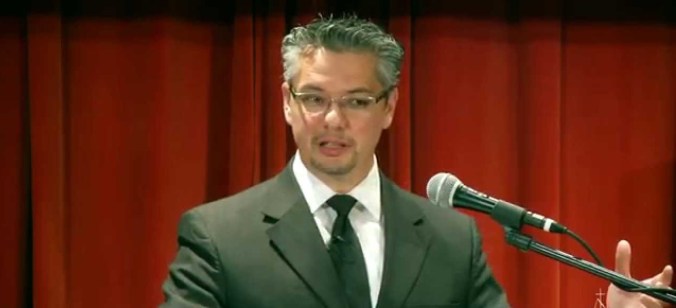
Ethics Hero: Notre Dame Political Science Professor Vincent Phillip Muñoz

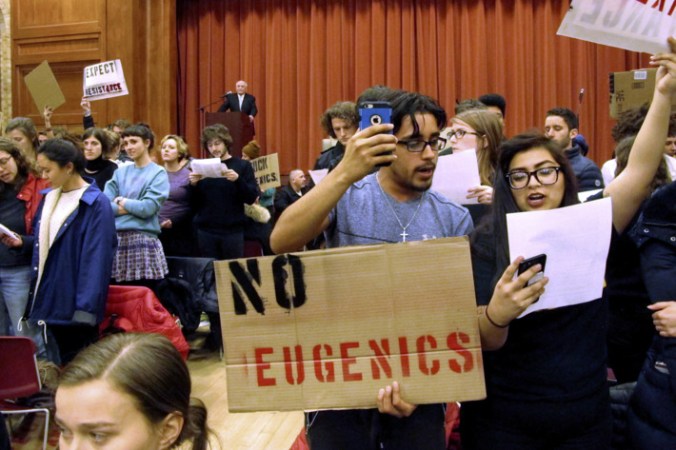
Vincent Phillip Muñoz is the Tocqueville Associate Professor of Political Science and Concurrent Associate Professor of Law at The University of Notre Dame. Following the violent protest that prevented his announced lecture at Middlebury College earlier this month, Prof. Muñoz invited Murray to speak at the University of Notre Dame next week. This occasioned some protests and objections from students and faculty at his own college, and he responded with an essay at RealClearPolitics, writing in part…

Charles Murray is speaking at Notre Dame because I and another Political Science professor assigned his book “Coming Apart” in our classes. His visit is one of several outside lectures that are part of this semester’s Constitutional Studies offerings. My class, “Constitutional Government & Public Policy,” addresses some of the most important and divisive issues in American politics: abortion, gay marriage, religious freedom, inequality, freedom of speech, death penalty, race and the meaning of constitutional equality, immigration, euthanasia, and pornography.

 The class is designed to prompt students to think more deeply and thoughtfully about contemporary moral and political issues. I don’t assign a textbook or “neutral” readings that summarize the issues; I require students to read principled thinkers who advocate vigorously for their respective position. I want my conservative students to read smart, persuasive liberal thinkers, and I want my liberal students to read thoughtful conservatives. Educated citizens can give reasons for their beliefs and can defend intellectually the positions they hold. That requires that we understand and articulate the positions with which we disagree.

…“But Murray is controversial and will make students feel uncomfortable,” my faculty colleagues say. Don’t I know that he has been accused of being racist, anti-gay, and a white nationalist? I’m told that bringing him to campus is not fair to Notre Dame’s marginalized students.

I have no desire to inflict unwanted stress or anxiety on any member of the Notre Dame community, especially our minority students. I appreciate the concern for student well being that motivates some of the opposition to Murray’s visit. But I believe what is most harmful to students—and, to speak candidly, most patronizing—is to “protect” our students from hearing arguments and ideas they supposedly cannot handle.To study politics today requires handling controversial, difficult, and divisive topics…

The price of a real education is hearing powerful arguments that make us realize our opinions are based on untested assumptions. Only then, when we realize that we do not know as much as we think we know, can genuine learning occur.

I invited Dr. Murray to Notre Dame months ago…Given what happened at Middlebury, it would be cowardly to disinvite Murray now. Rescinding his invitation would communicate that violence works; that if you want to influence academia, sharpen your elbows, not your mind. It would tell those who engaged in violence—and those who might engage in or threaten violence—that universities will cower if you just appear intimidating. Rescinding Murray’s invitation would teach exactly the wrong lesson…

Notre Dame faculty critical of Murray have implored me to think about the larger context of what his visit means. I am. That is why I will not rescind his invitation. As a professor and program director, my job is to do what we are supposed to do at universities: pursue the truth through reasoned dialogue and discussion. Whether you find Charles Murray’s scholarship persuasive or objectionable, his visit offers an opportunity to learn. That is why I invited him to speak at Notre Dame. After Middlebury, it’s all the more important that he do so.

It is almost an insult to academia to call Prof. Muñoz ‘s statement heroic. It should be obvious. Dissenters from the position he articulates should be instantly recognizable as regrettable outliers, the opponents of academic freedom and freedom of thought, the advocates of censorship and ideological indoctrination. Yet increasingly it is this traditional view of higher education that Muñoz advocates that is under attack. Continue reading

Catching Up On “Instersectionality,” And Finally Paying Attention

There are more than 22,000 tags used here, even if you eliminate the duplicates due to my typo problem, and still  “intersectionality” is not among them. I have seen the term, mostly recently, but only in contexts that led me to dismiss it as leftist, scholarly jargon, the kind of word radicals throw around to confuse their opposition and make people think they are intellectual when they are really arguing nonsense. I wasn’t wrong: it is one of those words. Still, it is a useful one, because it helps explain several phenomena of great importance, which can be collectively described as the increasing totalitarian tilt of the political left, especially since the election of Donald Trump. I should have realized the importance of the word long  ago and investigated: I apologize. Bias makes me  stupid too.

Over at New York magazine, Andrew Sullivan had one of his lucid moments—when he can bypass his anger at anti-gay attitudes (the bias that makes HIM stupid), Sullivan can be brilliant—, and delivered a perceptive essay about “intersectionality,” beginning with the recent disgrace on the Middlebury College campus, where a student protest designed to prevent sociologist Charles Murray from speaking turned into a violent riot, injuring a professor. Do read all of Sullivan’s article, but here are some key passages:

[W]hat grabbed me was the deeply disturbing 40-minute video of the event, posted on YouTube. It brings the incident to life in a way words cannot. At around the 19-minute mark, the students explained why they shut down the talk, and it helped clarify for me what exactly the meaning of “intersectionality” is.

“Intersectionality” is the latest academic craze sweeping the American academy. On the surface, it’s a recent neo-Marxist theory that argues that social oppression does not simply apply to single categories of identity — such as race, gender, sexual orientation, class, etc. — but to all of them in an interlocking system of hierarchy and power. At least, that’s my best attempt to define it briefly. But watching that video helps show how an otherwise challenging social theory can often operate in practice.

It is operating, in Orwell’s words, as a “smelly little orthodoxy,” and it manifests itself, it seems to me, almost as a religion. It posits a classic orthodoxy through which all of human experience is explained — and through which all speech must be filtered. Its version of original sin is the power of some identity groups over others. To overcome this sin, you need first to confess, i.e., “check your privilege,” and subsequently live your life and order your thoughts in a way that keeps this sin at bay. The sin goes so deep into your psyche, especially if you are white or male or straight, that a profound conversion is required….

Like the Puritanism once familiar in New England, intersectionality controls language and the very terms of discourse. It enforces manners. It has an idea of virtue — and is obsessed with upholding it. The saints are the most oppressed who nonetheless resist. The sinners are categorized in various ascending categories of demographic damnation, like something out of Dante. The only thing this religion lacks, of course, is salvation. Life is simply an interlocking drama of oppression and power and resistance, ending only in death. It’s Marx without the final total liberation.

It operates as a religion in one other critical dimension: If you happen to see the world in a different way, if you’re a liberal or libertarian or even, gasp, a conservative, if you believe that a university is a place where any idea, however loathsome, can be debated and refuted, you are not just wrong, you are immoral. If you think that arguments and ideas can have a life independent of “white supremacy,” you are complicit in evil. And you are not just complicit, your heresy is a direct threat to others, and therefore needs to be extinguished. You can’t reason with heresy. You have to ban it. It will contaminate others’ souls, and wound them irreparably….Murray’s old work on IQ demonstrates no meaningful difference between men and women, and Murray has long supported marriage equality. He passionately opposes eugenics. He’s a libertarian. But none of that matters. Intersectionality, remember? If you’re deemed a sinner on one count, you are a sinner on them all. If you think that race may be both a social construction and related to genetics, your claim to science is just another form of oppression. It is indeed hate speech….This matters, it seems to me, because reason and empirical debate are essential to the functioning of a liberal democracy. We need a common discourse to deliberate. We need facts independent of anyone’s ideology or political side, if we are to survive as a free and democratic society. Trump has surely shown us this. And if a university cannot allow these facts and arguments to be freely engaged, then nowhere is safe. Universities are the sanctuary cities of reason. If reason must be subordinate to ideology even there, our experiment in self-government is over.

This outburst was apparently too much for Andrew, his old libertarian/conservative persona emerging full-force after a long hiatus, so his piece suddenly shifts into a standard issue anti-Trump rant. It’s fascinating to see, because Andrew apparently hates the President so much that he can’t perceive that the same antipathy created by “intersectionality” that he rebuts regarding Murray (after all, Sullivan is friends with Murray), applies to the President (whom he detests) as well. The proof is how Trump’s misogyny and opposition to illegal immigration has led the Left to presume that he is racist, classist and homophobic as well. He’s not. But, to quote Sullivan against himself, “But none of that matters. Intersectionality, remember? If you’re deemed a sinner on one count, you are a sinner on them all.”

Thus Sullivan pivots to blaming all of the social and political tilt he correctly deems as dangerous on Donald Trump, and in doing so, he becomes the partisan hack he so often appears to be: Continue reading