Conservatives Take Note: Media Bias Doesn’t Explain Everything

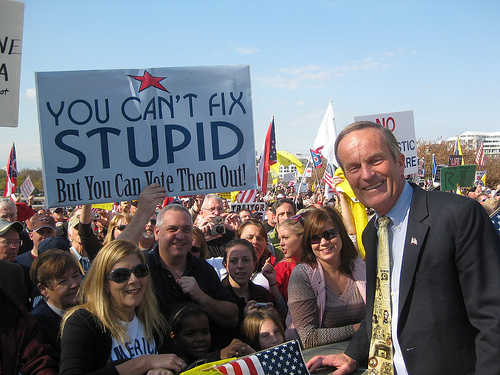
Rep. Akin and his fans.

Pervasive media bias against them has the added affect of making Republicans and conservatives both paranoid and less likely to perceive their own flaws. In this it is like racism: that black Americans know that elements of society refuse to treat them fairly makes it difficult for them to assess their own accountability when they fail. Given the opportunity to blame failure on ourselves or others, most of us are inclined to choose the latter: psychologists call it the fundamental attribution error. That tendency, however, undermines our ability to evaluate areas where we need to improve, and to improve them.

The news media’s leftward bias warps public opinion, tilts elections and distorts public policy. A few candid  journalists acknowledge this, like ABC’s Jake Tapper, who opined to Laura Ingraham yesterday that the media “helped tilt the scales” against Hillary and John McCain in 2008, saying that “Sometimes I saw with story selection, magazine covers, photos picked, [the] campaign narrative, that it wasn’t always the fairest coverage.” Weasel words for unethical media bias, true, but for a member in good standing of the liberal Beltway media like Tapper, an admirable confession. This is justly frustrating to conservatives, but they can’t let it drive them stupid, for this is the Catch 22 of all pervasive bias. If a group blames everything on bias, it begins to make the bias look justified.

Hypervocal, a snazzy blog that delves into such matters and much else, has an excellent analysis of a current example of this phenomenon, as conservatives complain that the news media is ignoring a juicy Minnesota scandal involving a gay Democrat while overplaying Rep. Todd Akin’s self-outing as an ignorant fool regarding rape, abortion, and female biology. This is such a regular refrain now any time an embarrassing event occurs involving a Republican that it is both predictable and laughable, and it is always unseemly. Continue reading
Reminder: July 2 Is “Thank Minnesota Day,” and Remember Gettysburg, Too.

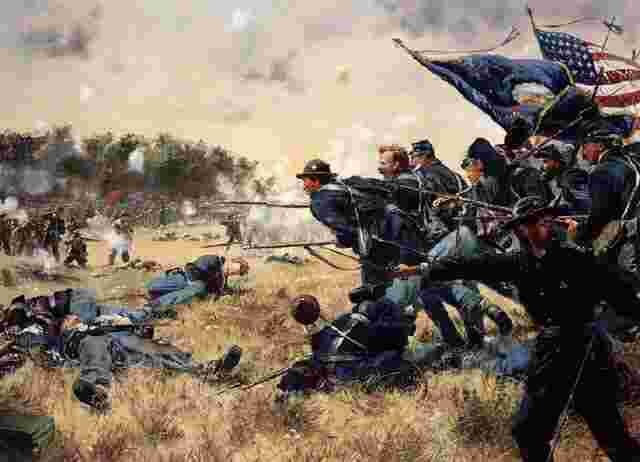
Last year on this date, I posted about the injustice of historical memory, and how the heroic exploits of the Maine soldiers on Little Round Top commanded by Col. Joshua Chamberlain on the second day of the Battle of Gettysburg have all but obliterated recognition of the even more remarkable sacrifices made by the First Minnesota Volunteer Regiment that same day, when it took on the suicide mission of blocking a hole in the Union line against a Confederate force that outnumbered it five to one. Those Minnesotans quite possibly saved the United States of America at the price of their lives.

I see that some readers are finding that post today: let me make it easier for everybody. Here is the link. This a day for all of us to honor the heroism of the First Minnesota, and indeed all of the Americans, North and South, who fought for their nation, their states, their ideals and the soul of America in the Pennsylvania town of Gettysburg, on July 2, 1863. Continue reading

A Ban on Threatening “Spiritual Injury”: Unconstitutional But Ethical?

There you go, Bill, letting people be unethical again...

Eugene Volokh, a First Amendment  provocateur, notes that Minn. Stat. Ann. § 211B.07 makes it a gross misdemeanor to

“….directly or indirectly use or threaten force, coercion, violence, restraint, damage, harm, loss, including loss of employment or economic reprisal, undue influence, or temporal or spiritual injury against an individual to compel the individual to vote for or against a candidate or ballot question.

The professor opines that the spiritual injury part, at least, is unconstitutional. Interesting.

Prohibiting the interference and manipulation of a human being’s rights of autonomy and self-determination by using threats to compel his voting choices is a legitimate area for the law, because ethics is notoriously inadequate at preventing electoral abuses. It is also an area where the law is an especially blunt instrument, and many conceivable violations of § 211B.07 would seem to risk colliding with free speech. “If you don’t vote for Ron Paul, I’ll never speak to you again!” comes to mind. The threat of “spiritual harm”—“Vote for Mitt Romney, my flock, or I condemn you to Hell!” adds the  free exercise of religion to the mix, particularly when the threat is linked to a position of a candidate that violates religious doctrine.

I have no difficulty concluding that any and all threats to force a citizen to vote according to another citizen’s desires are wrongful and damaging to democracy, and should be condemned and discouraged to the maximum extent possible. Ethical though such prohibitions may be, some, like the use of threatened spiritual injury, are impossible under the Bill of Rights.

So threatening to send someone to Hell if they vote for Newt Gingrich—a reasonable result, when you think about it—is unethical, but a law punishing that threat is unconstitutional.

Sorry, Ethics…looks like it’s all up to you!


The Twin Cities, Cheating CitizensTo Balance Their Budgets

I'm confused...I thought the police were supposed to arrest con artists, not be con artists!

Municipal governments are having a difficult time balancing budgets in these challenging economic conditions, but the twin cities of Minneapolis and St. Paul, Minnesota have devised a surprisingly effective way to pick up oodles of extra cash.

Steal it.
From its citizens.

I’m not kidding. City records show that St. Paul, for example, has kept nearly a quarter-million dollars from impound lot auctions this year that should have properly gone to vehicle owners. But the law requires the car owners to ask for their money, and both St. Paul and Minneapolis do their level best to keep that information from trickling through all the documentation and red tape. The St. Paul Police Department, which runs the St. Paul impound lot, sends owners of impounded vehicles a certified letter shortly after their car is towed. The letter includes citations to one city ordinance and five state laws that govern the towing, impoundment and auction of vehicles. Car owners  have to look up the fifth state law cited and read that law’s fourth paragraph before learning of the right to a refund. And to do that, they have to know what they should be looking for—which the letter doesn’t tell them.

Cute, eh? Continue reading

Answer the #@!!*&%! Question, Michele!

I don’t have the transcript of David Gregory’s interview with Rep. Michele Bachmann (R.-Min), Queen of the Tea Party, on “Meet the Press,” but it went something like this:

Gregory: Do you think the government should be shut down unless the President agrees to more budge cuts?

Bachmann: I think the fielding of Don Hoak at third base for the 1960 Pirates was truly outstanding, and definitely a key to the team’s success. Baby bok choy is delicious.

Gregory: Let me play you a clip of your recent comments. Do you really believe that the President is trying to jeopardize the economy?

Bachmann: Most people think Anchorage is the capital of Alaska, but it’s really Juneau. And, of course, Anne Boleyn had three breasts.

Gregory: I’m asking a direct question…do you really believe that the President has anti-American motives?

Bachmann: I’m now going to recite everything Barack Obama has done wrong from the second grade to the present, and in pig-latin, just for the fun of it….

Okay, I’m a little sketchy on the details. Continue reading

Our Future: This Will Happen to You Unless Our Irresponsible Leaders Repair the Infrastraucture, and Quick

From Chanhassen, Minn, an awful experience that is just the beginning—trust me on this. Yet our politicians don’t have the courage or integrity to do what has to be done to stop it.

A taste:

“Along Lake Susan and Chanhassen Hills drives, residents learned that something was terribly wrong in their homes Wednesday night when a geyser of sewage began spewing from toilets on the lower levels…”

Be very afraid. More than that, be angry. A must read.

Don’t Tell Mom the Client’s Dead

The Minnesota Supreme Court has suspended a lawyer for settling a case without revealing to the opposing side the small matter of his client being dead. There aren’t many misconceptions a lawyer is absolutely required to correct by informing the other side, unless the lawyer or the client clearly created a the misconception by its own words or actions. But the death of a client mid-case is one of them. Continuing to negotiate as if the client is alive is an affirmative and material misrepresentation.

This principle is always good for a laugh in a legal ethics seminar, but instances of its application are rare. In this case, the suspended lawyer may have uttered a famous quote when his adversary, after agreeing to a settlement, heard that the client had died and asked him whether it was true. Thomas Lyons, Jr. replied, “Yes. How ironic!” Continue reading