“Wait, I Have The Right To Consult A WHAT?”

Miramda attorney

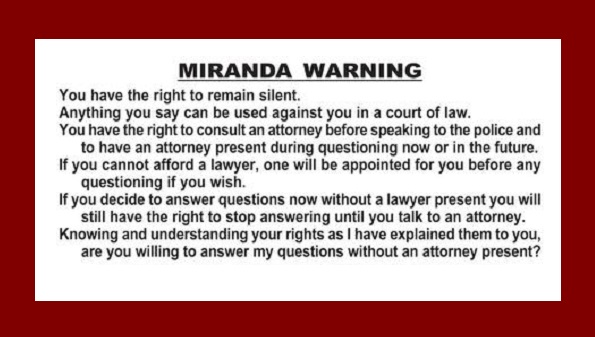
Devin Malik Cunningham, 21, is accused of the robbery and murder of a 71-year-old man. His lawyers argued that his confession should be excluded from the trial because he didn’t understand the Miranda warning given to him when he was arrested. Specifically, Cunningham claims that testified that he was confused when asked whether he wanted “an attorney,” and that is why he agreed to speak with police.  He said that he thought an attorney is a judge.

No wonder he didn’t want to speak to a judge. Judge William Amesbury of Luzerne County, Pennsylvania ruled that his claim was absurd, noting that there was no evidence of a cognitive or learning disability that would support Cunningham’s alleged misunderstanding.. There was also evidence that an arresting  officer explained during questioning that an attorney is a lawyer.

I wonder what is the presumed understanding of basic English vocabulary words for an English speaker. Cunningham’s Hail Mary defense, if accepted, might have opened up a brand new avenue for accused criminals, sexual harassers, and those derided as uncivil. I think he may have made a bad choice regarding what he thought “attorney” meant. Why not plead complete confusion: he thought an attorney was a platypus! Or a salve for athlete’s foot!


Continue reading

The Bad Judges And The Law Dog

The legal commentariat is much amused by a case out of Louisiana involving  the right to counsel. I don’t think it’s funny at all.

( Oh all right, it’s a little funny.)

Warren Demesme was being interviewed by detectives, not for the first time, about some alleged sexual misconduct with minors. He was read his rights, “Mirandized,” as they say, and said that he understood, and waived those rights. (He could, however, choose to invoke them at any time, per several Supreme Court rulings.)

At some point the interview got tense, and the suspect said,

“If y’all, this is how I feel, if y’all think I did it, I know that I didn’t do it so why don’t you just give me a lawyer dog cause this is not what’s up.”

He was not, however, given access to a lawyer, and when he appealed his subsequent conviction on the grounds that he requested legal assistance and was not accommodated, the lower court rejected his argument, saying that he had not made his desire for a lawyer clear and unambiguous. Incredibly, the Louisiana Supreme Court agreed, writing in part,

The defendant argues he invoked his right to counsel. And the basis for this comes from the second interview, where I believe the defendant ambiguously referenced a lawyer..As this Court has written, “[i]f a suspect makes a reference to an attorney that is ambiguous or equivocal in that a reasonable police officer in light of the circumstances would have understood only that the suspect might be invoking his right to counsel, the cessation of questioning is not required.” State v. Payne (La. 2002); see also Davis v. United States (1994) (agreeing with the lower courts’ conclusion that the statement “[m]aybe I should talk to a lawyer” is not an unambiguous request for a lawyer). In my view, the defendant’s ambiguous and equivocal reference to a “lawyer dog” does not constitute an invocation of counsel that warrants termination of the interview and does not violate Edwards v. Arizona (1981).

Right.

And the vote on the Supreme Court in favor of this indefensible ruling was 8 to 1. 8 to 1!

Forget it, Jack. It’s Louisianatown. Continue reading

Ethics Dunce: Slate Crime Blogger Justin Peters

Read the Slate crime blog, and you could end up like this in seven days...

Read the Slate crime blog, and you could end up like this in seven days…

Slate triggered a mini-ethics train wreck by hiring a non-lawyer for what any fool could surmise would be an assignment that would often require knowledge of the law: covering the broad issue of crime for Slate’s readers. Note: to all those scambloggers who insist that there are no good jobs in which having a law degree would be an obvious asset: here’s an example. Their note back to me: “Oh, yeah? This why didn’t Slate hire one of us?”

Touché! I presume, however, that this was because the journalist Slate did hire, Justin Peters is an editor at the Columbia Journalism Review and has pals in Slate’s management…or, in the alternative, the online magazine has a death wish. I don’t think Slate has anything against lawyers. Peters is unethical, because ethical professionals don’t accept jobs they are unqualified to perform. Then again, journalists increasingly are unaware of the concept of ethics, so now we are back to Slate, and why they would hire someone to opine in a law-strewn field without knowing shinola about the law. Continue reading