The Kevin Pillar Suspension: What Exactly Are The Current Societal Standards Regarding Homophobic Slurs, Civility, And Free Speech? I’m Confused.

In the seventh inning of the Atlanta Braves’ 8-4 win over the Toronto Blue Jays on Wednesday, Braves reliever Jason Motte “quick pitched”  Jays outfielder Kevin Pillar, striking him out. Quick-pitching isn’t illegal except in extremes, in which case it is called a balk.  It is, however, considered a bush-league tactic. Tempers were flaring in this game already, and Pillar was so upset by the pitch that yelled “Faggot!” at Motte. A “benches-clearing incident” ensued, called such because baseball players seldom really fight.

Nobody in the stands heard what Pillar said,  and most of the players didn’t either.  It was later lip-read off of the videotape of the game. There is no evidence that Motte is gay, so this was just a spontaneous utterance intended to mean “I don’t like you,” or something. If Motte were gay, and Pillar called him a faggot, this would be personal denigration based on a characteristic.

I mention this because calling a woman a bitch is not sexual harassment in the workplace; it’s just uncivil. Calling a man a bitch, however, has been found to be sexual harassment, as an innuendo about sexuality rather than character. It seem pretty clear  that Pillar was not making a sexual allegation.

After the game, sensing what was to come, Pillar issued an apology to Motte, saying, “It was immature, it was stupid, it was uncalled for. It’s part of the game.” Is there any doubt that athletes saying vulgar things to each other (and umpires) on the field is part of the game? I have seen players, managers and coaches clearly say “fuck,” “shit,” and “son of a bitch” for decades, too many times to count. One of my all-time favorite players, hippie former Boston lefty Bill Lee, was once caught by a face-on camera as he sparked a real baseball fight by pointing at the Yankees’ Greg Nettles and articulating, “HEY FUCKHEAD!” Lee wasn’t suspended or fined, and this was thirty years ago.

But Major League Baseball launched an investigation of Pillar. Of words. On a baseball field.   Pillar issued a more complete apology on his Twitter account:
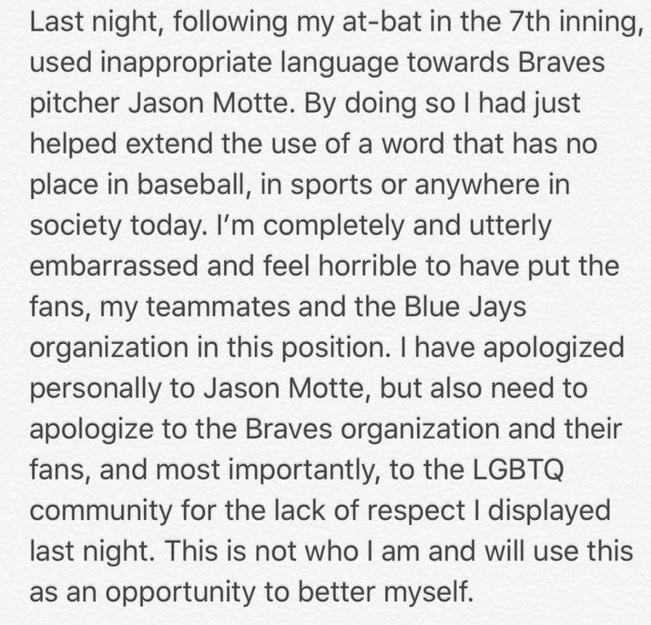
He apparently guessed what was coming, or had been tipped off. Yesterday, the Toronto Blue Jays suspended Pillar for two games. Pillar isn’t yet in the highly-paid star category: he makes “only” $521, 000. A two game suspension will cost him about $6433 for a one syllable expletive. MLB has not taken any action, and apparently won’t.

Now, the Blue Jays, like any employer, can make any rules it chooses regarding the workplace. Obviously slurs cause bad feelings and are not the kind of things a professional sport wants its young fans to associate with its heroes. Still, any time people get punished for mere words my ethics alarms go off, and they also go off when so many people don’t seem to have ethics alarms regarding chilling speech and expression. Therefore I have some questions: Continue reading
Baseball Installs An Anti-Hazing, Anti-Bullying Policy That Proves It Doesn’t Understand What’s Wrong With Bullying And Hazing

mlb-drag-1

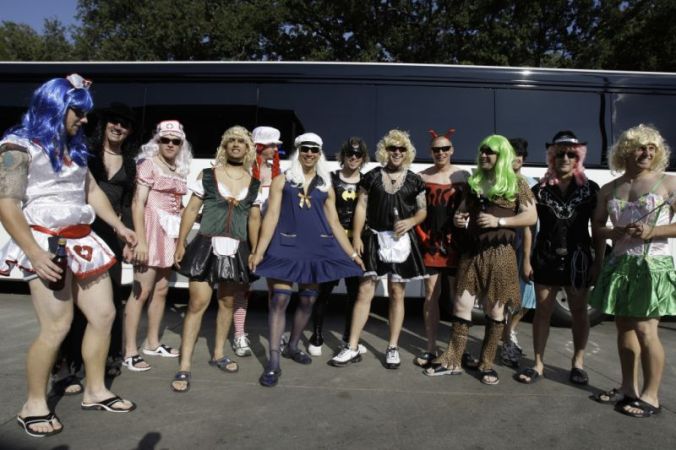
Every year, Major League Baseball teams indulge in a high-profile, stupid and offensive ritual by forcing their rookies to dress in ridiculous costumes as they travel  home after their final road trip. This is  hazing, the team’s veterans humiliating the team’s young players and forcing them to show proper deference and character by submitting to it. Most of the time, the humiliation involved dressing in drag, because, as every red-blooded American male knows, nothing is worse than being compared to a woman. Continue reading

Ethics Hero: Major League Baseball

homeplate collisionsAt least one major league sport cares about its players’ health more than it does about highlight films.

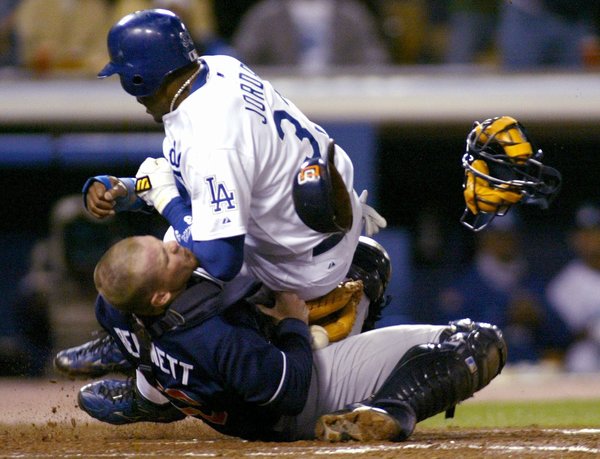
Today Major League Baseball announced that it will be banning collisions at home plate, one of the most exciting plays in baseball, and one of the most dangerous. The violent and unpredictable convergence of large human bodies created when runner and ball arrive at home plate nearly simultaneously as a catcher positions his body to receive a throw while blocking access to the plate have decided games and championships, but wrecked careers and, quite possibly, brains. Football’s frightening record of player dementia prompted baseball to check its records, and there was tell-tale evidence that concussions take their toll on ex-catchers as well.

Last season, for the first time, baseball required players suffering concussions to stay on a special disabled list until they were cleared to play after a head examination. The new ban represents more progress.

The rules change will probably take this form, according to ESPN: Continue reading

Deriliction of Duty at the MLB All-Star Game.

This week’s Major League Baseball All-Star Game got the lowest TV ratings in the history of the so-called “mid-summer classic,” which proves that Lincoln was right: you just can’t fool all the people all of the time—even when they are baseball fans. The All-Star Game was originally devised as a dream competition in which the best players from the American and National League would play a game that was hard-fought and full of the spectacular exploits of the best players alive. For decades it was like that, too, until sky-rocketing salaries and America’s culture of celebrity turned a large proportion of the players into egomaniacal, self-promoting monsters. Continue reading

LaBron, Steinbrenner, and Warped Sports Ethics

Sports ennoble us through the  symbolic exploits of latter-day mythic heroes, who use their amazing skills and talents to exemplify courage, grace under adversity, loyalty, accountability, sacrifice, and, of course, sportsmanship.

Or so they say.

Sometimes it works out that way, but just as often an extraordinary athlete like LeBron James will choose to use his prominence to promote less attractive character traits, like greed, vanity, disloyalty, cruelty and boorishness. For some reason, the mega-millions LeBron was going to receive for fleeing Cleveland as an NBA free agent was not sufficient booty: the basketball star felt that “branding” required that he tease as many cities and franchises as possible, rub Cleveland’s loss in the faces of his previously worshipful fans in that city, and then announce his final choice of new employers in an ESPN TV special that embarrassed his sport and his species. James is not alone, of course; he has lots of company among college and professional athletes whose preening and selfishness make it impossible to use their names and “role model” in the same sentence.

But for the use of sport to warp ethical priorities, nothing quite matches the nauseating accolades being heaped on the late George Steinbrenner, whose ownership of  the New York Yankees was a decades-long advertisement for the principle that the end justifies the means, and as long as you win, nothing else really matters. Continue reading