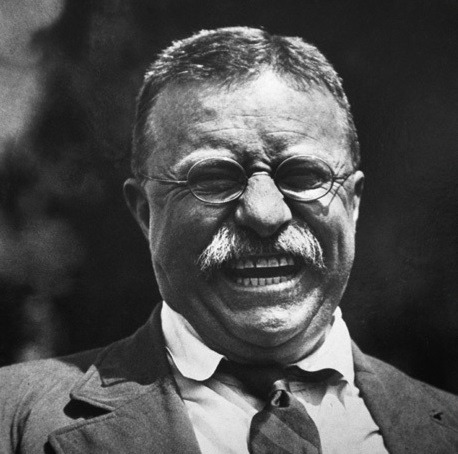
Is Teddy looking down from Rough Rider Heaven and smiling at Trump’s Big Tweet?
Of course, I knew suggesting that President Trump’s deliberate attacks on Amazon via Twitter was an impeachable offense would set heads a-blowing. The resulting debate has been fascinating, with interesting historical parallels being proposed. This comment, by Chris Marschner, is the first of two erudite and well argued rebuttals.
Not to hold you in unnecessary suspense, I am not convinced or dissuaded. I do not see Teddy Roosevelt’s policy-oriented attacks on the era’s monopolies, correctly leading a movement to reform an area of widespread capitalist abuses that eventually were agreed to be criminal, with Trump’s tweeting crudely phrased animus to the public. Nor do I find Obama’s general criticism of big money lobbying efforts by energy interests in general and the Kochs in particular at the same level of abuse of power as Trump taking aim at the owner of the Washington Post,
I am a lifetime fan of Teddy, but he crossed many lines, and could have been legitimately impeached himself. As I have stated before in multiple posts, the power of the Presidency is too great to be abused with casual wielding against individuals and named businesses. As always, there are exceptions. I’ll concede that taking on the robber barons and the monopolists in the early 20th Century can be fairly designated as one. Chris seems to feel that there is a close parallel in Amazon’s growing power, but that’s not the case the President chose to make, instead focusing on a deal Amazon forged with the Postal Service, as much to keep the latter in business as to benefit Amazon.
Basic lessons in POTUS leadership: if you are going to cross lines of appropriate uses of power, 1) You better be right and 2) Be Presidential about it.
Other examples, like Obama designating Massey Energy as responsible for the Upper Big Branch mining disaster before the investigation was complete, can not be so easily excused, but can be fairly labelled a mistake. (Obama made many, too many, such mistakes.) Trump’s attack on Amazon is neither as limited as Obama’s mistake, not as carefully considered and justifiable as Roosevelt’s trust-busting. I would like to see future Presidents restrained from abusing power in this way, even if it takes a trail before the Senate to do it. If we don’t restrain it, we will be sorry.
But the other side has some good arguments: by all means, read them.
Here is Chris Marschner’s Comment of the Day on the #2 in “Morning Ethics Warm-Up, 4/4/2018: Baseball Lies, A Presidential High Crime, And A Judge Makes A Panty Raid”:
I would like to point you to this in 2015:
https://www.usatoday.com/story/news/politics/2015/08/26/war-words-obama-v-koch-brothers/32423959/
“When you start seeing massive lobbying efforts backed by fossil fuel interests, or conservative think tanks, or the Koch brothers pushing for new laws to roll back renewable energy standards or prevent new clean energy businesses from succeeding, that’s a problem,” Obama said at the summit. “That’s not the American way.”
“Josh Earnest said the exchange illustrates the kind of president Obama set out to be.”
“This is exactly why the president ran for office, it’s why he ran for this office, is that for too long, we saw the oil and gas industry exert significant pressure on politicians in Washington, D.C.,” he said. And when Obama fights that influence, “the special interests, including the millionaires and billionaires that have benefited from that paralysis, start to squeal. And I guess in this case, at least one billionaire special interest benefactor chose to squeal to a Politico reporter.”
This type of rhetoric does not include Obama officials publicly stating (incorrectly and improperly) that one of the Koch brothers paid no income taxes. (http://freebeacon.com/politics/hazy-memories/)
Is it only an abuse of power when referencing specific individuals? Does it matter if you say the 1% don’t pay their fair share or is it an abuse of power only if you identify them by name?
I will concur with the Koch brothers that it is beneath the dignity of the president to go after a specific individual, but to suggest that it amounts to even a misdemeanor abuse of power is a stretch. If calling out a specific firm is an impeachable offense then why was there no call to impeach Obama when he routinely criticized and mocked Koch Industries, Fox News and others that did not line up with full throated support of his agenda.
But , Obama was not the first to chastise “punch down” on a business person. Who can forget the trust buster himself Teddy Roosevelt. JP Morgan was singled out for bad behavior. Continue reading →

 Ethics Alarms