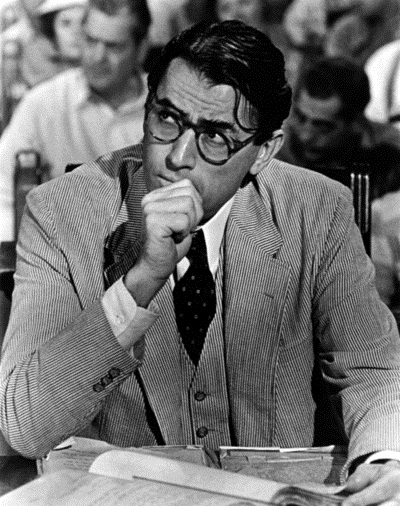
Of Atticus Finch, “Go Set A Watchman,” And Icon Ethics

AtticusToday Harper Lee’s “sequel” to “To Kill A Mockingbird” is officially released, though reviews have already been published. The big story is that the new novel’s now grown “Scout” discovers during the civil rights upheavals of the 1950s that her father and hero Atticus Finch is a racist, had attended a Klan meeting, and is prone to saying things like …

“Do you want Negroes by the carload in our schools and churches and theaters? Do you want them in our world?”

The new Atticus is providing ammunition to those who enjoy tearing down American heroes and icons. Finch is perhaps the most revered fictional lawyer in American culture, admired by the public as well as the legal profession. The American Bar Association named its award for fictional portrayals of lawyers in films and literature after Finch, whose pro bono defense of a wrongly accused black man in a bigoted Alabama town forms the central conflict of Lee’s classic. Burnishing Atticus’s reputation further was the beloved portrayal of the character, reputedly based on the author’s father, by Gregory Peck in the Academy Award winning film adaptation. Peck received the Award for Best Actor as well as the Presidential Medal of Freedom, and as a civil-rights activist often stated that he admired Finch over all his other roles. In 2003, American Film Institute voted Finch as the greatest hero in American film.Wrote Entertainment Weekly, “[Finch] transforms quiet decency, legal acumen, and great parenting into the most heroic qualities a man can have.”

Atticus, however, has had his detractors through the years, notable among them the late Monroe Freedman, a  habitual iconoclast and contrarian who wrote two law review articles declaring that Finch was neither hero nor a particularly admirable lawyer. He wrote in part: Continue reading

Encore: “The Ethics of Letting a Lying Defendant Testify”

"Objection! The defendant's pants are clearly on fire!"

“Objection! The defendant’s pants are clearly on fire!”

I’m in Ohio today, talking about legal ethics with a large law firm, and the discussion there turned to the difficult problem of the lying criminal client. Here is a post on the topic from the early days of Ethics Alarms, slightly updated, and the disturbing thing is that we are no closer to finding a satisfactory and ethical solution to the problem.

What do you do when your guilty client wants to claim he’s innocent in the witness chair, under oath? Continue reading

An Unethical Ethics Conference

The Fourth International Legal Ethics Conference at Stanford Law School has lined up  over 100 speakers. It is giving them no honorarium, hotel, meals or travel expenses, and despite the fact that they are providing the content and attraction for the event, the Conference still requires them to pay  registration fee of $350. Stanford is also charging its students a registration fee to attend, generously reduced to “only” $250.  But the conference can afford to be so generous, because it will also be getting registration fees from lawyers who are required to fulfill bar-mandated Continuing Legal Education requirements.

I have argued, and behavioral science suggests, that thinking about ethics helps one’s ethics alarms work well and often. The Stanford Conference suggests that either this is not as certain as I believed, or that the people running the ethics conference don’t actually think about ethics, which, if true, adds fraud to their list of ethical outrages.

The unfair and irresponsible requirements of the Stanford event has prompted least one prominent legal ethicist, Prof Monroe Freedman, to abandon plans to attend, saying, “I’m a card-carrying capitalist, but this kind of exploitation in the name of ethics could turn me into a Marxist, or a cynic.”

We should be concerned about a culture whose those in the ethics business are increasingly unethical. The sad lesson seems to be that when there is a conflict between commerce and ethics, commerce wins.

The Ethics of Letting a Lying Defendant Testify

It’s snowing like crazy outside, and I’m stuck putting the lights on a nine-foot tree.  My only escape from the pine needles assaulting my tender skin is ethics reverie, and I find myself thinking, once again, about the classic criminal defense attorney’s ethical challenge:

What do you do when your guilty client wants to claim he’s innocent in the witness chair, under oath? Continue reading