Moral Luck and Baseball: The High-Profile Ruinous Ball-Strike Call Comes AFTER The Problem Has Been Addressed


Next season, Major League Baseball will implement the Automated Ball-Strike (ABS) Challenge System. For the first time in regular-season history, batters, catchers and pitchers will have the right to challenge balls and strikes. Teams will begin each game with two available challenges and can continue challenging until they lose challenges twice.

The system has been desperately needed for many years, ever since each player’s strike zone could be seen on television screens during game broadcasts. As usual, baseball dragged its metaphorical feet addressing the problem, with the idiotic “bad calls by the umpire are part of the game” argument that traditionalists and ex-players are still using. That logic makes as much sense as defending medical malpractice because “everyone makes mistakes.” Sure, before video technology could prove a key ball or strike call was a bad one, tolerating home plate umpire mistakes (like the one that cost the Boston Red Sox Game 3 of the 1975 World Series and conceivably the Series itself) were part of the game, because nothing could be done about it. Now something can.

Continue reading

Ethics Alarms Encore! “July 3: Pickett’s Charge, Custer’s First Stand, Ethics And Leadership”

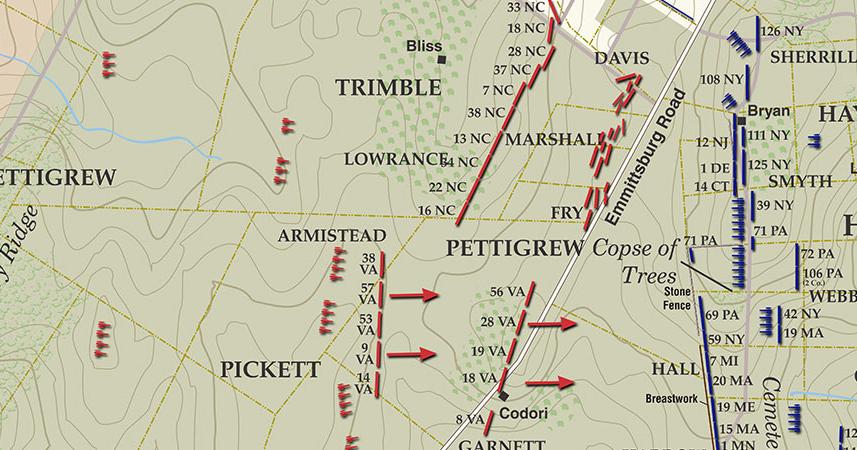
Picketts-Charge--330-to-345-pm-landscape

July 3  was the final day of the pivotal Battle of Gettysburg in 1863, reaching its bloody climax in General Robert E. Lee’s desperate  gamble on a massed assault on the Union center. In history it has come to be known as Pickett’s Charge, after the leader of the Division that was slaughtered during it.

At about 2:00 pm this day in 1863, near the Pennsylvania town of Gettysburg,  Lee launched his audacious stratagem to pull victory from the jaws of defeat in the pivotal battle of the American Civil War.  The Napoleonic assault on the entrenched Union position on Cemetery Ridge, with a “copse of trees” at its center, was the only such attack in the entire war, a march into artillery and rifle fire across an open field and over fences. When my father, the old soldier, saw the battlefield  for the first time in his eighties, he became visibly upset because, he said, he could visualize the killing field. He was astounded that Lee would order such a reckless assault.

The battle lasted less than an hour. Union forces suffered 1,500 casualties,, while at least 1,123 Confederates were killed on the battlefield, 4,019 were wounded, and nearly 4000 Rebel soldiers were captured. Pickett’s Charge would go down in history as one of the worst military blunders of all time.

At Ethics Alarms, it stands for several ethics-related  concepts. One is moral luck: although Pickett’s Charge has long been regarded by historians and scholars as a disastrous mistake by Lee and in retrospect seems like a rash decision, it could have succeeded if the vicissitudes of chance had broken the Confederacy’s way.  Then the maneuver would be cited today as another example of Lee’s brilliance, in whatever remained of the United States of America, if indeed it did remain. This is the essence of moral luck; unpredictable factors completely beyond the control of an individual or other agency determine whether a decision or action are wise or foolish, ethical or unethical, at least in the minds of the ethically unschooled.

Pickett’s Charge has been discussed on Ethics Alarms as a vivid example, perhaps the best, of how successful leaders and others become so used to discounting the opinions and criticism of others that they lose the ability to accept the possibility that they can be wrong. This delusion is related to #14 on the Rationalizations list,  Self-validating Virtue. We see the trap in many professions and contexts, and its victims have been among some of America’s greatest and most successful figures. Those who succeed by being bold and seeing possibilities lesser peers cannot perceive often lose respect and regard for anyone’s authority or opinion but their own.

Continue reading

Paging Moral Luck! Paging Moral Luck!

Judge S. Kato Crews, a progressive appointee by President Biden to the U.S. District Court in Colorado, refused to allow an injunction against the San Jose State women’s volleyball team from including a biologically male “transwoman” (above) to compete with the team in a women’s volleyball conference tournament this week. He ruled that appellate and Supreme Court precedents clearly establish that the protections of Title IX and the 14th Amendment apply to transgender individuals.

A key factor in the decision seems to be that the plaintiffs, which are the other colleges in San Jose State’s conference, a current co-captain of the San Jose team, other former players and the recently-suspended assistant coach, should have filed the suit earlier. The conference’s transgender participation policy has been in effect since 2022 and four conference opponents and one non-conference opponent forfeited games against San Jose State beginning in September.

“The rush to litigate these complex issues now over a mandatory injunction,” Crews ruled, “places too a heavy burden on the defendants”—the Mountain West Conference and its commissioner, two administrators at San Jose State, the school’s head volleyball coach and the board of trustees of the California State University System. That’s a reasonable judicial call under most circumstances, but the judge and the entire pro-trans movement in the U.S. is now at the mercy of moral luck. That is the annoying life reality that random occurrences out of the control of decision-makers have a way of retroactively defining a decision as either prudent and wise or reckless and wrong. Crews’ decision neatly tees up the perfect conditions for moral luck to settle the trans athletes in women’s sports controversy

Continue reading

A Manager’s Baseball Decision Has Lessons For The Non-Baseball World.

In a game over the weekend between the Boston Red Sox and Detroit Tigers, Red Sox starting pitcher Cooper Criswell was pitching the game of his life. In a 0-0 tie through four innings, the Tigers had no base-runners at all. Criswell, a rare breaking-ball and control specialist who serves as Boston’s fifth starter now that those above him on the depth chart have been injured, appeared to have perfect command of his pitches, as evidenced by the large number of strikeouts he was getting, and he is not a strike-out pitcher. Criswell also threw just 52 pitches in his four innings, and that is well-below any likely fatigue level.

Nonetheless, despite being literally perfect that far, Cooper Criswell did not come out to the mound for the fifth inning. Red Sox manager Alex Cora replaced him with lefty Rich Hill, because the Tigers had three tough lefties coming up to bat (left-handed batters typically hit right-handed pitchers like Criswell better than they hit lefties like Hill).

Hill walked one of the left-handed batters, and the first right-handed batter he faced as a result hit a two-run homer. The Red Sox never caught up.

After the game, Cora had no regrets, telling the press that pulling Criswell was part of a predetermined plan. “We drew it up, they had a bunch of lefties,” Cora said.. “He gave us enough. We went to Rich in that situation. We had a big pocket of lefties. Just the righty burned us.”

There are two ethics issues here.

Continue reading

From the Res Ipsa Loquitor Files: This Is The Quality of Judge Biden Is Nominating and the Senate is Confirming

In the stunning exchange above on May 22, Sen. Ted Cruz confronted one of Biden’s nominees to the Federal bench who placed a serial rapist who is a biological male (that is, all standard equipment included) in a women’s prison. She claimed, incredibly, that she always makes her decisions based on the facts of a case and the law, while repeatedly refusing to answer Cruz’s specific questions by repeating an obviously pre-programmed evasive answer (like the three university presidents who kept saying that whether anti-Semitic speech was acceptable on campus depended on “the context”), “I considered the facts presented to me, and I reached a decision…,” etc.

Cruz contended that the judge made ideological loyalty a higher priority than the fact or law, citing the fact that she deemed a 6’2″ serial rapist with a penis a “safe” inmate in a prison full of women.

Continue reading

While We’re On The Topic Of Derek Chauvin…

…do you know what the difference is between him and this Alabama cop?

Moral luck. That’s all.

If the tasering killed the man, and it was possible, she’d be exactly as culpable as Chauvin. She might be more culpable, because her victim wasn’t actively resisting arrest when she used the weapon.

Indiana Jones And The March Of Folly

I have to ask: what the hell is going on with Harrison Ford’s nose in the photo above from “Indiana Jones and the Dial of Destiny”? It looks like he borrowed it from Dustin Hoffman’s make-up kit from “Little Big Man,” when Dustin played a 111-year old man. But I digress…

It is now certain that Disney’s fifth and one hopes final Indiana Jones movie will be a financial disaster. It cost $300,000,000 to make, and with marketing and other costs, a big Hollywood film has to clear about twice its filming costs to break even. That’s not happening; three weeks after its release, “Dial of Destiny” is already trailing two less-hyped summer films, and is being treated as “dud on arrival.”

“Movie Web” has done the best analyses I’ve seen regarding the film’s conceptual, artistic and marketing problems (here and here), and I’d love to write about those, but this is an ethics blog, so I’m officially interested in just one aspect of the debacle: Why didn’t anyone stop it?

Continue reading

Ethics Quiz: Spitting In The Eye Of Moral Luck

I assume you recall that Buffalo Bills safety Damar Hamlin’s heart stopped during a prime time televised game in January. The diagnosis was that a hard hit got him in exactly the wrong place, causing the otherwise healthy athlete to nearly die on the spot.

Now Hamlin has been cleared to return to football activities, Bills General Manager Brandon Beane announced yesterday, saying that three specialists had cleared Hamlin play NFL football again.

“My heart is still in the game,” Hamlin said in a news conference, proving he could still engage in a play on words. “I love the game. It’s something I want to prove to myself — not nobody else.”

Your Ethics Alarms Ethics Quiz of the Day

Is it responsible for the NFL to let Hamlin play again?

Continue reading

Ethics Quiz: The Weather Lady’s Collapse

Let me begin by announcing that she seems to be Ok, and is recuperating at home.

Your Ethics Alarms Ethics Quiz of the Day is…

Is laughing the first time you see that video (as I did)  unethical, as in unkind, uncaring, and disrespectful, a violation of the Golden Rule?

Related questions:

  • Is slapstick comedy corrupting?
  • Is this a guy thing?
  • I am a physical comedy aficionado; I’ve staged it, written it, and performed it. Does that excuse me, or damn me?
  • I laughed before I knew what happened to the poor woman. Would it change your answer if she had died? (It shouldn’t, you know. Moral luck again.)

Ethics Quiz: Axis Sally

Mediocre movies can still raise important ethics questions, and so it is with a 2021 bomb called “American Traitor: The Trial of Axis Sally.” The film dramatizes the bizarre tale of Mildred Gillars, a Maine-born American woman of modest looks and talents who rode her aspirations for a Hollywood career into an infamous gig as an infamous Nazi German radio propagandist during World War II. My father told me about her broadcasts from Berlin, and how she used sexy tones to tell American servicemen that they were doomed, that the Jews, not Germany, were their real enemy, and that their wives and girlfriends were cheating on them while they were in Europe fighting Hitler’s “invincible army.”

Her last broadcast was just a few days before Germany surrendered; Gillars was arrested and charged with being a traitor. In 1948, “Axis Sally” faced a very real threat of being hanged as she went on trial for eight counts of treason. Thanks in great part to a vigorous (if reluctant) defense by famed criminal defense attorney James Laughlin, played by Al Pacino in the film, the jury found her guilty of only one, and what could have been a 30 year jail term turned into ten.

Dad said that American GIs thought “she”Axis Sally” was hilarious, that no soldiers took her seriously, and that her singing was terrible. Her broadcasts were popular in the U.S., as she often relayed news of American prisoners of war to show how well they were being treated by their German captors.

Although I suspect that Pacino’s ringing closing argument in her defense was punched up considerably from the original by Laughlin and maybe even contained some arguments Laughlin did not make, the points he raises in the movie are fascinating:

Continue reading