Morning Ethics Warm-Up, 5/9/2018: Iran Deal Exit Edition

Gooooooooooood Morning Tehran!

1  Goodbye to an illegal—hence unethical— treaty. To get the pure ethics issue out of the way at the start, the argument from critics of President Trump’s rejection of the Iran nuclear deal that, as MSNBC partisan-hack-disguised-but-none-too–well-as an-objective-journalist Andrea Mitchell wrote,

“So no matter what happens now, what they have basically said to the rest of the world is that we are not obeying an agreement that we signed. Now the United States of American under one administration can sign a deal, but it may not be accepted by future presidents.”

What was always the most undebatable objection to Obama’s deal was that it was a treaty that bypassed the Constitutional requirements for treaties. Such a significant agreement with such major risks and implications should have been submitted to the Senate as the Constitutional process demands. Thus it was illegal, as with so much of what the weak previous President foisted on the nation, the theory was that wrong and illegal or not, once “the deal” was in place it was a fait accompli. Note the irony of Obama’s worshipful congregation expressing fears that Trump is autocratic. All Trump could do was to submit the already established deal to Congress to un-do, and despite a majority in favor of doing just that, a filibuster by Democrats blocked it.

Verdict: This time President Trump has the Constitution on his side, and when the Constitution doesn’t suit Democrats, they ignore it.

2. An Ethics Hero for candor: Blogger Ann Althouse concluded her comments about the big news yesterday by saying, “I’m just looking at the public theater, of course. I have no idea what is really going on.”

Brava! And neither do I. And neither do you. Moreover, whether President Trump’s gambit turns out to be regarded as a brilliant masterstroke or a tragic blunder is entirely moral luck, just as his apparent success with North Korea is. All sorts of consequences, good, bad, and currently unimaginable, are possible.

3. Bias makes you CNN. This morning both CNN and CNN’s HLN were fearmongering with viewers, flogging the likelihood that Trump’s rejection of the Iran deal would raise gas prices, and also lose jobs because U.S. airline sales of passenger jets to Iran cannot be completed. Think about the ethical nature of that argument for keeping the deal in place. Lifting sanctions on Iran has allowed the nation to fund terrorism across the region, but its all worth it to Americans if gas prices stay low. Nice.

Then there was CNN’s openly partisan White House correspondent Jim Accosta, who tweeted this:

“Obama policies dumped by Trump: Iran deal, Paris Climate Agreement, Trans-Pacific Trade Deal, DACA, Obamacare Individual Mandate.”

Accosta apparently really thinks that this is res ipsa loquitur for how bad Trump is. A journalist so isolated by his political biases from reality can’t be a competent political reporter. I’m not a Trump supporter, but with the possible exception of the trade deal, I view all of the rest as positive developments, or at least arguably so, especially since most of them were examples of Obama skirting the Constitution or governing by edict. Continue reading

Morning Ethics Warm-Up, 4/27/18: Everything Is Spinning Out Of Control!!!

Good MORNING, everyone!!!

(And good morning, little Louie..)

1. The state of American journalism, CNN’s Headline News quadrant: A recent poll claims that 50% of Republicans regard the news media as “enemies of the people.” Just because it is actively manipulating the news to try to topple the President of the United States? How unreasonable! No, I am beginning to believe that the 21st Century U.S. news media is really the Enemy of the Cerebral Cortex. On HLN this morning, James Comey’s disastrous interview on Fox News yesterday (among about 400 other stories of more relevance to Americans) was deemed newsworthy, but not one but two royal family stories were: the wedding dress for the American woman whose name I can’t remember who is going to marry the British prince who doesn’t matter on a date I don’t give a damn about, and, again, what the new royal great-grandchild’s name will be. The breathless reporting on these two world-altering events took over 10 out of the 40 minutes the network devotes to news rather than pharmaceutical commercials, a full 25%.

But that’s not all. HLN newsbabe Robin Meade emulated “Best in Show’s” Fred Willard’s cruelly hilarious send-up of Joe Garagiola’s embarrassingly lunk-headed turns as a “color man” at the Westminster Dog Show by asking the dumbest question, I think, I have ever heard on the air. If you haven’t seen “Best in Show” a) What’s the matter with you? and b) here are typical questions asked by Willard during the fictional dog show’s broadcast as “Buck Laughlin,” an ex-pro athlete, to his British dog expert  (“Trevor Beckwith”) co-host and others:

“Now tell me, which one of these dogs would you want to have as your wide receiver on your football team?”

“Doctor, question that’s always bothered me and a lot of people: Mayflower, combined with Philadelphia – a no-brainer, right? Cause this is where the Mayflower landed. Not so. It turns out Columbus actually set foot somewhere down in the West Indies. Little known fact.”

“Now that looks like a fast dog. Is that faster than a greyhound? If you put them in a race, who would come in first? You know if you had a little jockey on them…”

Robin, however, against all odds, topped Buck, asking the British reporter, after learning that the new total would be named, “Louis,”

“Now in American, when we hear that name we immediately think, “Louie Louie, oh no, yeah, yeah, yeah, yeah, yeah, baby.” Is that the way it is in England too? “

Continue reading

From The Ethics Alarms “It’s About Time!” Files: Iowa Strikes Down A “Dangerous Animal” Ordinance

Pinky was a happy, healthy pet dog  until March 2016, when a friend visiting Pinky’s owner let her into the yard unsupervised. The neighbor’s cat, Rebel, had wondered into the yard, and Pinky had the feline in his maw until her owner ran out and commanded her to drop it.  Rebel survived the trauma, but needed three dozen staples for her wounds.

Pinky was impounded after the city’s humane officer declared her a dangerous animal under the city ordinance. Of course, Pinky is a pit bull mix, so bias was already working against her. The Des Moines ordinance that bans the keeping of “dangerous animals” includes banning any animal “that has exhibited vicious propensities in present or past conduct, including such that the animal … has bitten another animal or human that causes a fracture, muscle tear, disfiguring lacerations or injury requiring corrective or cosmetic surgery.”

Such an ordinance could only be written by someone willfully ignorant of the behaviors of dogs as well as the vicissitudes of moral luck. Our wonderful and gentle English Mastiff, Patience, for example, once caused a bloody wound to my wife’s scalp when she gave the dog an unexpected buss on the muzzle. The dog jerked her head in surprise, nicking my wife’s head with a tooth. The wound bled profusely, and required stitches—and it was 100% my wife’s fault. Patience literally wouldn’t hurt a fly…indeed, she was afraid of flies.

As for Rebel, any cat that invades a dog’s home turf is asking for trouble. Continue reading

Morning Ethics Warm-Up, 4/6/2018: The Good, The Bad, And The Ugly

Gooooood Morning!

1. From the Moral Luck files:

What you just saw is a bald eagle landing on Seattle Mariners starter James Paxton’s shoulder during the National Anthem before yesterday’s Mariners-Twins game.  Here’s a closer look…

http://www.youtube.com/watch?v=hY274MR-bZg

The eagle got confused: it is supposed to go to his trainer, in one of the more spectacular Anthem displays that has ever been devised: I’ve seen this performance several times.  After the game, Paxton was asked why he didn’t try to escape. His answer:

“I’m not gonna outrun an eagle, so just thought, we’ll see what happens.”

Heck, he had already endured the horror of Dessa’s incredibly off-key rendition of “The Star Spangled Banner,” what’s a mere bald eagle attack? Seriously, Paxton’s quote is an ethics guide: Don’t panic, don’t act on emotion, assess the situation, see what happens, and act accordingly. Of course, the fact that this strategy worked out well helps: if the eagle had ripped his eyes out, everyone would be saying Paxton was an idiot not to run.

How I would have loved to see this happen to Colin Kaepernick!

2. How the President gets himself into ethics trouble. I just watched a clip of Trump speaking yesterday about California’s sanctuary cities. “The thing is that these cities are protecting bad people,” he said, with emphasis. Naturally, this will be characterized as racism. It’s not racism, however. The statement is just overly simplistic, and exacerbated in its inflammatory elements by the President’s rudimentary vocabulary, in which the only operable adjectives appear to be great, bad, horrible, wonderful, terrible, sad, and a few more. It is impossible to communicate about complex issues competently and fairly with such meager tools. Illegal immigrants have broken our laws and willfully so. That is not good, but it does not make all of them bad people….though many are. Continue reading

Review: Ethics Alarms Concepts And Special Terms

Recently updating the Ethics Alarms list of concepts and frequently used terms reminded me that I had been meaning to post them for review and assistance to those relatively new here. Of course, the link has always been right there at the top of the home page, but I have this sneaking suspicion that it isn’t visited very often.  Here, then, is the up-to-date list.

CONCEPTS

Non-Ethical Considerations: Defined above, non-ethical considerations are important because they are often the powerful impediments to ethical conduct, and the cause of many conflicts of interest. Non-ethical considerations are many and diverse, and include:

  • The need and desire for shelter, health, wealth, fame, security, self-esteem, reputation, power, professional advancement, comfort, love, sex, praise, credit, appreciation, affection, or satisfaction
  • The desire for the health, comfort, safety, welfare and happiness for one’s family, loved ones, friends, colleagues, an co-workers
  • The pursuit of vengeance or retribution
  • Hunger, lust, pain, ambition, prejudice, bias, hatred, laziness, fatigue, disgust, anger, fear
  • …and many more

Ethical Dilemma: This is an ethical problem in which the ethical choice involves ignoring a powerful non-ethical consideration. Do the right thing, but lose your job, a friend, a lover, or an opportunity for advancement. A non-ethical consideration can be powerful and important enough to justify choosing it over the strict ethical action.

Ethical Conflict: When two ethical principles demand opposite results in the same situation, this is an ethical conflict. Solving ethical conflicts may require establishing a hierarchy or priority of ethical principles, or examining the situation through another ethical system.

Ethical Gray Area: Gray areas are situations and problems that don’t fit neatly into any existing mode of ethical analysis. In some cases, there may even be a dispute regarding whether ethics is involved.

Reciprocity: The ethical system embodied by The Golden Rule, and given slightly different form in other religions and philosophies. It is a straight-forward way of judging conduct affecting others by putting oneself in the position of those affected. Reciprocity should always be available in any ethical analysis, but it is frequently too simple to be helpful in complex ethical situations with multiple competing interests.

Absolutism: Absolutist systems do not permit any exception to certain ethical principles. The champion of all absolutists, philosopher Immanuel Kant, declared that the ethical act was one that the actor was willing to have stand as a universal principle.

One principle of absolutism is that human beings can never be harmed for any objective, no matter how otherwise worthwhile. Absolutism has the advantage of making tough ethical calls seem easy, and the disadvantage of making debate impossible. One sees absolutism reflected today in the controversies over war, torture, abortion, cloning, and capital punishment.

Utilitarianism: Utilitarianism accepts the existence of ethical conflicts and the legitimacy of some ethical dilemmas, and proposes ethical analysis based on the question, “Which act will result in the greatest good for the greatest number of people?’ It entails the balancing of greater and lesser goods, and is useful for unraveling complex ethical problems. Its drawback, or trap, is that utilitarianism can slide into “The ends justify the means” without some application of absolutist and reciprocity principles.

Consequentialism: In formal ethics, utilitarian schools of philosophy are sometimes lumped together as “consequentialism,” in that the ethical decision-making is based on seeking the best result. Here we just uses the above term, utilitarianism.  Consequentialsm, in contrast, is the flawed belief that the rightness or wrongness, or even wisdom, of chosen conduct is measures by its actual results rather than its intended results. If “if all worked out for the best,” in other words, the conduct that created the desirable result most have been ethical, whatever its intent or however the conduct was determined to be necessary or desirable. This is a fallacy.

Cognitive Dissonance:
Cognitive dissonance is a psychological phenomenon first identified by Leon Festinger. It occurs when there is a discrepancy between what a person believes, knows and values, and persuasive information that calls these into question. The discrepancy causes psychological discomfort, and the mind adjusts to reduce the discrepancy. In ethics, cognitive dissonance is important in its ability to alter values, such as when an admired celebrity embraces behavior that his or her admirers deplore. Their dissonance will often result in changing their attitudes toward the behavior. Dissonance also leads to rationalizations of unethical conduct, as when the appeal and potential benefits of a large amount of money makes unethical actions to acquire it seem less objectionable than if they were applied to smaller amounts.

Moral Luck: The common situation where an unethical act is only discovered, noticed, or deemed worthy of condemnation due to unpredictable occurrences that come as a result of the act or that affect its consequences. Moral luck is the difference, for example, between two mildly intoxicated drivers, one of whom arrives home without incident, while the other has an unwary child dash in front of his automobile, leading to a fatal accident that he couldn’t have avoided if completely sober. Yet the unlucky driver will be a pariah in the community, while the more fortunate driver goes on with his life.

SPECIAL TERMS USED ON ETHICS ALARMS

Continue reading

Facebook’s “Ugly Memo” Is Completely Ethical.

Facebook employees were horrified last week by over a leaked 2016 memo from  Facebook VP Andrew “Boz” Bosworth defending the social network’s aggressive expansion plans. Naturally, since the news media is in a Hate Facebook mode, ever since it was discovered that the social networking giants didn’t just let Barack Obama and Hillary Clinton acquire personal, data from its users: Republicans got some of the “big data” too, the Bosworth memo, nicknamed “The Ugly,” was more fodder to declare Mark Zuckerberg’s baby evil.

It may be evil, but not on the basis of the memo. Here’s what Bosworth wrote:

The Ugly

We talk about the good and the bad of our work often. I want to talk about the ugly.

We connect people.

That can be good if they make it positive. Maybe someone finds love. Maybe it even saves the life of someone on the brink of suicide.

So we connect more people

That can be bad if they make it negative. Maybe it costs a life by exposing someone to bullies. Maybe someone dies in a terrorist attack coordinated on our tools.

And still we connect people.

The ugly truth is that we believe in connecting people so deeply that anything that allows us to connect more people more often is *de facto* good. It is perhaps the only area where the metrics do tell the true story as far as we are concerned. That isn’t something we are doing for ourselves. Or for our stock price (ha!). It is literally just what we do. We connect people. Period.

That’s why all the work we do in growth is justified. All the questionable contact importing practices. All the subtle language that helps people stay searchable by friends. All of the work we do to bring more communication in. The work we will likely have to do in China some day. All of it.

The natural state of the world is not connected. It is not unified. It is fragmented by borders, languages, and increasingly by different products. The best products don’t win. The ones everyone use win.

I know a lot of people don’t want to hear this. Most of us have the luxury of working in the warm glow of building products consumers love. But make no mistake, growth tactics are how we got here. If you joined the company because it is doing great work, that’s why we get to do that great work. We do have great products but we still wouldn’t be half our size without pushing the envelope on growth. Nothing makes Facebook as valuable as having your friends on it, and no product decisions have gotten as many friends on as the ones made in growth. Not photo tagging. Not news feed. Not messenger. Nothing.

In almost all of our work, we have to answer hard questions about what we believe. We have to justify the metrics and make sure they aren’t losing out on a bigger picture. But connecting people. That’s our imperative. Because that’s what we do. We connect people.

Anyone who thinks this is a horrible or unethical sentiment doesn’t understand the fallacy of consequentialism, doesn’t comprehend moral luck, and doesn’t understand ethics or the concept of liberty. The section in the memo that has the Left’s new moralists suffering from the vapours is this one:

“So we connect more people. That can be bad if they make it negative. Maybe it costs a life by exposing someone to bullies. Maybe someone dies in a terrorist attack coordinated on our tools.”

That’s not “ugly.” That is a statement of reality, though admittedly one that certain political groups can’t understand, or choose not to accept. The value of tools that expand human power and experience is not diminished because they can be, and predictably will be, misused by some people, sometimes tragically. The nation was built on a basic understanding and embrace of that concept. Recently, a powerful movement has arisen challenging the assertion that personal; liberty is a universal good, on the grounds that liberty can be abused..  Here are some of the parallel and equivalent statements that this group currently challenges, often in  angry and demonizing terms: Continue reading

Morning Ethics Warm-Up, 3/21/18: Ethics Observations As The Snowflakes Fall

Good Morning!

1 Moral luck.  In Great Mills, Maryland, a student with a handgun entered a high school and began shooting. He was brought down by a lone, armed and trained officer before anyone was killed. In the Parkland shooting, the equivalent officer chose to avoid a confrontation. There were other material differences: yesterday’s student shooter seems to have had a specific target in mind (his ex-girl friend) whereas the Parkland shooter was juts out to kill as many kids as possible. One student carried a hand-gun (which is very difficult for anyone to acquire legally in Maryland, which has among the toughest gun laws in the country), while the Florida shooter had a semi-automatic rifle. However, the primary difference was moral luck: if a competent and courageous officer had entered Marjory Stoneman Douglas High and shot Nikolas Cruz before he could inflict carnage, and Deputy Blaine Gaskill, instead of almost immediately entering the school and shooting 17-year-pld Austin Wyatt Rollins dead, had done a Scot Peterson impression and remained outside, the results in Parkland and Great Mills might have been reversed. In any case, the results would not have been changed by different gun laws or demonizing the NRA and lawful gun owners, only by different responses by human beings, and the vicissitudes of moral luck.

I think Marjory Stoneman Douglas High has serious cultural and management problems that played a larger role in the massacre than gun policies. Today’s news certainly suggest that…

2. This is how puppies end up dead in airplane luggage bins…The headline that caught my eye was “Pit bull goes on rampage in elementary school.” What actually happened was that a pit bull -mix puppy got out of the yard and ran onto a nearby elementary school playground where small children were playing, they started screaming and running because their parents had either taught them to be terrified of dogs or never instructed them how to interact with them, the puppy chased the kids into the school, and began jumping and nipping, as puppies tend to do. I was taught not to run from dogs at about the age of four. The consensus later was that the dog was not aggressive, but was just stimulated by all the commotion and playing. A teacher calmed the dog. You know, dogs are a feature of our neighborhoods and communities, and failing to teach children basic dog-interaction skills is as irresponsible as not teaching them how to cross the street. Anti-pit bull hysteria doesn’t help either. “Rampage.”

Then, this morning, I watched an episode of “My Cat From Hell” on the Animal Planet cable channel. In the first segment, one of a family’s two cats was behaving aggressively, biting and scratching in response to any human contact. The reason became apparent to the cat therapist quickly: the family’s two little girls were abusing both cats, treating the more passive of the pets like a stuffed animal as the  parents laughed and took photos. The second segment was even worse. A couple had bought a Munchkin cat—which is an ethics issue itself, since these are deformed cats bred to have such short legs that they can’t climb or jump—

and apparently thought of the creature as a cute animated decoration. They had no toys or comforts for the cat, just a bare room and a litter box. “Have you ever played with your cat?” the therapist asked. “Play? Well, no, we’re both really busy,” came the response.  And the couple wanted to know why was the cat was behaving so neurotically… Continue reading

Morning Ethics Warm-Up, 2/23/18: Stupid And Incompetent Edition

Good Morning…

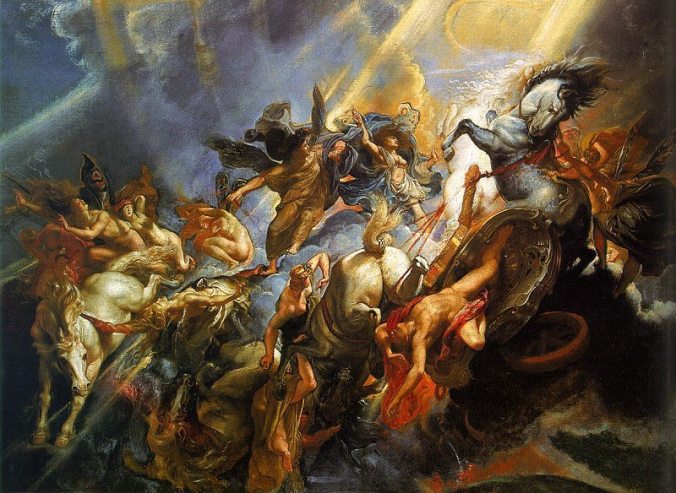
(That’s Phathon, by the way, the son of Helios, the Greek sun god, falling to his death after trying to drive his father’s sun-chariots across the sky. I’m sure you knew that...)

1 “Children or Guns?” We can’t be too critical of 16 and 17-year olds who employ poor reasoning and bumper-sticker rhetoric to demand “something” [New York Times two-page paid ad—sure,  the kids are responsible for it; you believe that don’t you?—reads: “We’re children. You guys are the adults….get something done.”—Parkland school shooting survivor] When the adults are making similar “arguments.” “Children or Guns?”  was the title of the  New York Times editorial two days ago. Yup, that’s the choice: either we can have children, or we can have guns! The Facebook declarations from users too old to go trick or treating are similarly hysterical. This messaging maleducates our young, especially the already harmed shooting survivors. The shooting made them justifiably angry and paranoid, now the cynical adults exploiting them are making them stupid. More notes from the re-invigorated Sandy Hook Ethics Train Wreck:

  • A teaching moment: Ethics Alarms has a flurry of high school students weighing-in here, some with more success than others. This is a good teaching blog for a lot of skills and disciplines, like rhetoric, logic, political debate and, of course, ethics.  At least one college course on ethics uses EA as a permanent resource (or did).

I’d love to see more students comment here, as long as they don’t expect to be coddled. This is a tough forum, and was designed to be. One piece of advice: Read the comment policies and the list of terms and concepts.

The armed officer stationed at Marjory Stoneman Douglas High School in Parkland, Fla., resigned Thursday after an internal review found he did not enter the school during last week’s deadly shooting. Broward County Sheriff Scott Israel announced Deputy Scot Peterson chose to resign after Israel suspended him without pay. “Scot Peterson was absolutely on campus through this entire event. He was armed. He was in uniform,” Israel said at a press conference…

“We’re not going to disclose the video at this time, and we may never disclose the video, depending on the prosecution and the criminal case,” Israel said. “But what I saw was a deputy arrive at the west side of building 12, take up a position — and he never went in.”

When asked by a reporter what Peterson should have done, Israel said the deputy should have “went in, addressed the killer, killed the killer.” Israel said the video made him “sick to [his] stomach” and left him feeling “devastated.” “There are no words,” he said.

Sure there are: “Moral luck” are two of them. So is “chaos.” Children and journalists are screaming with fury at the NRA, whose sole job is to set up the most absolute defense possible to protect the Second Amendment as the ACLU is pledged to do with the First, for what we now know was a catastrophic breakdown in multiple human government systems.

We know that the school, the police and the FBI were warned that Nicholas Cruz could be a school shooter multiple times. We know he posted a YouTube video with  the comment: “I’m going to be a professional school shooter.” Law enforcement reportedly flagged the comment last September so YouTube would remove it. Problem solved! Now we know that the professional with a gun—the fail-safe— whose job it was to protect the students from exactly this kind of threat was derelict when the system needed him to do his job rapidly and well.

Unfortunately, this isn’t an anomaly, and it would be helpful if the students learned that. The government is made up of fallible humans, and often fails, even when it isn’t corrupt and abusing power. Systems, even the best ones, break down and allow metaphorical dinosaurs to run amuck. You’re never going to be “safe,” and if you think so, someone has lied to you, or you are deluded. For many years beginning in high school, I kept a newspaper clipping about a man, minding his own business and walking home from work ,who was killed by “a flying mailbox”–a truck had slammed into one and it was hurled hundreds of feet in the air, eventually landing on this poor guy, who not only didn’t know what hit him, he wouldn’t have believed it if he had been told.

This has always been the brilliance of the Founders’ vision of a nation and a culture where citizens not only take individual responsibility for their lives, but are guaranteed that right. The bad luck and confluence of unpredictable and uncontrollable circumstances (chaos) tell us that a society where citizens have freedom and guns  available will have periodic tragedies. The fact that multiple government employees and systems failed in Parkland also tells some citizens that the more they are able to protect themselves, the safer they will be.

They are not wrong.

  • The Second Amendment version of the Streisand Effect. Gun sales, which spiked to record levels during the Obama administration because of its irresponsible anti-gun rhetoric, is booming again, as citizens decide they better arm themselves, especially with semi-automatic weapons, before the Left’s “sensible” gun grab. Thus the end result of all the screaming and finger-pointing  will be more guns than ever.

Good job!

  • New vistas in virtue signalling…My Facebook friends, who are drooling all over themselves right now, were cheering the viral video of the guy burning his own AR-15 so it “would never be used” in a mass shooting. This is right up there with Rhett Butler shooting Bonnie Blue’s pony because she was killed trying to ride it, but even dumber. Yes, that rifle is going to escape and kill kids.

The words this time are “showboating” and “virtue-signalling.” That gun was never going to used in a shooting. It’s fungible, so its destruction does nothing and means nothing. The individuals who would misuse their weapons would never do what he’s doing. This is like a non-drinker pouring a bottle of whiskey down the drain before he gets in a car, to protest drunk-driving. It’s like the owner of a loving American Pit Bull Terrier killing his dog because he’s been convinced the breed is dangerous. It’s like him castrating himself so he won’t rape anyone, like Harvey Weinstein.

It’s not an argument, it’s not an example, it’s not intellectually honest. Naturally, everyone is cheering.

This is the incompetent level of the current gun debate.

  • And so is this: At President Trump’s White House meeting with survivors of school shootings and their family members, a father asked, “How many more children have to get shot?”, and this was deemed worthy of a front page headline. That’s an unethical question, a “When did you stop beating your wife?” question, in which answering it accepts a false premise. “No more!” would be a commitment to installing a police state. “647!” would also be unacceptable, presumably.  The President, neither a deep thinker nor a Constitutional expert, gamely foundered with random suggestions, one of which, the arming of teachers, was furiously attacked and ridiculed by the anti-gun zealots, who have yet to suggest a measure that would have stopped the latest shooting and wouldn’t involve gutting the Bill of Rights.

2. We are poor little lambs who are dumb as hell...I suppose it is gratifying to know that Yale’s institutions are as silly and self-destructive as Harvard’s. I was expecting this one: it is Hasty Pudding Show Redux. Harvard was stupid first, though!

Yale’s Whiffenpoofs, the country’s oldest collegiate a cappella singing group, capitulated to #MeToo anti-male  attacks on campus and this week named Sofia Campoamor, a junior, as the first female member of the all-male  singing group since its founding in 1909. Well, that’s the end of that. Apparently certain kinds of sounds are now politically intolerable in Progressive Cloud Cuckoo Land. All male singing groups, all female singing groups, and mixed gender singing groups have different, distinctive and aesthetically pleasing sounds. Unless Sophia is a bass, or plans on taking hormones, the addition of a female voice to an all-male harmony ensemble changes its sound. Have you ever heard a mixed gender barbershop quartet? It doesn’t sound like a barbershop quartet, just as adding a male to the Supremes would mean the group wouldn’t sound like the Supremes.

The Progressive drive for agenda-driven conformity is a symptom of its totalitarian proclivities. There is nothing wrong or unethical about all-male musical ensembles, and the sound they create is worth preserving. I wouldn’t cross the street to hear the ‘Poofs, but the group has allowed itself to be sacrificed to political correctness.

3. Finally, this entry in the “When ethics alarms don’t ring” files. A dining hall at New York University advertised a special meal in honor of Black History Month:  barbecue ribs, corn bread, collard greens, Kool-Aid and watermelon-flavored water. After black students complained, two low-level black employees were fired for choosing  a menu that Andrew Hamilton, the president of New York University, called “inexcusably insensitive.” 

Foul. The black employees were given an impossible assignment, a trap, really: “OK, decide what we’re going to serve for the Black History meal.” Their supervisors gave inadequate guidance, and no oversight. What would you serve? My answer: nothing different from any other meal, except maybe better than usual. But without guidance, I can see how this gaffe was made. And so self-righteous, privileged black students got two people fired as retribution.  Victory.

Morning Ethics Warm-Up, 2/18/18: Sunday Potpourri

Good Morning!

1. Now THIS is a bribe…Al Hoffman Jr., a Florida-based real estate developer and a prominent Republican political donor “demanded” yesterday that the party pass legislation to restrict access to guns, and vowed not to contribute to any candidates or electioneering groups that did not support a ban on the sale of military-style firearms to civilians. “For how many years now have we been doing this — having these experiences of terrorism, mass killings — and how many years has it been that nothing’s been done?” Mr. Hoffman said in an interview. “It’s the end of the road for me.”

The only ethical GOP response is, “Bye!” Donors may not tie their support to specific legislative measures. That’s a quid pro quo. a bribe. The party should—I would prefer “must”—respond by officially and publicly telling Hoffman that its elected officials  will do what they believe is in the best interests of their constituents and the nation, and he is free to contribute to whatever he deems appropriate.

Moreover, his statement shows that he doesn’t know what he’s talking about. This is yet another “Do something!” yelp.

2. Yet more anti-gun hysteria...Could there be a more nakedly emotional and irrational headline than this one in today’s Sunday Times: “Why Wasn’t My Son the Last School Shooting Victim?”(That’s the print version…the online headline is different.)

3. I may have to put “cultural appropriation” on my list of things have to flag every time it’s used…From a New York Times article about Wes Anderson’s new animated film about dogs exiled to a miserable island in the wake of “dog flu” comes this astounding cut-line:

“Critics Address The Issue Of Cultural Appropriation In ‘Isle of Dogs'”

It seems the American director’s work here is influenced by the films of iconic Japanese director Akira Kurosawa.  The Horror. Hey, what the hell business does Japan have running  professional baseball leagues? Here’s a quick poll as a warm-up for the Warm-Up:

Continue reading

I Worry About Cary Grant [Updated]

…and James Cagney. And Kirk Douglas. And Bette Davis. And Rita Hayworth.

Seeing Kirk Douglas at the Golden Globes revived the concern that every Christmas season intensifies for me, when I realize that it is only Christmas that keeps such giants of entertainment past as Gene Autry, Bing Crosby and Dean Martin from fading into permanent obscurity.  The cultural figures who we remember are mostly the beneficiaries of moral luck, not a fair merit-based calculation. It is a random process, and culture, which is significantly defined by who and what we remember and who and what we forget, should not be shaped by coincidence, chance, and random amnesia.

It should not be, but it is. A classic example outside the realm of entertainment is the strange case of  Col. Joshua Lawrence Chamberlain, the hero of Little Round Top in the Battle of Gettysburg, and by some assessments the savior of the Union itself. When the story of Gettysburg was assembled by the battlefield commission, plaques erected and statues placed. Chamberlain’s desperate stand protecting the Union army’s flanks on Day Two of the battle didn’t make the cut. Despite as remarkable a career as anyone from Maine could have, and more than one shining moment of distinction during the Civil War, he was forgotten for more than a century. Then a brilliant, best-selling historical novel, “The Killer Angels,” recounted his heroics leading the 20th Maine so vividly that Chamberlain memory was re-animated, and began receiving the attention from historians that it deserved from the start.

In popular culture, whether a performer’s unique talents and contributions are remembered after more than a generation is now almost entirely dependent on whether there is a film featuring them that is regularly presented on television. Only a handful of performers who have permanently entered iconic status avoid that standard: I’d include Charlie Chaplin, Marilyn Monroe, Fred Astaire, Judy Garland, Shirley Temple and John Wayne in this category, with a few debatable others. (And even the Little Tramp, MM, Fred, Judy and The Duke aren’t necessarily  safe: once Rudolf Valentino, Laurel and Hardy, Lon Cheney, Greta Garbo, Boris Karloff and James Dean could be safely called icons. I doubt one Millennial in a hundred could identify any of them. Marlene Dietrich has a thumb-hold on her iconic status only because of  Madeline Kahn’s film-long send-up of her in “Blazing Saddles.”) Continue reading