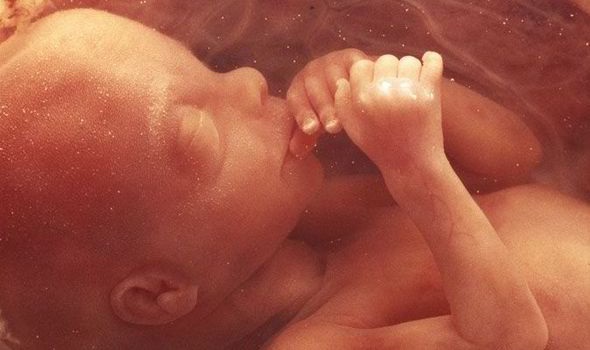
“I think abortion is evil, but it is a necessary evil.” Discuss.

Foetus-435110

This blog doesn’t discuss evil very often because it is not a term appropriately associated with ethics. Evil is a concept related to morality. In an ethics discussion, I would take evil to mean something extremely, irredeemably unethical by any ethical analysis or system. The statement “I think abortion is evil, but it is a necessary evil” appeared parenthetically in a comment by Beth, a frequent commenter on Ethics Alarms who is a mother and a lawyer, regarding the Planned Parenthood videos. Though the news media appears to have successfully distorted that story by focusing only on whether the videos were evidence of illegal “trafficking in body parts” by Planned Parenthood, that was not the reason I posted the essays, and it is not the reason those videos are significant in the ongoing debate over abortion rights. Two high ranking individuals in the organizations casually discussed the crushing and crunching of the heads and torsos of living and helpless individuals with the sensitivity I would associate with stepping on a roach. If this doesn’t disturb you, it should. If it does disturb you, as it did Beth, what does that mean?

Abortion is one of the most important and difficult ethics issues in the culture, indeed in world culture. It involves millions of lives and millions of deaths, law, bioethics, religion, social policy, science, human rights and feminism, as well as society’s ultimate respect for life itself. I have written about the ethics of the abortion debate frequently (you can find most of the relevant posts here), but to summarize the Ethics Alarms views on the topic:

1. Abortion is an ethics conflict, meaning that there are ethical principles in opposition to each other, requiring society to set priorities.

2. The absolutist position on the anti-abortion side is that abortion involves the taking of innocent human life, which begins from conception, and is thus unethical in all cases. It is a strong position if one accepts the underlying assumption.

3. However, no absolute position is really absolute. Every ethics absolute has an exception, or several: there must be some circumstances when abortion is necessary and right. (This is not true of moral absolutes, since moral absolutes are self defining. If the power dictating a moral precept says it is absolute, it is so.)

4. The absolutist position on the abortion side of the argument holds that a woman’s right to have complete dominion over her body, reproductive activity and health justifies abortion in all cases. This is not a strong position, and in fact is one that cannot be honestly argued or sustained. It supports abortion on demand for any purpose or preference, entirely at the mother’s discretion.

5. To make that argument, extreme pro-abortion advocates have had to deny the humanity and human rights of unborn children, even to the point of arguing that they are not individuals at all, but mere “parasites,” or “tumors.” The removal of a second life from the equation that is at the core of the abortion problem makes the abortion decision easy and guilt-free; it also settles the debate by pretending the central issue doesn’t exist. That issue is that there is another life involved, not just the mother’s.

6. The debate over the ethics of abortion has been handicapped by the tactic of both sides to pretend a legitimate interest championed by the other doesn’t exist. A woman’s ability to control her own life, career and what happens to her body is an important societal issue, yet the term “pro-life” ignores it entirely. It is not the only important interest involved in the abortion decision, however, as the term “pro-choice” suggests.

7. Neither absolute position, whatever its theoretical virtues, is practical from a policy perspective. Desperate women who are pregnant will seek abortions, people will help then (or exploit them, or kill them), and public policy cannot pretend otherwise. Society will not tolerate punishing women for aborting their unborn children, whether they deserve to be punished or not. Yet allowing mothers to have unborn children killed on a whim leads to the callous, ugly, dangerous attitude toward innocent life on display in the Planned Parenthood videos. Callousness toward any human life, history has shown us, is a slippery slope with the potential of doing terrible harm to the culture.

8. Roe v. Wade was a premature Supreme Court decision and a badly reasoned one. Until and unless it is overturned, abortion is a right. That does not mean, and never meant, that abortion necessarily is right.

9. Because absolutism fails here, abortion is a problem that demands utilitarian analysis–balancing of interests and values, in the best interests of society, long and short-term, and everyone in it, according to the facts as we understand them.

10. Balancing requires an honest acknowledgement that there is something to balance. The “pro-choice” and “pro-life” dichotomy doesn’t acknowledge that in their most extreme incarnations, and since abortion is currently a right, the pro-choice lobby detects no reason to yield to logic, science and reality. Continue reading

Why Ethics Rules Are Useless Without Common Sense

HIPAA

An ethicist’s pet peeve: People who misuse formal ethics rules to justify unethical or stupid behavior because they never thought about what why the rule exists.

This happens a lot. My favorite example was the famous athlete enmeshed in a scandal. Ay a press conference, he said that he couldn’t answer specific questions because of “atttorney-client privilege,” and not one of the reporters had the education to say, “Huh? You’re the client! The attorney-client privilege prevents your lawyer from revealing what you told him. It doesn’t stop you from revealing anything, you cretin.” In my seminars, when an attendee cites a professional ethics rule as the reason why he shouldn’t do something, I often ask, “And why is that a rule? What’s wrong with what it forbids?” Often, disturbingly often, the individual has no idea.

The New York Times today featured another example: medical providers and others not even subject to the law using HIPAA to avoid giving out information they could and should give out, in mots cases misinterpreting the law to do so. Among the examples in the Times story:

  • A retirement home refusing to tell friends of a resident that the resident had died (only health care providers, health insurers, clearinghouses that manage and store health data, and their business associates are covered by The Health Insurance Portability and Accountability Act of 1996. a.k.a. HIPAA)
  • A hospital that  refused to accept information about a patient’s allergies from the patient’s daughter (Wow: hospitals can receive medical information; HIPAA restricts the ways they can disclose it)
  • Another relative of a patient reprimanded by hospital staff for talking about her loved one’s medical problems in the cafeteria, because, she was told, it was a HIPAA violation.
  • A minister told a church staff not to announce the names of ailing church members because it was would violate HIPAA  (That’s right: he really thought it was against the law to tell congregation that someone was sick.)
  • Some providers cite HIPAA to block patients from seeing their own records.

This is why morality alone doesn’t make people ethical, especially if they aren’t very bright. Continue reading

Professor Schwitzgebel Concludes That Ethicists Aren’t Very Ethical—Luckily, According To Him I’m Not An Ethicist, So I Don’t Take It Personally

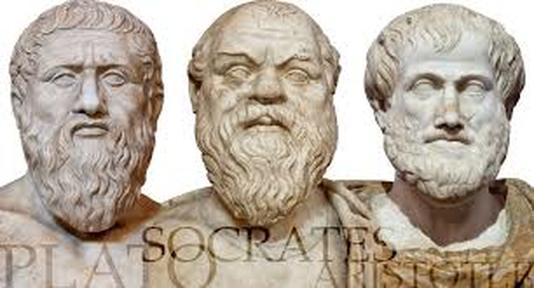
Greek phil

Eric Schwitzgebel is professor of philosophy at University of California, Riverside, as well as an author and a blogger. His essay “Cheeseburger Ethics” immediately caught my attention, as his thesis is one that I have embraced myself, occasionally here: ethicists are not especially ethical.

The essay is thought-provoking. He’s a philosophy professor and an academic, so naturally he views his own, isolated, rarified species of ethicist as the only kind. In announcing the results of his “series of empirical  studies” on the ethics of ethicists, Professor Schwitzgebel announces, “…by ‘ethicist’, I mean a professor of philosophy who specialises in teaching and researching ethics.” Got it, prof. I, in contrast, am the kind of ethicist typically denounced on other blogs as a “self-proclaimed” I don’t regard myself as an academic, my degrees are in American government and law, and my specialty is leadership and the role of character in developing it. My job isn’t to teach half-interested students about the abstract thoughts of dead Greeks and Germans; my job is to make professionals, elected officials and others understand what being ethical in their jobs and life means, how to distinguish wrong from right, and how to use proven tools  to solve difficult ethical problems they will face in the real world. I get paid for it too.

My audiences hate ethics, usually because of the people who Prof. Schwitzgebel has decided are the “real” ethicists. They have made ethics obscure, abstract and gnaw-off-your-oot boring for centuries, with the result that the mere word “ethics” sends the average American into a snooze. I have had corporate clients ask me to teach ethics without using the word “ethics.” The most common evaluation I read are from participants who write that they dreaded my seminar and were shocked that they were engaged, interested, entertained, amused…and learned something useful and occasionally inspiring.

Is it ethical to reduce the public’s interest in and respect for the very subject—a vital one– you have chosen to specialize in and teach, often because you have lousy speaking and teaching skills? Why yes, I’d call that very unethical. So I agree with Schwitzgebel’s assessment of his colleagues. Continue reading

29 Reasons Why “81 Things Mike Huckabee Has Denounced” Should Be Denounced


Republican National Convention

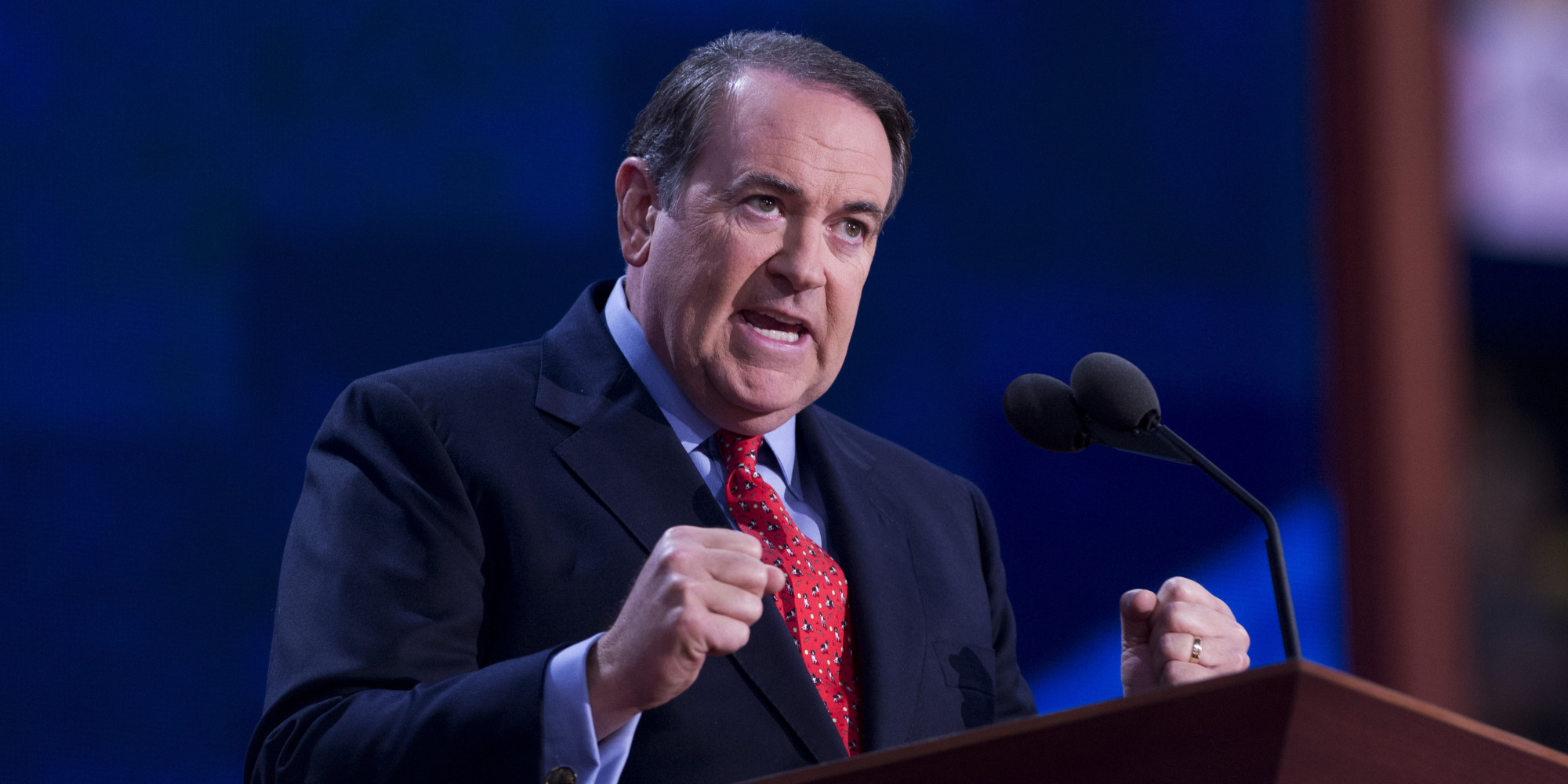
Political reporter—not humorist, not feature-writer, but reporter—David Farenthold of the Washington Post wrote a long feature (it is a hit piece, disguised) called “81 Things Mike Huckabee has denounced.” It doesn’t matter to me which politician this kind of junk is written to trash: Huckabee’s as deserving a target as anyone. On my rapidly growing list of candidates I would take a hacksaw to my neck before voting for, he is filed somewhere among Rand Paul, Bobby Jindal and The Donald. Farenthold’s  article itself would be unethical if it was written about The Green River Killer. It is in that horrible abuse of journalism category known here as “Making Readers Dumber and Less Ethically Astute Than They Already Are.

Here are the 29 reasons why I am denouncing “81 Things Mike Huckabee has denounced.”

Reasons #1-7 It is dishonest.

It’s pretty obvious what the post is about, but the author doesn’t have the guts or the honesty to admit it. The real title should be, “Mike Huckabee opposes gay marriage, so it’s okay for me to trash him about everything I can think of whether it’s fair or not.”  After correctly noting in his reasons 3 (“Same-sex marriage”) and 4. (“The Supreme Court decision that legalized same-sex marriage nationwide.”) that Huckabee is not a fan of gay marriages,  Farenthold also devotes 68 though 79, plus 81, on his list of his  “things” directly to this, and in deceitful fashion  places the last 13 of them at the end of his list. Many are misleading in the context of his stated purpose, giving me seven reasons to denounce his list:

  • #68. claims that Huckabee “denounced”  “Homosexuality, in general” when he referred to it as  “a sin” 41 years ago in a Baptist newspaper advice column.  That’s not a denunciation. To a Baptist, that’s a statement of fact.  (Reason #1 )
  • In #70,  Farenthold says that Huckabee denounced “Homosexuality, in general” is this quote: “I’ve had people who are gay that worked on my staff. It’s not like I’m some homophobe. If you ask me is it the normal pathway? I don’t think so.” “I don’t think homosexuality is a normal pathway” is a “denunciation”? No, it’s an opinion, and not even an inflammatory one. Gays comprise less than 10% of the population: that alone is sufficient to justify “not normal.” (Reason #1)
  • In #71. Farenthold accuses the Republican of “denouncing”  gay parents by saying, “The children…really cannot, get critical early-life lessons in how a heterosexual family functions successfully.” OK, maybe, and so what? And adopted boys raised by a lesbian couple can’t get critical  early-life lessons in how to use a urinal. (Reason #3 )
  • For his 72nd  item, Farenthold calls this statement…

“Of the seventy-three sex scenes shown that week…two involved male homosexual couples.”

…a denunciation of  “Same-sex couples in TV shows.” Pointing out a statistic is now “denunciation”? (Reason #4)

  • #74 alleges that  “It actually became easier to get out of a marriage than to get out of a contract for the purchase of a used car!” is a denunciation of “Allowing heterosexual couples an easy path to divorce. ”  In fact, he was talking about divorces generally, in a book about strengthening families,  marriage, and commitment. (Reason #5)
  • The stretching gets absurd in #75. Huckabee  declared that citizens should engage in civil disobedience after the Supreme Court’s decision declaring same sex marriage a right. He did not, in any way, denounce “States allowing same-sex couples to marry, after the Supreme Court said they could.” He said that he would do something else.  (Reason #6 )
  • For his last “denunciation,” the Post’s Congressional beat reporter cites this question—“Do you want a president who follows? Or do you want a president who leads?” as one encompassing “President Obama and Hillary Rodham Clinton, for changing their minds and embracing same-sex marriage.”I could make this one about three reasons for an ethical denunciation , so dishonest is it, but I’ll be kind. Farenthold is spinning. Everyone in D.C., and most out of it, know that both Clinton and Obama based their public views on gay marriage on the polls and the opinions of the Democratic base, and didn’t have sudden epiphanies. Huckabee was quite accurately and fairly criticizing political cowardice and a lack of integrity on the parts of both Democrats, not the fact that they “changed their minds.” Just because a political reporter is playing in the sandbox of the Post “Style” section doesn’t mean that his blatant display of partisan bias is any less disturbing, or that it implicates his trustworthiness as a journalist any less.  (Reason #7 )

We get it, Dave. You really, really dislike politicians who don’t support gay marriage and believe it should not be made a right. You could make that point legitimately rather than grossly mischaracterizing the nature of the arguments of one of them who disagrees with you. Continue reading

Death Throes Of The Death Penalty: Dumb Expert, Dumb Advocates, Dumb Debate

“Next!”

As I recently concluded, the death penalty is beyond saving, not because it can’t be defended ethically and morally, but because the issues are tangled beyond repair.

The controversy over the legality of the so-called drug cocktails that somehow became our execution method of choice is a perfect example. The battles over capital punishment trapped policy-makers into this kinder, gentler, ridiculously complicated method of execution that has suffered snafus ranging from unavailable drugs to ugly extended deaths. The problem is the floating definition of “cruel and unusual punishment,” prohibited by the Constitution, but almost entirely subjective. Many judges think killing a killer is itself cruel by definition, and the more reluctant Western Europe becomes to execute the worst of the worst, the easier it is to make the argument that the death penalty is also unusual.

I don’t get it. I never have. India once executed condemned criminals by having the subject place his head on a stump under the raised foot of  trained elephant, which on a command would smash the head like a grape. Quick, painless–messy!—but virtually fool-proof. A pile-driver would be an acceptable equivalent.  Ah, but ick! In this stupid, stupid, intellectually dishonest debate, ick always equals “cruel and unusual,” because to opponents of the death penalty, killing people, even horrible, dangerous people, is inherently icky.

(Oddly, ripping unborn babies out of the womb is not, but I digress.)

I’ve admitted it, and I will again. (This lost Ethics Alarms Luke G., one of its best commenters the last time.*) It is obviously wrong to intentionally prolong an execution or deliberately cause pain, but if the occasional execution is botched and the condemned suffers, that should be cause for great rending of garments, nor should it be used to discredit capital punishment. As I wrote here about Clayton Lockett’s execution in Oklahoma

“There was no question of Lockett’s guilt, and his crime was inhuman. Such wanton cruelty and disregard for innocent life warrants society’s most emphatic rebuke, and the most emphatic rebuke is death. It is essential that any healthy society make it clear to all that some crimes forfeit the continued right to not just liberty, but also life. Anyone who weeps because this sadistic murderer experienced a few extra minutes of agony in the process of being sent to his just rewards has seriously misaligned values. No method of execution will work every time, and to make perfection the standard is a dishonest way to rig the debate. If the death penalty is justified, and it is, then we should expect and accept the rare “botch.” Meanwhile, if the concern really is efficiency, reliability, speed of death and minimal pain, there are literally dozens, maybe hundreds of methods of swift execution that would accomplish this. They just won’t pass the standards of death penalty opponents, because no method will.”

Today the Supreme Court heard oral arguments on the question of whether Oklahoma’s use of the common surgical sedative midazolam did not reliably make prisoners unconscious during lethal injections, thus violating the Eighth Amendment’s protection against “cruel and unusual punishment.” It’s a ridiculous case, which arises out of the botched April 2014 execution of Lockett that sparked the post I just quoted. It is a ridiculous case because the method of execution isn’t worth arguing over. Elephant. Head. Problem solved. Why is Oklahoma fighting about which cocktail to use? This is the anti-capital punishment team’s game, and sooner or later, the result is preordained.  Continue reading

Unethical Quote Of The Week: Ohio Governor John Kasich

“[T]he most important thing is, what does the Lord want me to do with my life?”

Potential GOP Presidential candidate John Kasich, Governor of Ohio, explaining what considerations will determine whether or not he enters the race.

"Governor? It's for you."

“Governor? It’s for you.”

There is so much wrong with Kasich saying this that the only question now is whether it disqualifies him for elected office.

I guess that’s excessive, though. In a political culture in which Hillary Clinton is considered qualified to be President, almost no one can be truly disqualified. Anything goes, as long as you are wearing the right team colors.

If the Founders knew their democracy would come to this, I think they would have decided to just submit to King George’s tyranny.

Kasich is a skilled governor, just as he was an outstanding House member in a crowd of Republican embarrassments during the Bush years. Then he tried being a talking head for Fox, and had the integrity to quit in disgust. He seemed to have the qualities necessary to elevate the Republican presidential field.

Guess not:

1. He is pandering. The GOP evangelicals and religious right have a lot of power and influence, and they are the only ones who could possibly take Kasich’s statement seriously. “Ah!” they will say, or so Kasich’s shameless advisors have convinced him, “He’s one of us! He believes that weather disasters are visted upon us because of America’s sins! He believes that women belong barefoot and pregnant, that Adam was ducking dinosaurs, that school prayer will cure our ills…that good people ought to be able to shun and exclude the sinful by refusing to sell them services that they provide to everyone else, and that homos are the spawn of Satan.” The statement that Kasich is dictated to by God hints that he thinks a theocracy is hunky-dory. Hey, look at Iran!

2. He is lying. Or he is deranged.

3. The belief that God is likely to choose you as a leader of the most powerful nation on earth is so devoid of humility and so unfair to and disrespectful of the democratic process that it boggles the mind.

4. It avoids personal accountability.

5. The statement is a declaration of incompetence and fecklessness. What other decisions will President Kasich place in God’s hands, or blame on Him when they turn out to be duds?

6. Waiting for God to declare the right course is an intentional abdication of ethics for the moral direction on others, or, if you prefer, Others.

 God made you say that, John, so you would not be President. You have your answer.

Dummy.


Read more:

Gay Marriage Combat Flashback: “When A Boycott Is Unethical”

Prop 8

Prolific commenter Steve-O suggested that my previous post, Planet Ethics To Earth’s Gay Marriage Combatants: “You’re Mean, You’re Disgusting, And You’re Embarrassing The Human Race”, would have done more good if I had written it a few years ago. That’s hindsight bias, of course, but I did point out the unethical nature of similar tactics more than a few years ago, when gay marriage advocates announced a boycott against the state of Utah. ( I also, more than a decade ago, explained why this debate would be intense and emotional, and suggested the only chance, admittedly a faint and likely futile one, that the anti-gay marriage forces had to prevail.) Steve’s suggestion is also fanciful, in that Perez Hilton’s inane pronouncements on a Lindsay Lohan Instagram carry about 100,000 times more weight and influence than anything written here, and probably more than anything written about ethics issues anywhere, by anyone.

With that sad fact noted, the renewal of the problem of punitive and unfair boycotts as well as the escalation of brutal tactics in the gay marriage wars justifies a re-print of this essay from the Ethics Scoreboard from 2008, shortly after Proposition 8 was voted into law by Californians. As an aside, I note with some nostalgia the sober style in which Scoreboard posts were written. Therein lies the difference between an ethics website that posted essays composed over several days, and an ethics blog that attempts to keep up with multiple issues a day. The former is certainly more professional in tone; the latter is more personal and unfiltered, and, as a result, more read.

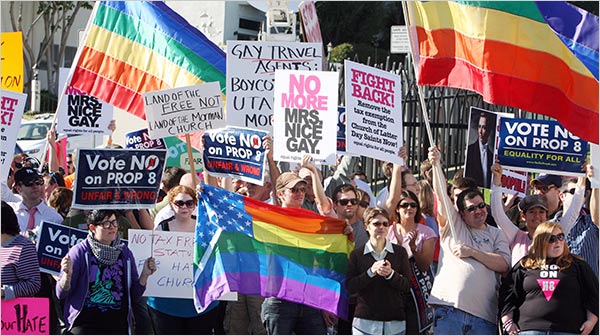
In the wake of California’s popular vote to over-ride its Supreme Court and establish marriage as restricted to heterosexual couples, gay rights advocates are urging an economic boycott of the state of …Utah.

Why Utah? Well, the Mormon Church, based in Salt Lake City, encouraged its members to work for passage of California’s Proposition 8. Thousands of Mormons worked as grass-roots volunteers and Mormon contributors gave tens of millions of dollars to the campaign. “At a fundamental level, the Utah Mormons crossed the line,” said gay rights activist John Aravosis, whose AmericaBlog.com is urging the boycott. “They just took marriage away from 20,000 couples and made their children bastards. You don’t do that and get away with it.” Continue reading

Planet Ethics To Earth’s Gay Marriage Combatants: “You’re Mean, You’re Disgusting, And You’re Embarrassing The Human Race”

earth-from-space

It is hard to mediate a dispute where both sides feel entitled to use scorched earth tactics that ensure that innocent people get hurt. The gay (or same-sex) marriage wars have quickly escalated to that point, and while it may have been predictable, it was not necessary.

Gay marriage advocates, who were winning and, it is now clear, will win, could have shown patience and compassion toward the unsuspecting Americans of faith who weren’t paying close attention to the epic cultural shift underway, and who are reacting like most human beings react when the basic traditions, assumptions, and beliefs that they grew up believing were good, fair and immutable suddenly move beneath their feet like unstable tectonic plates—with confusion, anger, fear, impulsive words and actions based on instinct and panic. The gay advocates couldn’t bring themselves to do it, though. They rationalized their aggressive strategy with the Goldwateresque “Extremism in the  defense of liberty is no vice” approach to social change. They insisted on demonizing opponents, without caring about their motives or their lack of understanding of the issues. Even passive acceptance wasn’t enough: the pro-gay marriage warriors had to purge contrary thoughts from the culture. Forget about tangible opposition: anyone who wasn’t thinking friendly thoughts about gays and their unions had to be destroyed. Use the fear of the tradition-bound against them. Crush them…beat them into submission.

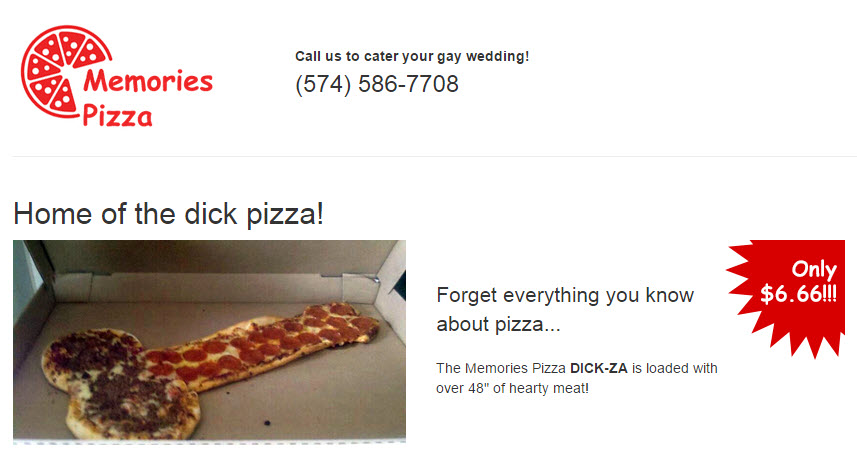
It has been ugly, destructive, and wrong. American shouldn’t lose their jobs for signing a petition or voting for a referendum. States, and all their businesses and individual livelihoods, shouldn’t be boycotted because of misguided laws. This week, a family that just want to make and sell good pizza was drawn into a controversy it neither understood nor could be expected to, and was targeted for destruction after the owner made a comment rife with ignorance about, well, everything. Does it really matter that a pizza seller mistakenly thinks that it would be honorable and virtuous not to cater a hypothetical same-sex wedding reception? Does the family really have to be brought to its knees, made an example of, and ruined to teach anyone else what can happen to them if they don’t conform to the new, mandated belief system?

Who respects or likes people who act this way? We call them bullies. We call them cruel. We call them fanatics. ( This hateful CBS reporter tried to derail the GoFundMe effort to raise funds to rescue the pizza place.) Unless we are determined to understand their motives, we are very likely to hate them.

So the advocates of gay marriage really think it advances their cause, and it is a just cause, to make people hate and fear them.

What utter, utter folly.

Naturally, as in any war, the other side has responded in an equally brutal and ugly manner, just worse—dumber, to begin with. It’s Dresden for Coventry all over again.  Continue reading

Well-Earned But Wrong: The Parody Website And The Attack On Memories Pizza

Memoriespizza

It is difficult to work up much sympathy for Memories Pizza, the Indiana pizza place that rushed to be known as the first business to announce that it plans on refusing to serve gay customers under the cover of Indiana’s new and poorly thought-out religious freedom law.  Oh, I agree that it was thoughtful of the owners to help show that the law, regardless of the neutral words used, was intended to be a rallying point for anti-gay advocates who want to fight back against what they see as a frightening cultural shift that they don’t understand and can’t accept, but the owners are still, to be blunt, morons.

Announcing that the law would allow them to refuse to cater a gay wedding, they injected their biases into a debate they were neither legally, ethically, morally or intellectually equipped to participate in. Crystal O’Connor, whose family owns the small-town pizzeria, spouted off  that “If a gay couple came in and wanted us to provide pizzas for their wedding, we would have to say no,”  as the national debate over the law was heating up. Well, no, Crystal, you wouldn’t have to, and the law probably wouldn’t protect you if you did. Baking pizza is not the exercise of religion, and nothing in the Bible says “Thou shalt not send pizza to the reception of a wedding you disapprove of.

I just heard one of the law’s supporters from a “family values” group that spends much of its time, words and money attacking homosexuality swear to Chris Cuomo on CNN that the law has nothing whatsoever to do with Indiana embracing anti-gay bigots (and tricking them into thinking that stunts like Crystal’s are acceptable). “It’s about conscience, ” he intoned, without giggling. But the law says nothing about conscience either.It prevents the government from  substantially burdening the exercise of religion. Catering an event, religious or not, is not a religious act, nor is a wedding reception a religious ceremony. It is no more legitimate to say that your conscience forbids you from selling pizza to strangers than it is to say that your conscience forbids you from letting a transsexual into your cab. O’Connor, not surprisingly, doesn’t comprehend the law. Continue reading

Jerks, Liars, Hypocrites, Fools and Hoosiers: 10 Ethics Observations On Indiana’s Religious Freedom Restoration Act Controversy

Indiana5

1. The law was passed to make discrimination against gays, trans individuals and especially same-sex couples seeking marriage if not easier, to at least seem easier. Anyone claiming otherwise is lying, or being intentionally obtuse. Would Indiana be passing this law without the Hobby Lobby decision or the various court rulings requiring photographers, bakers, and other businesses to provide the same products and services to gay couples that they do to heterosexuals? Yes, you say? Tell me another.

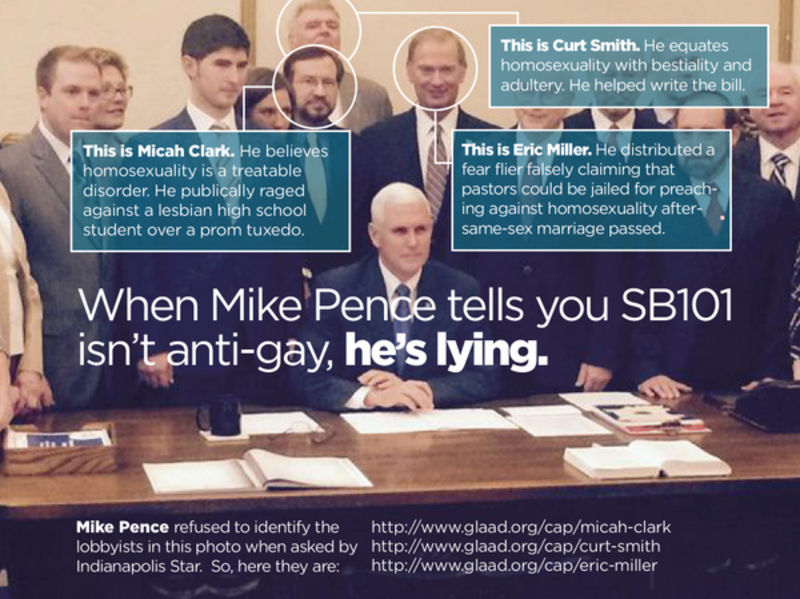
As GLAAD alertly pointed out, Governor Pence was surrounded by anti-gay activists when he signed the bill:

GLAAD Pence

This is res ipsa loquitur, and doesn’t speak well for the Governor’s candor or intelligence.

2. Context matters. The original laws of this sort (the Federal law signed by President Clinton is also called the Religious Freedom Restoration Act) were part of the left’s long range pro-drug strategy, like medical marijuana. It was essentially a hippie law designed to create a slippery slope to recreational drug legalization by allowing fringe religious groups, specifically Native American tribes, to use peyote in tribal ceremonies. Now you understand why Clinton signed the bill.

Oops. Excuse me if I enjoy the spectacle of the clever members of the Church of the Perpetually Stoned—including the ACLU, which once supported such laws as long as they pointed the way to their young lawyers being able to have their Saturday night joints legally but now opposes them—being hoisted on their own petard.

“When the federal government adopted a religious protection act in 1993, same-sex marriage was not on the horizon,” whines the New York Times. Well, competent, well-considered, properly drafted, responsibly passed laws don’t suddenly become unbearable, then fine, then unbearable again with every shift of the cultural winds. The intent of the law was never to protect mainstream religions, but cloaked itself in language that did. It backfired.

3. That being stipulated, the good states need to read their own laws before they start grandstanding. Connecticut Governor Dan Malloy just announced on Twitter that he plans to sign an executive order banning state travel to Indiana in response to its Religious Freedom Restoration Act. Yet Connecticut, hippie enclave and bedroom community of rich, white, liberal New Yorkers that it is, happily jumped on the religious freedom train with a law of its own, one that, as the Federalist points out, makes discrimination on the basis of religion easier than the Hoosier version, which only prohibits the government from substantially burdening religion. Connecticut’s law does not include the word “substantially,” meaning that all government-enacted burdens on religion are theoretically illegal.

I wonder how Malloy is going to ban government travel to Connecticut? Is the theory that the same law can be good when liberal states pass it and evil when those bad conservative states pass it? It is more likely that the governor hasn’t looked at his own state’s law.

4. The hysteria being stirred up over the supposed horribles Indiana’s law will lead to is irresponsible. Jonathan Adler explains on The Volokh Conspiracy: Continue reading