Regarding “Conclave”

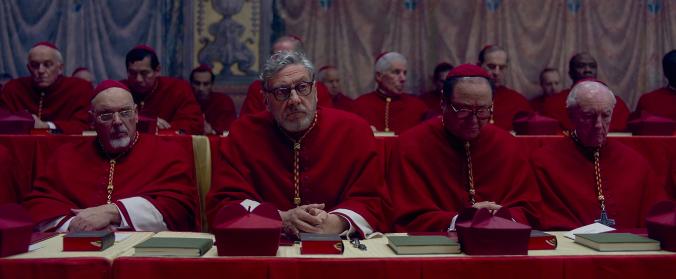
As the Cardinals meet in Rome to find a new Pope for real, it is a propitious time to consider “Conclave,” the “thriller” (as Wikipedia calls it, a stretch) about a fictional conclave after the death of a fictional Pope. I had several friends recommend the film to me, and I finally watched it this week.

I’ll complete this ethics overview without spoilers since the film is relatively new, but wow, what a disappointment. Strong cast, excellent performances, brilliant production design and cinematography, but still, “Conclave” has to be one of the most wildly over-praised films I’ve seen since “Don’t Look Up!,” “The Crying Game” or “Ghost.” This overt Hollywood woke propaganda piece received eight nominations at the 97th Academy Awards, a number once reserved for all-time classics like “Ben-Hur,” “West Side Story” or “Lawrence of Arabia.” Its Best Picture nomination shows how far movie-making standards have fallen and that it won Best Adapted Screenplay is outrageous, since the screenplay was the worst aspect of the movie, predictable, over-wrought and unbelievable.

My late wife was superb at sleuthing out “surprise” endings of movies by the half-way mark or earlier; this time I felt like I was channeling her spirit because I guessed the movie’s ending (and woke propaganda mission) the second the key character showed up. I also thought, “Oh no, really? They are stooping to this?” Indeed they were.

“Conclave” is, ultimately, trivial and soap opera-ish, no better and less entertaining than the loony movie version of Dan Brown’s follow-up to “The Da Vinci Code,” “Angels and Demons.” Along the way to an anti-climax, we get more of the “white man bad/black man victim,” pro-LGTBQ+ proselytizing that Tinseltown has been addicted to for years.

I’ll give “Conclave” this: it was better than “Snow White” and a lot shorter than “Wicked.”

Mis-Remembering the Mutiny on the Bounty, a “Print the Legend” Classic

Today, April 28, is the anniversary of the famous mutiny on board the H.M.S. Bounty, when Fletcher Christian, the ship’s “master’s mate,” seized control of the ship and set its captain, William Bligh, adrift in the Pacific with a small group of sailors who refused to join Christian’s rebellion. The story of the mutiny and its aftermath has become a romantic cautionary tale that inspired three major Hollywood treatments, each with star-studded casts. If you ask the average American what happened on The Bounty, he or she will probably reply that a cruel captain who abused his crew was challenged by an honorable and courageous officer who took over the ship from a monster, and met with tragedy himself. Virtually no accounts of the event support that version of events, but that is the legend, and it persists to this day.

Why? It’s a better story, at least a clearer and more morally uplifting story than the truth, that’s why. Real life is messy and our heroes and villains tend to be more complicated than our emotions can handle, and this is especially true of the Bounty story. You see above the most famous moment from the great John Ford film, “The Man Who Shot Liberty Valence,” when the old newspaper editor refuses to report the shocking discovery that the heroic deed leading to the successful political career of a famous statesman and U.S. Senator never occurred. Ethics Alarms has discussed the “Print the legend” phenomenon so many times that it has its own tag. None of the examples that I have examined deserve that tag more than the mutiny on the Bounty.

Continue reading

Confronting My Biases, Episode 19: Movie Continuity Errors and Cheats

A long time ago, I read an article complaining about how nobody says “goodbye” at the end of phone calls in movies and TV shows. Characters just hang up. “Now that I’ve pointed this out, I guarantee that it will drive you crazy,” the author wrote. It does drive me crazy: in stage and movie director terms, it “takes me out of the story.” Because it’s so obviously a device to save time, the omission of “goodbye” reminds me that I’m watching a performance. (Lately, I have noticed, “goodbyes” are appearing here and there, but still in a minority of productions.)

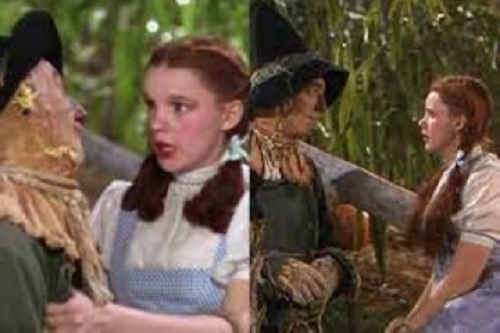
My late wife was a fanatic about such things, and she ruined many a show and film by pointing then out. One of her favorites, a pretty famous continuity botch, was Judy Garland’s constantly changing pig-tails in “The Wizard of Oz”: they are shorter and longer not only from scene to scene, but sometimes from shot to shot in the same scene. Grace was also the one who first pointed out to me the absence of rear-view mirrors in most shots of a character driving a car; now that drives me crazy.

Continue reading

Why Are Women Still Screaming In Movies?

This has bugged me for a long time, but my pique came to a head yesterday when I was watching the early Ray Harryhausen effort “It Came From Beneath the Sea”—you know, the one with the giant octopus that attacks San Francisco?

A lovely actress whom I had never been aware of before named Faith Domergue played a female scientist specializing in marine biology. Throughout the movie, despite being Kenneth Tobey’s love interest (You remember him, right? The hero in the original “The Thing From Outer Space”? Later a villain in “Billy Jack” and one of the air traffic controllers in “Airplane”?) she was completely professional, always composed, bristling at sexist comments and assumptions from the male pigs around her (this was in 1955, remember). And yet when the giant octopus that she had insisted was real while everyone else pooh-poohed the idea finally appeared, she screamed like a teenage girl at an Elvis concert. Why would she do that? She was the only one who was expecting to see a giant octopus! The men around her, in contrast, looked startled or went into action (getting the hell off the beach); only the woman screamed.

Continue reading

Unethical Film and Theater Reviewer Bias, Part II: “OK, It’s a Good Movie, But Where’s the Climate Change Propaganda?”

I supposed technically Margeret Renkl isn’t a film reviewer for the Times: officially she’s a “contributing opinion writer who covers flora, fauna, politics and culture in the American South.” I don’t care: she criticizes an action movie that audiences are enjoying because it doesn’t deliver the progressive agenda propaganda that she thinks good little Big Brotherites should jam into the brains of the trusting public at every opportunity.

Renkle can bite me, and so can the Times for publishing her dreck.

Renkl and the Times concede that “Twisters,” which appears to be the non-superhero hit that Hollywood desperately needs, “ is a humdinger of a summer blockbuster that delivers exactly what theatergoers want in an action film: plenty of explosions, destruction, high-speed chases and heroism, all with a dash of wit and sexual tension thrown in. It is not — and does not aspire to be — high cinematic art.” However, it is, she argues, a missed “golden opportunity to talk about what scientists know and don’t know about how climate change might be affecting the formation, strength, frequency and geographic distribution of tornadoes, or why they now tend to develop in groups.”

No, it’s really not. A movie people want to see for escape and entertainment isn’t a “golden opportunity” for the writers and producers to bombard them with favored and faddish data related to progressive public policy. The Ethics Alarms standard response to the “Why are you talking/writing/singing about what you want to instead of what I want to” is “Write your own blog, direct your own play, produce your own movie or sing your own song.

Continue reading

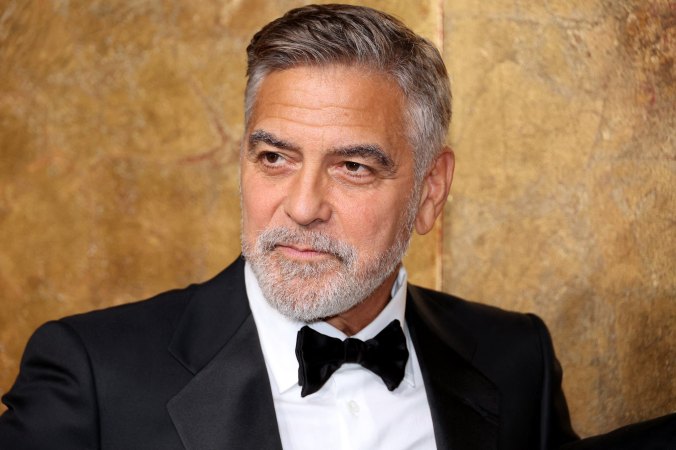
Stop Making Me Defend George Clooney!

In a typical ad hominem rant on Truth Social, Donald Trump attacked George Clooney, who recently joined the “Dump Biden” team with an op-ed in the New York Times calling on the President to step aside.

“So now fake movie actor George Clooney, who never came close to making a great movie, is getting into the act,” Trump wrote. “He’s turned on Crooked Joe like the rats they both are. What does Clooney know about anything?….Clooney should get out of politics and go back to television…Movies never really worked for him!!!”

As is so often the case, the former President doesn’t know what he’s talking about. Clooney can legitimately be criticized for his part in deceiving the public about Biden’s disabilities; as Christian Toto recently pointed out, Hollywood power-players—like Clooney—were despicably complicit in hiding Biden’s real condition from the public. However, claiming the Clooney “never came close to making a great movie” is unfair, uninformed and ignorant, and saying that “movies never worked for him” is just silly.

Continue reading

A Reward For the Historically and Culturally Literate: “Unfrosted”

If you are looking for a funny rather than syrupy entertainment diversion for your mother (or grandmother) this Mother’s Day, you couldn’t do better than spend 90 minutes or so with Jerry Seinfeld in his new movie for Netflix, “Unfrosted.”

Don’t worry: it’s a lot better than “Bee Movie.”

The film, co-written by the comic, is sly, clever and funny provided that the viewer knows enough about the popular culture of the early Sixties—you know, before everything went crazy—as well as U.S. history to understand what is being satirized. Seinfeld has always been a Sixties trivia buff as he demonstrated repeatedly on his classic sitcom, but this movie is an orgy of such references: JFK, the space program, the Cuban Missile Crisis, Jack LaLanne, Werner Von Bron, Quickdraw McGraw and Saturday morning cartoons, Johnny Carson, Walter Cronkite, Silly Putty, the Twist, Thurl Ravenscroft (the original voice of Tony the Tiger who also sang “You’re a Mean One, Mr. Grinch!” ) the Doublemint Twins (who are both apparently impregnated by JFK while Jackie is away), on and on.

Continue reading

Everybody SING! “Trump’s Deranged for Christmas…You Can Count on He…”

...Trump might blow the race to Joe
By acting crazily.
Christmas Eve found Donald
Roasting no chestnut
Trump’s deranged for Christmas
He’s in a nasty rut
!

Here is what the man who wants to be trusted to hold the most powerful job on earth sends out to the public…

Continue reading

As Disney Supporters Complain About Censorship, Disney Engages In Artistic Censorship And WrongThink Control

Doyle: You dumb guinea.
Cloudy: How the hell did I know he had a knife?
Doyle: Never trust a nigger.
Cloudy: He coulda been white!
Doyle: Never trust anyone.

That exchange has been excised from the versions of the film used on Turner Classic Movies, iTunes and Criterion. The film’s distributor, 20th Century Fox, was acquired by Disney before the scene disappeared. It is artistic censorship, straight up; no more acceptable than painting over the breasts Reubens paintings, or bleeping out “damn” is Rhett Butler’s famous kiss-off to Scarlet (as was done regularly when the movie began being shown on network television.)

Again, we are faced with deciding whether the motives here were stupid or sinister. I probably vote for both. The accelerating effort to declare the word “nigger” as taboo regardless of intent, use or context is pure attempted mind-control and Orwellian WrongThink totalitarianism—now embraced, as in other totalitarian tactics, by most of the Left and the Democratic Party. It is also unprincipled pandering to Critical Race Theory extremism. The rational mind boggles at what canonical works of art and literature face permanent scarring if the practice is allowed to take hold. Just off the top of my recently repaired head, I can think of several superb films that include “nigger” in the dialogue, like “The Shining,” “In the Heat of the Night,” “To Kill a Mockingbird,” “Mississippi Burning,” “Pulp Fiction,” and of course, “Blazing Saddles.”

Continue reading

Early in William Friedkin’s classic film “The French Connection,” Jimmy “Popeye” Doyle (Gene Hackman) argues with his partner, Buddy “Cloudy” Russo (Roy Scheider) regarding Russo recently sustaining a knife wound in a confrontation with a black drug-dealer:

Doyle: You dumb guinea.
Cloudy: How the hell did I know he had a knife?
Doyle: Never trust a nigger.
Cloudy: He coulda been white!
Doyle: Never trust anyone.

That exchange has been excised from the versions of the film used on Turner Classic Movies, iTunes and Criterion. The film’s distributor, 20th Century Fox, was acquired by Disney before the scene disappeared. It is artistic censorship, straight up; no more acceptable than painting over the breasts Reubens paintings, or bleeping out “damn” is Rhett Butler’s famous kiss-off to Scarlet (as was done regularly when the movie began being shown on network television.)

Again, we are faced with deciding whether the motives here were stupid or sinister. I probably vote for both. The accelerating effort to declare the word “nigger” as taboo regardless of intent, use or context is pure attempted mind-control and Orwellian WrongThink totalitarianism—now embraced, as in other totalitarian tactics, by most of the Left and the Democratic Party. It is also unprincipled pandering to Critical Race Theory extremism. The rational mind boggles at what canonical works of art and literature face permanent scarring if the practice is allowed to take hold. Just off the top of my recently repaired head, I can think of several superb films that include “nigger” in the dialogue, like “The Shining,” “In the Heat of the Night,” “To Kill a Mockingbird,” “Mississippi Burning,” “Pulp Fiction,” and of course, “Blazing Saddles.”

Continue reading

Arrogant, Deluded And Ignorant Is No Way To Go Through Life, Jennifer Lawrence…

Jennifer Lawrence is a charismatic, versatile, talented movie star, but someone misled her into believing that everything that pops into her head is worth saying, and it isn’t. In this case, it wasn’t just banal or gratuitous progressive blather points, but a wildly false and disrespectful over-praising of her own significance at the expense of actresses that she ought to be honoring rather than insulting.

In a recent interview with Variety magazine, the star of the “Hunger Games” movies (beginning in 2012), “Silver Lining Playbook” and other films said,

“I remember when I was doing ‘Hunger Games,’ nobody had ever put a woman in the lead of an action movie because it wouldn’t work. We were told … girls and boys can both identify with a male lead, but boys cannot identify with a female lead.”

If you don’t know your film history, don’t make statements about film history. It makes one look like a conceited fool, as the social media mob rushed to inform Lawrence. Continue reading