Is “The Three Amigos” Really Racist, or Have I Just Been Brainwashed?

I am proud to say that I thought “The Three Amigos” was a largely unfunny and lousy movie when I saw it the first time…this, despite the fact that I generally admire John Landis as a director of comedies (he will always have a place dear in my heart for directing “Animal House”), and although I generally appreciate the talents of the movie’s stars, Steve Martin and Martin Short (Chevy Chase not so much). For some reason it has been showing repeatedly on MGM+ of late, and upon re-watching the thing after my sock drawer was in order, I found another reason to hate it other than its annoying tone and its predictable gags. This time around, the film seemed egregiously racist.

Oh no! Have 40 years of relentless bludgeoning by political correctness, hyper-sensitivity and wokism taken over my brain? When I first viewed the film (which Wikipedia tells me was ranked 79th on Bravo’s list of the “100 Funniest Movies,” a factoid that only reaffirms my long-standing belief that Bravo is useless), that thought never occurred to me for a second.

One of many films that borrows heavily from the Western classic (and ethics movie) “The Magnificent Seven,”—others include “A Bug’s Life” and “Battle Beyond the Stars” along with a pretty bad remake, with Denzel Washington standing in for Yul Brenner—“The Three Amigos” (the film’s score is by the same composer who scored “The Magnificent Seven”) tells the tale of three incredibly white silent movie stars who end up rescuing a town of substantially helpless and poor Mexicans. The town’s tormenter is “El Guapo,” the evil leader of the most ugly, stupid, dirty and brutal band of Mexican bandits in silver screen history. All right, maybe the Mexicans in “The Wild Bunch” are worse, but the white guys in that bloody film are hardly what you’d like to see your daughter bring home to meet the family either. Naturally the three white guys prevail, despite their collective IQ of about 210, for an average of 70 each (it actually breaks down to 85 for Martin’s character, with Short at 70 and Chase at 65).
Continue reading

My Mickey Rooney (1920-2014) Post: “Ethics, Stereotypes, and Holly Golightly”

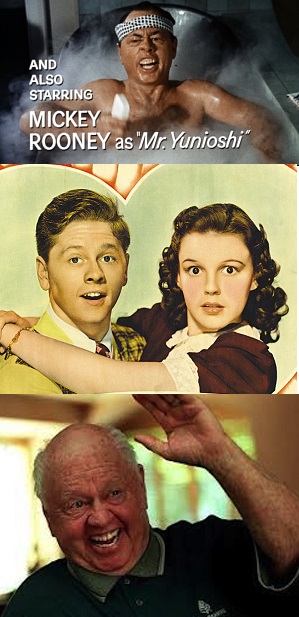
Some of the many faces of Mickey Rooney...

Some of the many faces of Mickey Rooney…

Ethics Alarms has almost 15,000 tags, which means that a lot of diverse topics hard been discussed here in connection with ethics issues. Saddened as I was to learn of the passing of the great Mickey Rooney, truly one of the most talented and versatile individuals in entertainment history and the last of MGM musical stars from the Golden Age of Hollywood, I can’t justify honoring his ethics; by all accounts, Mickey was not as admirable a human being as he was a performer. Still, Ethics Alarms has a Mickey Rooney post, from 2011, and when I read it over just now, I still liked it. Thus I will honor Mickey by reposting my defense  of perhaps his most criticized performance. For one of his best, watch this. Yes, Judy’s in it too. (TCM has made everyone take down their Mickey clips, but so far, this Russian pirate site still has it. I know, I know—but Mickey would approve. This ethical breach is for you, Mick…) Continue reading

Ethics, Stereotypes, and Holly Golightly

"Andy Hardy, the Asian Years"

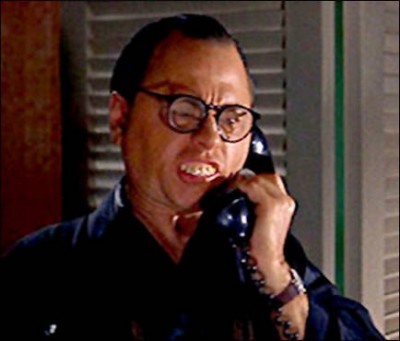
A Bronx woman, Ursula Liang, has started a petition against Brooklyn Bridge Park’s “Movies With A View” series showing “Breakfast at Tiffany’s,” the 1961 Audrey Hepburn classic that gave us “Moon River” and one of actress Hepburn’s most endearing performances. Why? Well, the movie, which has long been popular for summer screenings in New York City and elsewhere, also contains a pre-political correctness performance by Mickey Rooney as Holly Golightly’s comic Japanese neighbor, “Mr. Yunioshi.”

Rooney’s performance, in my opinion, was cringe-worthy even in 1961, one of director Blake Edwards’ not uncommon excesses in vaudeville humor, placed in a context where it didn’t belong. It is a scar on an otherwise marvelous film, but there is nothing inherently wrong with comic stereotypes. Stereotypes are a staple of comedy, and have been forever; the question is whether a particular stereotype is cruel, gratuitous, harmful, or funny. Some stereotypes are cruel and funny. Continue reading