Twenty-Five Indispensable Movies For Understanding American Culture

After this post and the comments it provoked, I vowed to get this one up before the end of the Fourth of July weekend. Twenty-five is an arbitrary number, and I mostly picked it because of time considerations. I’m also going to restrain my comments regarding the choices to a few sentences, at least for today. I may expand on them later.

Before compiling this list, I checked several others online with a similar theme. None made any sense to me, and all were, at their core, left-biased, anti-American, and, frankly, ignorant. My favorite line from the Rolling Stone list: “American culture is driven by Black culture and queer culture. Full stop.” After a statement like that, I couldn’t care less what films are on the list. The Guardian thinks “Don’t Look Up,” a really bad, unfunny satire, tells us anything about America other than how climate change hysteria has infected Hollywood. The woke Hollywood Reporter’s list includes the anti-white racist horror movie “Get Out,” which tells me that this list can’t be trusted either. And, of course, all the lists include “The Godfather,” a great movie that is an allegory for American culture only if you don’t like and admire America. I do. You won’t find “Godfather” 1 or 2 on the Ethics Alarms list.

One more point: it is hard enough getting the list down to twenty-five without trying to rank them, so I won’t. The numbering is just to keep track. Here you are…

A Brief Observation On A Slow Day At Ethics Alarms…

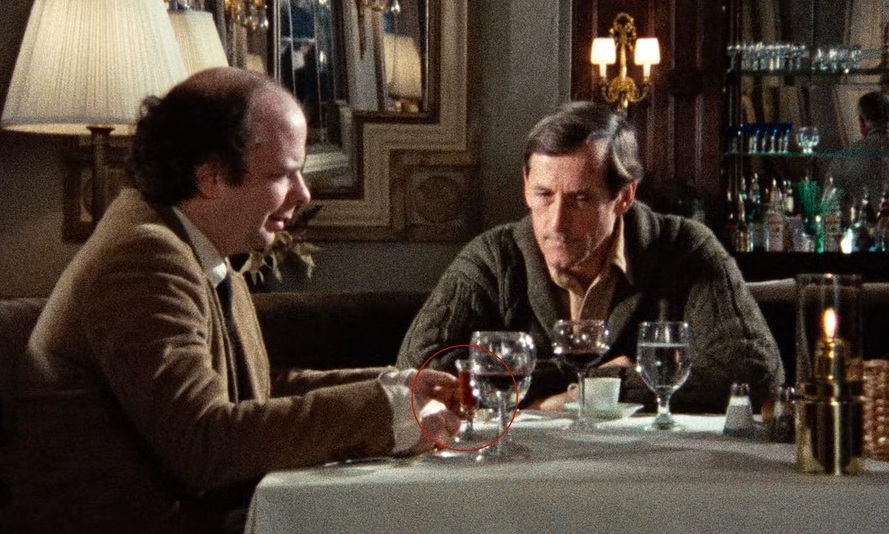
Ann Althouse, the retired Madison Wisconsin law professor/bloggress whose posts often interest me, today wrote that “My Dinner With Andre” is her favorite movie, and that this is her favorite passage from it:

“I mean, you see, I think if you could become fully aware of what existed in the cigar store next door to this restaurant, I think it would just blow your brains out! I mean… I mean, isn’t there just as much ‘reality’ to be perceived in the cigar store as there is on Mount Everest? I mean, what do you think? You see, I think that not only is there nothing more real about Mount Everest, I think there’s nothing that different, in a certain way. I mean, because reality is uniform, in a way. So that if you’re–if your perceptions–I mean, if your own mechanism is operating correctly, it would become irrelevant to go to Mount Everest, and sort of absurd! Because, I mean, it’s just–I mean, of course, on some level, I mean, obviously it’s very different from a cigar store on Seventh Avenue, but I mean…”

Well, that explains a lot.

As readers here know, I am a creature of popular culture, especially movies and plays. I have long thought that Althouse’s cultural literacy was undernourished, and that it explains her quirky and often flat-out weird perspectives. Now I know that she really doesn’t “get” movies, which is just…sad. Yeah, there are some interesting observations made in this filmed and the scripted encounter between two professional intellectuals kind-of sort-of playing themselves, but it isn’t drama, it isn’t visually interesting, and if that’s a movie, I’m a catfish. Ann is one of those remote and superior people my parents would occasionally have over to play bridge, who boasted about not having a television.

I do not believe one can comprehend the United States of America without knowing our rich film and entertainment history; if we ignore it, we are stumbling around in the dark. I would name the movies I believe are crucial parts of that heritage, but it would take too much space, and would be infuriating incomplete. I will say this, however: “My Dinner With Andre” isn’t on the list.

Independence Day Weekend Open Forum! [And A Rueful Movie You Might Want To Watch After You’ve Finished “1776”…]

That’s “The Egg” above, from the excellent movie adaptation of “1776.” I’ve performed that number many times as part of the regular repertoire of my now defunct D.C. musical revue group, “The Music Lobby.” (Of course I played John Adams.)

“1776” is one of several movies I always watch this time of year, along with “Gettysburg” and “Mr. Smith Goes to Washington.” Last night ,however, I took the advice of a friend and occasional EA participant and watched “Eddington,” a controversial 2025 movie that you probably haven’t seen, as very few people have.

Wikipedia describes “Eddington” as a “satirical neo-Western thriller,” which should tip you off that it defies easy labeling. The movie was a box office disaster: I would attribute that to terrible marketing and the fact that “Eddington” has something in it to offend just about everyone. Begin with the title, which reveals nothing about the movie: it sounds like an episode of “Downton Abbey.” In 1965, a satire about the funeral industry based on Evelyn Waugh’s “The Loved One” succeeded with the catch line, “The motion picture with something to offend everyone!” People went to see it on a dare. That might have worked with “Eddington.”

The film is the artistic expression of Ari Aster, the writer/director who is best known for his horror movies. “Eddington” is kind of a horror movie as well: it focuses on a small New Mexico town going especially nuts in 2020 when the rest of the country was going nuts too. It does not have a happy ending (neither did 2020); its protagonist (another fascinating performance by Joaquin Phoenix) is confused, inarticulate, and not very bright. I believe it is the first and probably the best possible embodiment of a “Great Stupid” movie—the term Ethics Alarms uses to describe the cultural, intellectual and political blight that spread its dark wings over the land in 2020.

You may have noticed that that blight is getting more ridiculous than ever in 2026.

The critics were divided over “Eddington,” usually complaining about Aster’s “lack of focus,” meaning that he mocked and denigrated all sides of the political spectrum and did not clearly take sides. That’s a virtue, in my view, as it takes on the Wuhan Virus lock-down and mask mania, social media and screen addiction, “influencers,” Black Lives Matter, the “white privilege” cant, anti-police rhetoric, the gun culture, the homeless, the Bidens, and much more. (I’m going to watch it again.)

Since much of themovie’s benefits lie in its unpredictability, I will not supply any more details except revealing the line that made me laugh out loud. A white teenager is seen lecturing his gobsmacked father at the dinner table about his generation’s determination to “eliminate whiteness,” parroting the now familiar gibberish of Ibram X. Kendri, the Black Lives Matter grifters, and Harvard professors. After listening to the rant, the father pauses a beat to gather his composure, and says, “Are you fucking retarded?

I’ll publish the best reviews of the movie as guest columns.

But I digress! This is the place for you to choose the ethics topic. Please do so with wisdom, taste, passion and dispatch…

Through A Rear-View Cultural Mirror: Ethics Observations on “Bye Bye Birdie” (1963)

In the weekend’s interview on The Steven Speirer Show, I explained the distinction between morality and ethics in part by noting that ethics, unlike morality, is constantly evolving over time, and thus requires constant reflection and reassessment. This was the theory behind my now defunct professional theater company in Northern Virginia, The American Century Theater, which revived older American plays and musicals now considered “dated” by the theater community. Old art is never dated, because we have to know where we have been in order to understand how we got where we are and where we are going.

A fascinating time capsule in this vein is “Bye Bye Birdie,” the 1963 film of the hit 1961 Broadway musical. That show, the “Grease” of its generation, was a current events satire of the rock idol phenomenon, inspired by the cultural uproar when Elvis Presley, at the peak of his first wave popularity, was drafted. The Broadway show launched the careers of Dick Van Dyke and Paul Lynde, and included several hits songs (“Put on a Happy Face,” “I’ve Got a Lot of Living To Do,” and others by Adams and Strouse, who later wrote “Applause” and “Annie”) as well as one of the most famous opening numbers in musical theater history, “The Telephone Hour.”

For a number of reasons, I was moved to watch the movie again for the first time since I saw it in a movie theater. Naturally, when the only tool you have is a hammer, everything looks like a nail. I’ve got some other tools to evaluate performance art, but the ethical issues raised by the film are many.

Most notably, the casting of Janet Leigh in the role of Rosie DeLeon, struggling songwriter Dick Van Dyke’s long-suffering girlfriend, would be castigated today. The role on Broadway was played by Chita Rivera, and this was considered a break-through: no Latina had ever played the romantic lead in a musical before. Rivera was already a major stage star and was nominated for a Tony for her performance as Rosie, but while Dick Van Dyke and Lynde from the original cast were carried over to the film version, Rivera was replaced by Janet Leigh of “Psycho” fame, in an unbecoming black wig.

Leigh was a movie star and considered good for the box office, and Rivera was not movie close-up beautiful by Hollywood standards. Nevertheless, this would be called “whitewashing” today. Rivera was crushed by the decision, but such injustices in the translation of shows from stage to screen were and still are standard practice, one of the most famous being Audrey Hepburn taking Julie Andrews’ place as Eliza in the movie version of “My Fair Lady.”

Ethics And Movie Thoughts Upon My Annual Viewing of “The Ten Commandments”

The only times I have written about one of my all-time favorite movies and guilty pleasures, Cecil B. DeMille’s 1956 epics of epics “The Ten Commandments,” I concentrated just on one aspect of the movie, the most ethical and historically significant part, the striking quote put in Moses’ ( that is, Charlton Heston’s) mouth by seven credited screenwriters.

It comes in the memorable scene where the Pharoah Seti,  played by the great Sir Cedric Hardwicke, asks his adopted son and the man he had wanted to designate his successor why he had chosen to join the Hebrew slaves, and had just told the king, as Moses was confined in chains, that if he could, he would lead his people out of Egypt and against Seti, though he loved the Pharoah still. “Then why are you forcing me to destroy you?” the heart=broken old man exclaims. “What evil has done this to you?”

Moses answers:

“That evil that men should turn their brothers into beasts of burden, to be stripped of spirit, and hope, and strength – only because they are of another race, another creed. If there is a god, he did not mean this to be so!”.

Less that a year before the film went into theaters to become one of top box office hits in Hollywood history, on Dec. 1, 1955, Rosa Parks was arrested for refusing to give up her seat on a Montgomery, Alabama city bus.  On Dec. 6, 1955, the civil rights boycott of Montgomery city buses, led by Rev. Martin Luther King , began. January 1956 saw Autherine Lucy, a black woman, accepted for classes at the University of Alabama in Tuscaloosa, the first African-American ever allowed to enroll.  On Jan. 30, the Montgomery home of Martin Luther King, Jr. was bombed. February 4 saw rioting and violence on the campus of the University of Alabama and in the streets of Tuscaloosa.  On the 22nd of that month, warrants were  issued for the arrest of the 115 leaders of the Montgomery bus boycott. A week later, courts ordered Lucy, who had been kicked out of the school, readmitted, but the school expelled her.

On many civil rights timelines, 1956 is not even mentioned. The History Channel’s civil rights movement time-line leaps from Rosa Parks in 1955 to 1957, when “Sixty Black pastors and civil rights leaders from several southern states—including Martin Luther King Jr.—meet in Atlanta, Georgia to coordinate nonviolent protests against racial discrimination and segregation.” But in 1956, audiences all over America were marveling at “The Ten Commandments,” with its anti-slavery message placed in a religious context over and over again.

This was a civil rights movie with a strong civil rights message packaged as a Bible spectacular, and it could not have been better timed. In fact, I believe it was a catalyst, and remarkably one fashioned by one of Hollywood’s most hard-line conservatives, Cecil B. DeMille, a supporter of the Hollywood blacklist and Joe McCarthy. If there was a 20th Century equivalent to “Uncle Tom’s Cabin,” the novel credited with making previously apathetic citizens aware of the horrors of slavery, it was DeMille’s movie. It could not have been an accident. 

There is a lot of ethics to ponder in the movie, though the nearly four-hour marathon is so full of other distractions that it isn’t a mystery why most viewers miss the  ethical problems involving loyalty, gratitude, whether the ends justify the means, and the burdens of leadership. When Moses is considering giving up his royal status (and likely ascension to the throne of Egypt) to join his people, the Hebrews, as slaves, Moses is asked by Nefertiri (Ann Baxter in a scenery-chewing tour-de-force), his lover and would-be future queen, if he wouldn’t serve his people better by achieving power as an Egyptian monarch than by accepting the fate of his heritage.  I noticed today that my late wife Grace, in one of her rare forays into the comment wars, wrote in part,

“Nefertiri, the witch, had bad advice for Moses. Luckily he didn’t take it. I learned early from my father, who was high in the administration of a Protestant denomination (and a PhD. philosopher), and who could have been elected a Bishop if he had played his cards right. When one day I suggested to him that he should play the right game (stay out of the Civil Rights Movement, e.g., and DON’T do things like march from Selma to Montgomery with Martin Luther King — too controversial at the time), so that he could actually be elected Bishop and then would have the real power to make the kind of positive change he wanted to make. His answer to me was, “I’m only afraid that if I played the game well enough to be elected Bishop, by the time I got there I might have forgotten what I wanted to do with that power in the first place.” God or no God, too few people (like elected officials, e.g.) stop to think what they give up — and who they owe — to get elected, and what it does to their attitudes, ethics, and behavior when they get there. Moses saw the same handwriting on the wall. Stay an Egyptian long enough and pretty soon you’ll start liking it enough to forget your heritage and your grand plans for freeing the Jews.  The courage of Cecil B. DeMille is absolute; and despite the current inability (or because of that inability) for Hollywood to create this kind of uber-spectacular — with all its casting problems and occasional hilariousness — this classic is worth seeing more than once.”

Continue reading

On The Dorr Bros. J-Curve Video…

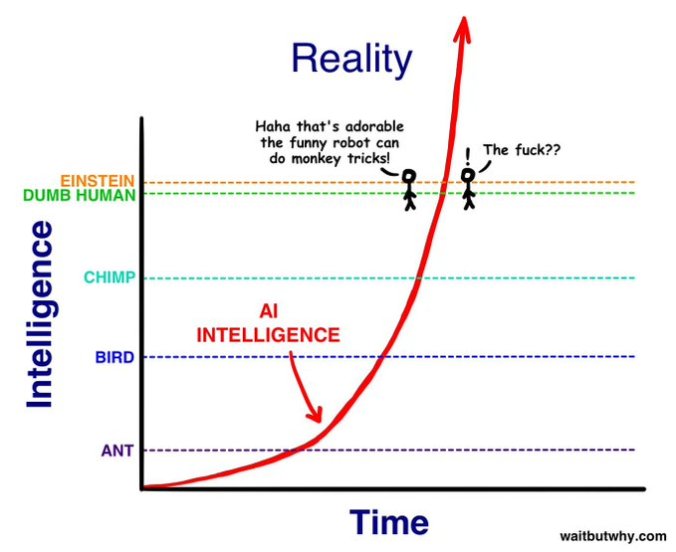
Ah, the J Curve! That’s what you see above, and it has many applications. Herman Kahn, the late futurist who was known as the smartest man in the world (is there anyone who holds that title today?) told me that the J Curve was especially valuable regarding new technologies that destroy previous concepts of what was possible. The microchip. The internet. Now, it’s AI.

Talk about fast! Just four days ago, a crude A.I. battle between Tom Cruise and Brad Pitt had Hollywood running for Xanax. Now the German Dor brothers said, “Hold our Augustiner-Bräu!” and produced this in a single day:

Soon Hollywood producers, directors and actors will be jumping off buildings like panicked stockbrokers on Black Tuesday, 1929. Or not. The smart ones will realize that they need to start making better movies. It shouldn’t surprise anyone that the typical shock and awe special effects orgies like “2012” and “San Andreus” can be made by a bot. It’s crap made for morons, stoners and people who can’t sit though “On the Waterfront.”

Let me know when the J Curve produces AI that can evoke Paul Scofield, John Hurt, Colin Redgrave, Susannah York and Wendy Hiller in this favorite Ethics Alarms scene:

…or the rest of the movie, for that matter. Until then, if then ever comes, talented actors, writers and directors have nothing to worry about. Intelligence and talent have always been weakly correlated, if at all.

Regarding “Conclave”

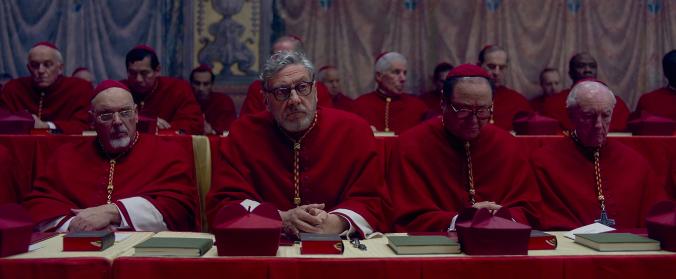
As the Cardinals meet in Rome to find a new Pope for real, it is a propitious time to consider “Conclave,” the “thriller” (as Wikipedia calls it, a stretch) about a fictional conclave after the death of a fictional Pope. I had several friends recommend the film to me, and I finally watched it this week.

I’ll complete this ethics overview without spoilers since the film is relatively new, but wow, what a disappointment. Strong cast, excellent performances, brilliant production design and cinematography, but still, “Conclave” has to be one of the most wildly over-praised films I’ve seen since “Don’t Look Up!,” “The Crying Game” or “Ghost.” This overt Hollywood woke propaganda piece received eight nominations at the 97th Academy Awards, a number once reserved for all-time classics like “Ben-Hur,” “West Side Story” or “Lawrence of Arabia.” Its Best Picture nomination shows how far movie-making standards have fallen and that it won Best Adapted Screenplay is outrageous, since the screenplay was the worst aspect of the movie, predictable, over-wrought and unbelievable.

My late wife was superb at sleuthing out “surprise” endings of movies by the half-way mark or earlier; this time I felt like I was channeling her spirit because I guessed the movie’s ending (and woke propaganda mission) the second the key character showed up. I also thought, “Oh no, really? They are stooping to this?” Indeed they were.

“Conclave” is, ultimately, trivial and soap opera-ish, no better and less entertaining than the loony movie version of Dan Brown’s follow-up to “The Da Vinci Code,” “Angels and Demons.” Along the way to an anti-climax, we get more of the “white man bad/black man victim,” pro-LGTBQ+ proselytizing that Tinseltown has been addicted to for years.

I’ll give “Conclave” this: it was better than “Snow White” and a lot shorter than “Wicked.”

Mis-Remembering the Mutiny on the Bounty, a “Print the Legend” Classic

Today, April 28, is the anniversary of the famous mutiny on board the H.M.S. Bounty, when Fletcher Christian, the ship’s “master’s mate,” seized control of the ship and set its captain, William Bligh, adrift in the Pacific with a small group of sailors who refused to join Christian’s rebellion. The story of the mutiny and its aftermath has become a romantic cautionary tale that inspired three major Hollywood treatments, each with star-studded casts. If you ask the average American what happened on The Bounty, he or she will probably reply that a cruel captain who abused his crew was challenged by an honorable and courageous officer who took over the ship from a monster, and met with tragedy himself. Virtually no accounts of the event support that version of events, but that is the legend, and it persists to this day.

Why? It’s a better story, at least a clearer and more morally uplifting story than the truth, that’s why. Real life is messy and our heroes and villains tend to be more complicated than our emotions can handle, and this is especially true of the Bounty story. You see above the most famous moment from the great John Ford film, “The Man Who Shot Liberty Valence,” when the old newspaper editor refuses to report the shocking discovery that the heroic deed leading to the successful political career of a famous statesman and U.S. Senator never occurred. Ethics Alarms has discussed the “Print the legend” phenomenon so many times that it has its own tag. None of the examples that I have examined deserve that tag more than the mutiny on the Bounty.

Continue reading

Confronting My Biases, Episode 19: Movie Continuity Errors and Cheats

A long time ago, I read an article complaining about how nobody says “goodbye” at the end of phone calls in movies and TV shows. Characters just hang up. “Now that I’ve pointed this out, I guarantee that it will drive you crazy,” the author wrote. It does drive me crazy: in stage and movie director terms, it “takes me out of the story.” Because it’s so obviously a device to save time, the omission of “goodbye” reminds me that I’m watching a performance. (Lately, I have noticed, “goodbyes” are appearing here and there, but still in a minority of productions.)

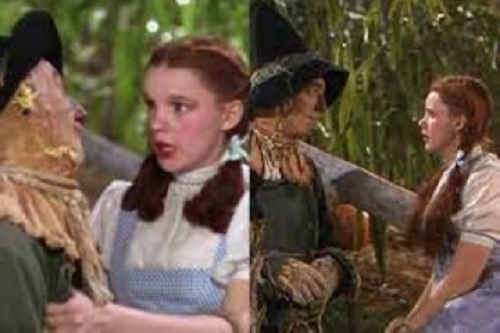
My late wife was a fanatic about such things, and she ruined many a show and film by pointing then out. One of her favorites, a pretty famous continuity botch, was Judy Garland’s constantly changing pig-tails in “The Wizard of Oz”: they are shorter and longer not only from scene to scene, but sometimes from shot to shot in the same scene. Grace was also the one who first pointed out to me the absence of rear-view mirrors in most shots of a character driving a car; now that drives me crazy.

Continue reading

Why Are Women Still Screaming In Movies?

This has bugged me for a long time, but my pique came to a head yesterday when I was watching the early Ray Harryhausen effort “It Came From Beneath the Sea”—you know, the one with the giant octopus that attacks San Francisco?

A lovely actress whom I had never been aware of before named Faith Domergue played a female scientist specializing in marine biology. Throughout the movie, despite being Kenneth Tobey’s love interest (You remember him, right? The hero in the original “The Thing From Outer Space”? Later a villain in “Billy Jack” and one of the air traffic controllers in “Airplane”?) she was completely professional, always composed, bristling at sexist comments and assumptions from the male pigs around her (this was in 1955, remember). And yet when the giant octopus that she had insisted was real while everyone else pooh-poohed the idea finally appeared, she screamed like a teenage girl at an Elvis concert. Why would she do that? She was the only one who was expecting to see a giant octopus! The men around her, in contrast, looked startled or went into action (getting the hell off the beach); only the woman screamed.

Continue reading