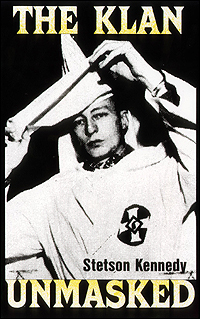
And he gave his book to Superman...
Author and folklorist Stetson Kennedy, who died this week, is another important and courageous American that most of us never heard of. Let’s try to catch up.
After a back injury kept him out of World War II, Kennedy began a lifetime career of crusading against bigotry and what he called “homegrown racial terrorists.” He served as director of fact-finding for the southeastern office of the Anti-Defamation League and as director of the Anti-Nazi League of New York.
In his 1954 book “I Rode With the Ku Klux Klan,” Kennedy wrote that he gained entrance to the Klan by posing as an encyclopedia salesman and using the name of an uncle who was a Klan member. While posing as a member, he learned many Klan secrets that he put to use undermining the organization’s reputation and support. With evidence he snatched from the Grand Dragon’s wastebasket, he gave the Internal Revenue Service what it needed to collect an outstanding $685,000 tax lien from the Klan in 1944, and he helped draft the brief used by the state of Georgia to revoke the Klan’s national corporate charter in 1947. He also testified in other Klan-related cases. Continue reading
 Ethics Alarms