I don’t like the implications of this story one bit.
In Clayton County, Georgia, a jury had just come in with an acquittal verdict in the trial of Eric Lydell Smith, who had been charged with nine counts including malice murder, felony murder and aggravated assault, in connection with the death of his neighbor, Eric Hernandez. Two years ago, Smith and Hernandez got into a fist fight on the street where both lived. Smith, an African-American, says he shot Hernandez—the mainstream newsmedia would refer to him as a “white Hispanic” if he had done the shooting— in self-defense, but prosecutors and witnesses told the jury the fight had ended and Hernandez was walking away when Smith killed him.
“Not guilty of malice murder,” the jury foreman read from the verdict form, as Hernandez’ family openly wept in court. One not guilty verdict after the another was announced. Then prosecutors, nobody is certain why, asked the judge to take the unusual step of polling the jury members. The first eleven jurors, in turn, repeated the announced verdict of “not guilty” on all counts. Then the 12th juror, a white woman, answered the judge’s “Is this your verdict?” with a shocking “No, your honor.”
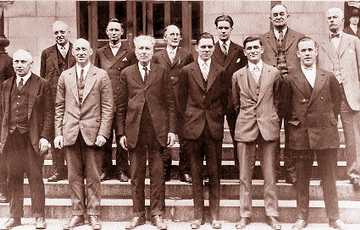
The all white Detroit jury that acquitted Dr. Sweet.
When I referred to Clarence Darrow’s support for terrorist John Brown in the previous post, I reviewed other references to the great trial lawyer that have appeared here. (As you may know, I authored a one-man play about Darrow, still performed to legal groups by actor (and my friend) Paul Morella, and with historian Ed Larson compiled selections from Darrow’s writings, court appearances and speeches, The Essential Words and Writings of Clarence Darrow.) I have also posted on his famous Leopold and Loeb argument against capital punishment, but I was shocked to find out that I never posted any part of his closing argument in the murder trial of Dr. Sweet. I need to remedy that omission now. That courtroom oratory is not only the best of Darrow’s closing arguments, but also the most relevant to current events. It is a masterpiece, and also astonishingly prescient and wise.
In 1925, Dr. Henry Ossian Sweet, a black man, moved his family into a house in a previously segregated section of Detroit. Mobs of whites gathered outside the house with torches, clubs and guns the first two nights of their residence, as police stood by passively. On the second night, a gunshot coming from the house killed one of the demonstrators, and all 11 residents of the home, including Dr. Sweet, were charged with murder. The National Association for the Advancement of Colored People hired Clarence Darrow to handle the defense.
There were two trials, the first ending in a hung jury. In the second, Darrow performed a seven hour closing argument, aspects of which have inspired homages in “To Kill A Mockingbird” and “A Time to Kill.” Despite the all-white jury, Dr. Sweet was acquitted, and the charges against the others were dropped. Darrow isn’t a legend for nothing.
I have left out the parts of the closing argument that recount the testimony and the facts of the case: you can read about the trials on Doug Linder’s excellent website, and you can read Darrow’s whole closing here. This redacted version focuses on Darrow comments about race and race relations. It is longer than the version we used in the play, but this is the version I would have used if audiences could tolerate a three hour one man show.
I continue to believe that this was the high point of Darrow’s incredible career, and also one of the most impressive—and gutsy—speeches in our history. Only Clarence Darrow would challenge an all-white jury like this in 1925. It is also unbearably moving. Paul, when he performs the selection, ends with tears streaming down his face, as Darrow did. You might too. Try reading it aloud to your kid. Or to yourself.
This post also relates to another recent post, the one about jury nullification. That is really what Darrow is arguing here, in the context of confronting racial injustice and bigotry for the survival of the nation and society. The white victim of the shooting was shot in the back. Darrow, at one point, calls it murder himself. Nonetheless, he argues that acquitting Sweet and his family is the right thing to do, whatever the law says.
Here is my abridged version of the epic closing argument made by Clarence Darrow, May 11, 1926, in defense of Dr. Sweet and his family.
Peter Mayhew, a.k.a. Chewbacca the Wookie, has released to the internet the page from his original Star Wars script that answers the crucial ethics dilemma discussed on Ethics Alarms in 2012.
As it seemed when we all first saw the film, Han Solo shot the porcupine fish-headed space-thug Greedo with a blaster before being fired upon, and I have no problem with that at all. It was self defense.
Nonetheless, a large group of activists, led by Greedo’s family’s lawyer and whipped into a frenzy by cable TV, demonstrated and protested based on a bar patron’s false report that Greedo had his hands up at the time. Luckily, the film proved this was false, though “Hands up! Don’t blast!” survived as a provocative refrain.
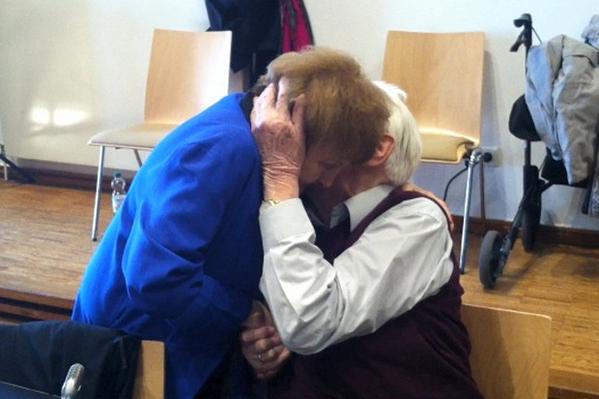
81-year-old Holocaust survivor Eva Kor recounted her memories of being one of Dr. Josef Mengele’s human guinea pigs in a letter to Oskar Groening, a former member of the SS at Auschwitz-Birkenau who is on trial in Germany for 300,000 counts of accessory to murder:
In May 1944, when we were taken to Auschwitz, my name was Eva Mozes. My family and I were part of the Hungarian transport. My family included my father Alexander Mozes, 44 years old; my mother Jaffa Mozes, 38 years old; my older sister Edit, 14 years old; my middle sister Aliz, 12 years old; and my twin sister, Miriam, 10 years old. Within thirty minutes after arriving on the selection platform, Miriam and I were ripped apart from our family forever. Only she and I survived, because we were used in experiments conducted by .
Within half an hour we became part of a group of twin girls aged two to sixteen: thirteen sets of little girls and one mother. We were taken to a processing center where they cut our hair short and took our clothes away. That evening they returned them with a red cross at the backs. Then they lined us up for tattooing. When my turn came, I decided to cause them as much trouble as a ten year-old could. Two Nazis and two women prisoners restrained me with all their force. They began by heating a needle. When the needle got hot, they dipped it into ink and burned into my left arm, dot by dot, the capital letter A-7063. Miriam became A-7064…
For the next two weeks I only have one clear memory: I was crawling on the floor because I could no longer walk. I was crawling to reach a faucet with water because they did not even give us water anymore.
In 1984, Kor founded CANDLES (Children of Auschwitz Nazi Deadly Lab Experiments Survivors), in an effort to locate other surviving Mengele twins; and in 1995 she opened the CANDLES Holocaust Museum and Education Center in Terra Haute, Indiana. She calls herself a “forgiveness advocate,” teaching children:
1. Never give up on yourself or your dreams. I did not know how to survive Auschwitz, but I was determined to do it. Here I am 70 years later because I never gave up.
2. Treat people with respect and fairness to eliminate prejudice from your life.
3. Forgive your worst enemy and forgive anybody who [h]as ever hurt you. I forgave the Nazis and I forgave everybody who hurt me.
Kor is one of the Holocaust survivors testifying at Groening’s trial. On its first day, Groening told the court that “it is beyond question that I am morally complicit. This moral guilt I acknowledge here, before the victims, with regret and humility.” Kor told him, “I appreciate the fact that you are willing to come here and face us.” She offered the defendant her hand, and he took it, brought her into a near embrace, and kissed her on the cheek.
Your Ethics Alarms Ethics Quiz as this week ends is…
The controversy over the legality of the so-called drug cocktails that somehow became our execution method of choice is a perfect example. The battles over capital punishment trapped policy-makers into this kinder, gentler, ridiculously complicated method of execution that has suffered snafus ranging from unavailable drugs to ugly extended deaths. The problem is the floating definition of “cruel and unusual punishment,” prohibited by the Constitution, but almost entirely subjective. Many judges think killing a killer is itself cruel by definition, and the more reluctant Western Europe becomes to execute the worst of the worst, the easier it is to make the argument that the death penalty is also unusual.
I don’t get it. I never have. India once executed condemned criminals by having the subject place his head on a stump under the raised foot of trained elephant, which on a command would smash the head like a grape. Quick, painless–messy!—but virtually fool-proof. A pile-driver would be an acceptable equivalent. Ah, but ick! In this stupid, stupid, intellectually dishonest debate, ick always equals “cruel and unusual,” because to opponents of the death penalty, killing people, even horrible, dangerous people, is inherently icky.
(Oddly, ripping unborn babies out of the womb is not, but I digress.)
I’ve admitted it, and I will again. (This lost Ethics Alarms Luke G., one of its best commenters the last time.*) It is obviously wrong to intentionally prolong an execution or deliberately cause pain, but if the occasional execution is botched and the condemned suffers, that should be cause for great rending of garments, nor should it be used to discredit capital punishment. As I wrote here about Clayton Lockett’s execution in Oklahoma…
“There was no question of Lockett’s guilt, and his crime was inhuman. Such wanton cruelty and disregard for innocent life warrants society’s most emphatic rebuke, and the most emphatic rebuke is death. It is essential that any healthy society make it clear to all that some crimes forfeit the continued right to not just liberty, but also life. Anyone who weeps because this sadistic murderer experienced a few extra minutes of agony in the process of being sent to his just rewards has seriously misaligned values. No method of execution will work every time, and to make perfection the standard is a dishonest way to rig the debate. If the death penalty is justified, and it is, then we should expect and accept the rare “botch.” Meanwhile, if the concern really is efficiency, reliability, speed of death and minimal pain, there are literally dozens, maybe hundreds of methods of swift execution that would accomplish this. They just won’t pass the standards of death penalty opponents, because no method will.”
Today the Supreme Court heard oral arguments on the question of whether Oklahoma’s use of the common surgical sedative midazolam did not reliably make prisoners unconscious during lethal injections, thus violating the Eighth Amendment’s protection against “cruel and unusual punishment.” It’s a ridiculous case, which arises out of the botched April 2014 execution of Lockett that sparked the post I just quoted. It is a ridiculous case because the method of execution isn’t worth arguing over. Elephant. Head. Problem solved. Why is Oklahoma fighting about which cocktail to use? This is the anti-capital punishment team’s game, and sooner or later, the result is preordained. Continue reading →
UPDATE (MAY 3): I have been convinced that the original post that generated this Comment of the Day went too far. Asking for support for Slager’s defense cannot be unethical: Slager has a right to a defense, and the best one available. My thoughts on that issue, in relation to the Freddie Gray cops, are here. I still think it is obvious that the individual who posted the appeal is doing so for unethical reasons, and is likely a racist, an apologist for a bad cop, and an idiot. But the appeal itself is not unethical, hence the website was not unethical to post it.
________________________________________________
How can a website dedicated to paying for the defense of fired police officer Michael T. Slager be unethical, when every citizen is guaranteed the right to a defense before a jury of his peers? I thought I made my ethical objections to the site clear when I wrote:
Slager deserves a fair trial and will get one, but anyone whose immediate reaction to seeing the horrific video is sympathy for this killer cop needs psychiatric treatment, and quickly.
I also made it clear—I thought–that the text of the appeal betrayed a strange and ugly urge to shield Slager from the consequences of his conduct, which was per se, on its face, undeniably illegal under the laws of every state in the land, including South Carolina. He shot a fleeing man in the back; he cannot claim self-defense. Deadly force is forbidden in such situations. Unless Slager noticed that victim Walter Scott had death-ray shooting eyes in the back of his head, Scott’s death is a homicide, and it’s an open and shut case. The only remaining question is what level of homicide.
The appeal said that the poster supported Slager. Wrong. We should not support police officers who shoot citizens in the back. It attempted to minimize Slager’s offense by calling it a “mis-step.” Intentionally shooting someone illegally is not a mis-step. It’s murder. Then the appeal reminded us that Slager has a family, and didn’t do anything bad before he shot a man to death. Well, “first offense” is not a big mitigating factor when it comes to executing people.
However, I appreciate Ethics Alarms newcomer Gustav Bjornstrand‘s comment, though I don’t think this is the best context for it. Here is his Comment of the Day on the post “Unethical Website Of The Month: Michael T. Slager Support Fund.” I’ll be back at the end.
I venture to say that to offer support to Slager is certainly ethical, in and of itself. That is, if one believed that he or anyone deserves monetary support in order to raise a defence. It is conceivable that even someone who was certain he had committed a crime would choose still to aid him in getting good representation. It is unethical, I suggest, for anyone to assume that Slager is guilty of murder before a court decides the issue. It is possible, even if improbable, that there were circumstances prior to Slager firing that may shed light on his decision to fire. Additionally, there are a few other factors that need to be taken into consideration:Continue reading →
For those who think that our ethical sensitivities don’t evolve for the better over time, I prescribe a careful viewing of that family classic, “It’s A Wonderful Life.”
At the film’s climax, George Bailey, the self-sacrificing hero who has been granted his inadvertent wish to see what the world would be like if he had never been born, finds the love of his life and (in the life he has given up for this dystopian hell) the mother of his children now unmarried, alone and working as a librarian despite the fact that she looks like Donna Reed. He embraces her, and since she’s never met him in this alternate reality, she screams, believing she is being sexually assaulted by a madman. Kind, jovial police officer Bert is summoned to quell the ruckus, and George, who is a bit upset, punches him in the face to avoid arrest, and runs away. Bert then takes out his pistol and fires it at George repeatedly.
He’s a lousy shot.
In 1946, when audiences first saw this film, nobody thought there was anything unusual about Bert’s professional conduct. Many, many films right through the 1960s show police officers, “good guys,” even ones not trapped in a strangely mean alternate reality like Ward Bond’s Bert, shooting at fleeing suspects or criminals. That was considered appropriate police procedure then, and the public, society and U.S. culture saw nothing amiss. You were expected, as a good citizen, to submit to a police officer’s lawful authority. If you resisted arrest and ran, then it was fair and reasonable for the officer to shoot you, ideally after a “Stop or I’ll shoot!” warning. Indeed, many people were shot, and killed, this way. If it was news, it wasn’t on the front page, and it wasn’t considered any kind of an outrage.
Now consider the public and media reaction to Michael T. Slager’s shooting of Walter Scott. We now know that Scott was resisting arrest: he had a bench warrant out on him for non-payment of over $18,000 in child support, and Slager was trying to bring him into custody. Instead of doing as the officer demanded, Scott resisted and ran. Burt would have shot at his back too; the difference is that Slager is a better shot, and George was faster. Slager, however, is completely reviled across the country; even his own lawyer found him so repugnant that he refused to represent him.
That represents a massive shift in cultural values in a little over half a century. Continue reading →
Professional Tip: Lawyers, it’s unethical to do this to your clients!
When a lawyer believes that representing a client is something that he or she cannot do effectively, either because of a deep personal bias against the client, another conflict of interest, a reasonable belief that the client is untrustworthy or unmanageable, or some other good reason, his duty is to withdraw from the representation. Believing or even knowing that the client is guilty is not a good reason. Guilty clients have rights, the system demands a competent defense, and sometimes—rarely, but it happens—a lawyer can be surprised to find out that his “guilty” client isn’t guilty after all.
UPDATE (MAY 3): I have been convinced that this post went too far. Asking for support for Slager’s defense cannot be unethical: Slager has a right to a defense, and the best one available. My thoughts on that issue, in relation to the Freddie Gray cops, are here. I still think it is obvious that the individual who posted the appeal is doing so for unethical reasons, and is likely a racist, an apologist for a bad cop, and an idiot. But the appeal itself is not unethical, hence the website was not unethical to post it.
______________________________________________
On Indiegogo, a competitor of GoFundMe, some deranged individuals have actually—can I be really writing this?—put up a website seeking funds to defend Michael T. Slager, who is, on the video above, shooting Walter Scott in the back as he fled, apparently executing him with multiple shots, handcuffing his motionless body, and then planting a stun gun beside him. Slager deserves a fair trial and will get one, but anyone whose immediate reaction to seeing the horrific video is sympathy for this killer cop needs psychiatric treatment, and quickly.
The text of the appeal is similarly jaw-dropping:
We’re campaigning to show our Support for Officer Michael T. Slager!
Why in the world would anyone want to support a man who has committed a murder and fanned the flames of distrust and racial discord in the process?
We believe in all of our LEOs and want to publicly support them!
Do you believe in video technology? Do you even support murderous law enforcement officers?Apparently so.
Although he may have made mis-steps in judgement he was protecting the community.
Calling shooting an unarmed fleeing man a misstep in judgement is like calling Jeffrey Daumer a bad chef. A white officer hooting a defenseless and fleeing black man endangers the community, by straining the bonds of trust that hold it together.
Michael is a former Coast Guardsman with two stepchildren and a wife who is expecting a child, served for more than five years with the department without being disciplined.
So what? Does this any of this earn him special immunity from the requirements of decency, justice, and respect for human life?
Please help in any way you can.
Why? Why should anyone want anything other than for this disgrace of a cop to be tried, convicted, and locked up for the rest of his life?
He has served five years with the department without being disciplined.
Oh. Well, that changes everything! He should be able to shoot anyone he decides to shoot, then.
Eight people have contributed to this nauseating appeal.
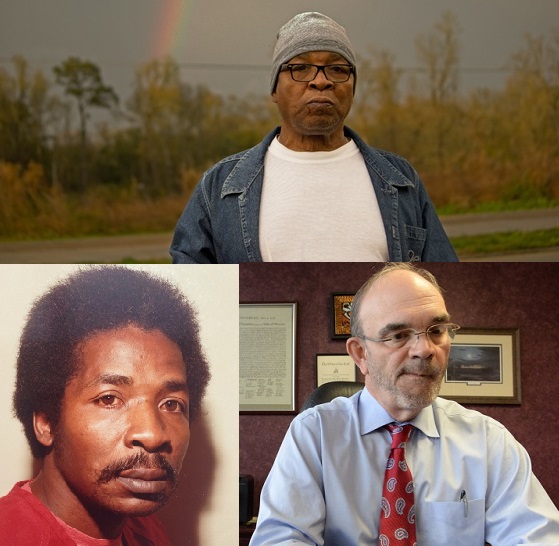
It’s more than an apology, really: it approaches self-flagellation. The tragic aspect of the confession and apology of former prosecutor A.M. “Marty” Stroud III, is that no one can really apologize for what he did, not after 30 years. For Stroud was the lead prosecutor in the December 1984 first-degree murder trial of Glenn Ford, who was convicted and sentenced to death for murdering Isadore Rozeman. Ford was innocent, and was finally released a year ago. His is a classic, horror story of justice derailed. Continue reading →





 Ethics Alarms